
You know the problem. Your ops team emails POs as PDF attachments. Someone copies the details into a spreadsheet. Nobody's quite sure what's been confirmed versus what's still outstanding. Then a delivery arrives and nobody can find the original order.
According to BCG (2026), only 18% of CPG companies have successfully scaled AI and automation beyond pilots. The other 82% are stuck somewhere between manual processes and enterprise systems they can't afford or justify.
This post covers the practical middle ground: purchase order automation that works for UK food and drink brands at £20m-£150m revenue, without a six-figure ERP project or a 12-month implementation timeline.
moving from manual to automated workflows
The Bottom Line - Most UK FMCG brands at £20m-£100m can automate PO processes for £500-£2,000/month - You don't need SAP to get structured PO tracking, approval workflows, and goods receipt matching - Only 18% of CPG firms have scaled automation (BCG, 2026), meaning most competitors are still manual - Start with your biggest pain point (usually goods receipt tracking), not a full procurement overhaul
What gap do most food and drink brands sit in?
Most UK food and drink businesses between £20m and £100m revenue have outgrown email-based purchasing but can't justify a full ERP. Schneider Electric (2026) found that 37.5% of CPG manufacturers cite legacy systems as their biggest blocker to automation adoption.
The pattern we see most often: a brand hits £30m-£50m turnover and suddenly the informal purchasing process starts breaking. Orders get missed. Duplicates happen because two people order the same thing independently. Nobody knows what's on order versus what's already arrived at the warehouse.
In our experience working with mid-market food brands, the typical breakpoint is around 80-100 POs per week. Below that number, a good spreadsheet and a diligent ops coordinator can hold it together. Above it, errors compound quickly.
Why SAP isn't the answer yet
SAP Business One starts at £50,000+ for a food manufacturing setup, and that's before customisation. Implementation takes 6-12 months. For a brand doing £40m in revenue with 15-20% net margins, that's a significant capital commitment with a long payback period.
The real cost isn't the licence fee. It's the 6-12 months of dual-running, the change management overhead, and the risk that you configure it wrong and end up with an expensive system nobody uses properly.
The middle ground exists
Between "email a PO as a PDF" and "implement SAP" sits a range of tools and approaches that give you 80% of the control at 10% of the cost. Structured templates. Automatic numbering. Status tracking. Basic approval workflows. That's what purchase order automation actually means at this scale.
Citation capsule: According to BCG (2026), only 18% of CPG companies have scaled automation beyond pilot stage, leaving the vast majority of UK food and drink brands reliant on manual purchasing processes that break down above 80-100 purchase orders per week.
What does PO automation actually mean at this scale?
Purchase order automation for a mid-size FMCG brand isn't a full procure-to-pay platform. At this scale, it means four specific things working together: structured PO creation, automatic numbering, status tracking, and basic approval workflows (BCG, 2026, notes that pilot-stage automation, focused on single processes like PO management, delivers measurable ROI fastest).
Let's be specific about what each of those means.
Structured PO creation
No more blank emails. Every purchase order uses a template that captures: supplier name, delivery address, line items with SKU codes, unit prices, quantities, requested delivery date, and payment terms. The template forces completeness. If someone can't fill in the fields, the order doesn't get raised.
Automatic numbering and status tracking
Every PO gets a unique sequential number. No exceptions. The status of each PO moves through a defined sequence: Draft, Sent, Confirmed, Partially Received, Fully Received, Invoiced, Closed. At any point, anyone in the business can look up a PO number and know exactly where it stands.
Basic approval workflows
Who can commit the company to what level of spend? This gets formalised, even if it's just a shared Google Sheet with approval columns at first. The goal: no PO goes to a supplier without the right person signing it off.
We've seen brands where the MD was personally approving every order over £200. That's not governance, that's a bottleneck. Sensible thresholds free up senior time while maintaining financial control.
The actual goal
Know what you've ordered, from whom, at what price, and whether it arrived. That's it. Everything else is a bonus. If you can answer those four questions for any PO in under 30 seconds, your automation is working.
How do you map your current PO process?
Before choosing any tool, document what actually happens today. In our experience, the documented process and the real process differ significantly in about 70% of brands we work with. Schneider Electric (2026) found 37.5% of CPG firms cite legacy systems as their top blocker, and informal workarounds are a big part of that legacy.
Ask these questions:
- How many POs do you raise per week? (Most brands at this scale: 50-200 across raw materials, packaging, and indirect spend.)
- Who raises them? One person, or distributed across buyers, production, and warehouse?
- Who approves them, and is that approval formal or informal?
- How do you track goods receipt? Paper delivery notes? Warehouse management system? Nothing?
- Where do errors actually occur? Duplicate orders? Wrong quantities? Missing deliveries?
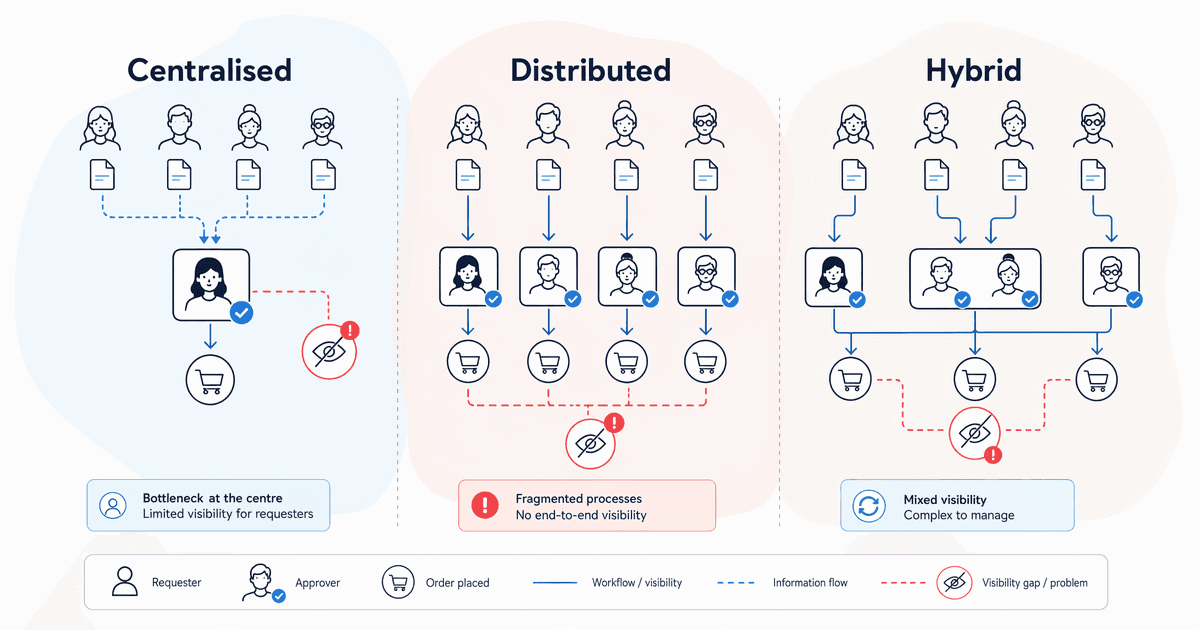
The common patterns
Pattern A: Centralised buyer. One procurement person raises all POs, usually in Excel. They know what's ordered because it's all in their head. Works until they go on holiday or leave.
Pattern B: Distributed chaos. Production raises raw material orders, warehouse raises packaging, office manager handles indirect. Nobody has full visibility. Duplicates are common.
Pattern C: Hybrid. A buyer handles raw materials (the big spend), but packaging and indirect are ad-hoc. Partial visibility at best.
The brands that get stuck aren't usually in Pattern A or B. They're in Pattern C, where part of the process works fine and part is chaos. This makes it hard to justify a full system change because "it mostly works."
How do you choose the right automation level?
Three tiers exist between manual spreadsheets and full ERP. The right choice depends on PO volume, complexity, and whether you need inventory integration. Only 18% of CPG companies have scaled automation beyond pilots (BCG, 2026), so don't over-engineer this.
sequencing your system integrations
Tier comparison
| Tier 1 | Tier 2 | Tier 3 | |
| Cost | £0-£500/month | £500-£2,000/month | £2,000-£5,000/month |
| PO volume | Under 100/week | 100-500/week | 200+/week |
| Tools | Google Sheets + Zapier/Make, Excel with macros | Tradogram, Procurify, ApprovalMax | Unleashed, Dear Inventory, Cin7 |
| Features | Templates, auto-numbering, basic status tracking | Full PO lifecycle, approval workflows, supplier portal | PO management + inventory, BOM, goods receipt |
| Best for | Brands just outgrowing email POs, <£30m revenue | Brands at £30m-£80m needing proper governance | Brands at £50m+ needing PO-to-inventory link |
| Limitations | No supplier-facing portal, manual goods receipt, breaks at scale | No native inventory link, limited manufacturing features | Higher complexity, longer setup, closer to ERP territory |
How to decide
Start with volume. Under 100 POs per week? Tier 1 is fine, genuinely. Don't spend money on a tool when a well-structured spreadsheet with automation connectors will do the job.
Between 100 and 300 POs per week with multiple people raising orders? Tier 2. You need proper user permissions, audit trails, and approval workflows that don't rely on someone checking a shared spreadsheet.
Over 200 POs per week and struggling to connect purchasing with stock levels? Tier 3. The inventory integration is what you're really paying for.
Citation capsule: UK food and drink brands processing 100-500 purchase orders per week typically find the optimal automation investment at £500-£2,000 per month using dedicated procurement tools, according to tier-based analysis matching Schneider Electric's (2026) finding that 37.5% of CPG manufacturers cite legacy systems as their primary automation blocker.
How should you structure approval workflows?
Approval workflows prevent unauthorised spend and create audit trails, but over-engineering them creates bottlenecks. The pattern we see most often at brands around £50m revenue: four threshold levels with clear escalation. Keep approval steps to a maximum of two per PO.
Suggested thresholds for a £50m brand
- Under £500: Auto-approved (pre-agreed suppliers and materials only)
- £500-£5,000: Line manager or procurement lead
- £5,000-£20,000: Operations director
- Over £20,000: MD or finance director
These aren't arbitrary. They reflect where financial risk becomes material relative to turnover. A £500 threshold on auto-approval means routine raw material top-ups don't need human intervention, but anything unusual gets a second pair of eyes.
Rules that actually work
Rule 1: Every extra approval step adds 4-8 hours to PO cycle time. If your production team needs ingredients tomorrow, a three-level approval chain for a £1,200 order is going to cause stockouts.
Rule 2: Auto-approval should cover repeat orders to approved suppliers at agreed prices. The approval workflow is for exceptions, new suppliers, or price changes.
Rule 3: Build in delegation. When the ops director is on holiday, who approves the £10,000 orders? If the answer is "nobody until they're back," your workflow has a single point of failure.
We've found that brands implementing approval workflows for the first time should start with just two levels: under £5,000 (buyer approves) and over £5,000 (director approves). Add complexity only when you have evidence it's needed.
How do you connect POs to goods receipt?
The biggest pain point in purchase order management isn't raising the PO. It's knowing whether what you ordered actually arrived. Three-way matching, comparing the PO, delivery note, and invoice, is the goal, even if the process starts manually. BCG (2026) identifies process visibility as the primary driver of automation ROI in CPG operations.
What three-way matching looks like in practice
- PO raised: 500kg of sugar from Supplier X at £0.85/kg, delivery 15 July.
- Goods receipt: Warehouse confirms 480kg arrived on 15 July (20kg short).
- Invoice received: Supplier invoices for 500kg at £0.85/kg.
The discrepancy between receipt (480kg) and invoice (500kg) triggers a query. Without tracking all three against the same PO number, you pay for 20kg you never received. Multiply that across 200 POs per week and the leakage adds up fast.
Start with tracking, not automation
You don't need to automate the matching on day one. What you need is a system where:
- Every delivery is recorded against a PO number
- Short deliveries are flagged immediately
- Invoices can be checked against what was actually received
Even a simple column in your PO tracker, "Qty Received" filled in by the warehouse team, is better than nothing. Automate the tracking first. Automate the matching later.
Practical options for goods receipt
Low-tech: Printed PO list in the goods-in area. Warehouse team ticks off deliveries and notes discrepancies. Someone enters this into the system daily.
Mid-tech: Tablet or phone at goods-in with a simple form (Google Forms, Microsoft Forms, or the Tier 2 tool's mobile app). Scans or enters PO number, confirms quantities.
Higher-tech: Barcode scanning integrated with your PO system. Delivery note scanned, quantities confirmed, PO status updates automatically. This is Tier 3 territory.
supplier onboarding automation
Citation capsule: Three-way matching, comparing PO, delivery note, and invoice against a single reference number, prevents payment leakage on short deliveries. For a brand processing 200 POs per week with even 2% quantity discrepancies, undetected short deliveries can represent £15,000-£40,000 in annual overpayment.
When should you move to a full ERP?
A Tier 2 or Tier 3 PO automation solution will serve most UK food and drink brands at £20m-£100m revenue for 3-5 years. You need a full ERP when specific operational triggers appear, not when a vendor tells you it's time. Only 18% of CPG firms have achieved scaled automation (BCG, 2026), so getting PO automation right first is already ahead of most competitors.
Signals you've outgrown lightweight automation
- Volume: Over 500 POs per week consistently
- Complexity: Multi-site operations where stock transfers between locations need tracking
- Manufacturing: Complex BOM or recipe management that needs to trigger purchasing automatically
- Compliance: Retailer or regulatory audits demanding full batch traceability from raw material PO to finished product
- Integration: More than 5 systems needing real-time data sync (WMS, TMS, quality, finance, production)
If fewer than two of these apply, stay where you are. Seriously. A well-implemented Tier 2 or 3 solution with clear processes will outperform a poorly implemented ERP every time.
The right sequence
- Get PO automation working (3-6 months)
- Add inventory management if needed (Tier 3)
- Run both for 12+ months, refining processes
- Evaluate ERP only when you hit multiple triggers above
- Use your PO automation data to spec the ERP properly
The brands that implement ERP successfully almost always ran a structured PO system first. The ones that jump straight from spreadsheets to SAP spend 40% of their implementation budget on process design they could have done for free with a Tier 2 tool.
practical guide to AI for FMCG
FAQ
How much does purchase order automation cost for a mid-size FMCG brand?
Costs range from £0-£500/month for structured spreadsheet automation up to £2,000-£5,000/month for lightweight ERP modules with inventory integration. Most UK food and drink brands at £20m-£100m revenue find the sweet spot at £500-£2,000/month with dedicated procurement tools. At these price points, payback typically occurs within 4-6 months through reduced duplicate orders and short-delivery leakage.
When should an FMCG business move from PO automation to a full ERP?
Consider a full ERP when you're processing over 500 POs per week, operating across multiple manufacturing sites, need complex BOM or recipe management, or face audit requirements demanding full batch traceability. If fewer than two of these triggers apply, a Tier 2 or Tier 3 automation solution will serve you well for years at a fraction of the cost. Only 18% of CPG firms have scaled automation fully (BCG, 2026).
What is three-way matching and why does it matter?
Three-way matching compares the purchase order (what you ordered), the goods receipt note (what arrived), and the supplier invoice (what you're being charged). Discrepancies trigger a review. Even basic PO automation should track all three documents against the same PO number. For a brand with 200 weekly POs, catching just 2% in short-delivery discrepancies prevents £15,000-£40,000 per year in overpayments.
Getting started this week
You don't need to solve everything at once. Pick one pain point, usually goods receipt tracking or approval visibility, and fix that first.
Here's a practical first week:
- Monday-Tuesday: Count your POs. How many per week, split by category (raw materials, packaging, indirect)?
- Wednesday: Map who raises and who approves. Document the real process, not the theoretical one.
- Thursday: Identify your tier based on the table above.
- Friday: If Tier 1, build your structured template. If Tier 2/3, book demos with two providers.
The brands that succeed with purchase order automation are the ones that start small, prove the value, and expand. The ones that fail try to build a perfect system on day one.