
The Bottom Line
- 75% of CPG companies are stuck in pilots; only 13% have AI embedded end-to-end (BCG/CGF, June 2026; Schneider Electric, April 2026) - Demand forecasting is the strongest starting point: up to 50% reduction in forecast errors (McKinsey, 2024) - The gap between "using AI" and "AI working" is about data foundations and process clarity, not technology cost - Start with one 90-day pilot, one owner, one measured baseline
AI in FMCG works, but not the way most vendor presentations suggest. It doesn't replace teams, automate entire departments, or deliver overnight ROI. What it does: reduce forecast errors by up to 50%, cut supply chain costs by 5–20%, and improve trade promotion decisions by revealing which half of your promo spend generates zero incremental volume.
The catch: 75% of CPG companies are stuck in pilots. Only 13% have AI embedded in core operations. The gap between "AI exists" and "AI is working" is almost entirely about data foundations, process clarity, and someone having the bandwidth to own it.
In our work with UK food & drink brands, we see the same pattern: the technology is the easy part. The hard part is getting 24 months of sales data out of four different retailer portals and into one usable format. This guide covers what AI actually does across FMCG departments, where the evidence supports real investment, how to assess whether you're ready, and how to structure a 90-day pilot that doesn't join the graveyard of abandoned experiments.
What AI actually does in FMCG (and what it doesn't)
Strip away the conference rhetoric and AI in FMCG does three things:
1. Pattern recognition at scale. AI processes years of sales data, promotional performance, seasonal signals, and external factors (weather, events, economic indicators) to spot patterns that humans miss — not because humans aren't smart enough, but because the data volume exceeds what anyone can hold in their head across 200+ SKUs and 5+ retail accounts simultaneously.
2. Repetitive decision automation. Replenishment triggers, stock allocation, report generation, compliance checking, invoice matching — tasks where the logic is consistent but the volume makes manual execution slow and error-prone. This isn't "AI" in the dramatic sense; it's structured automation informed by data patterns.
3. Prediction under uncertainty. Demand forecasting, promotional uplift estimation, pricing impact modelling — decisions where historical data helps but doesn't guarantee outcomes. AI doesn't predict the future perfectly. It predicts it less badly than spreadsheet models, and it improves as it sees more data.
What AI doesn't do in FMCG (despite what you'll hear):
- It doesn't eliminate the need for humans who understand FMCG. AI models that forecast demand still need someone who knows that a Tesco gondola end in January behaves differently from a Sainsbury's shelf-end in March.
- It doesn't work without accessible data. If your sales data is in 4 retailer portals, your production data is on paper, and your promo history is in someone's head — AI has nothing to learn from.
- It doesn't deliver ROI in week one. Every credible implementation follows the same arc: data preparation (4–8 weeks), pilot (8–12 weeks), measurement and validation (4 weeks), then a decision on whether to scale. Anyone promising faster is either selling you something simple rebranded as AI, or skipping the measurement that proves it works.
For a full breakdown of what AI means compared to simpler automation (RPA, workflow tools), see our explainer on AI vs. automation in FMCG.
Where AI for FMCG delivers measurable ROI — department by department
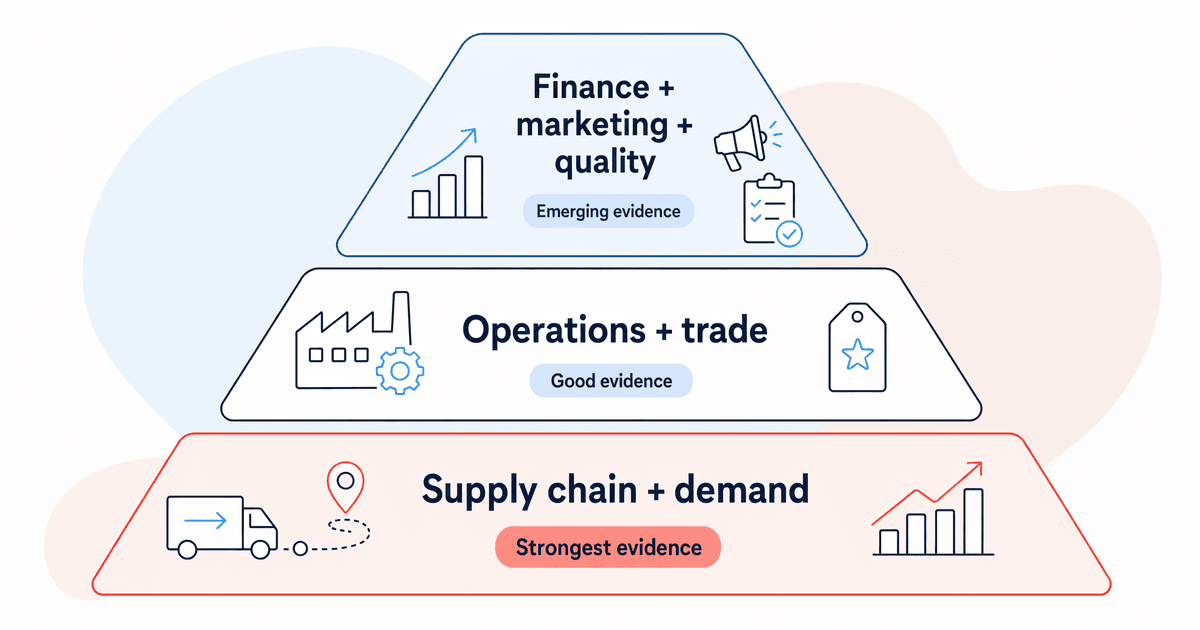
Not every department benefits equally. Here's the evidence-ranked order:
Tier 1: Strong evidence, clear ROI, lowest data barrier
Demand planning & supply chain — The starting point for most FMCG AI deployments. McKinsey (2024) reports AI reduces forecasting errors by up to 50%. Mondelez (June 2026) reports 2–4% store-level sales uplift from SKU recommendation models and 2–3% reduction in inventory waste across 3,000 production AI models. BCG (June 2026) identifies demand forecasting, pricing, and transport optimisation as frontrunner focus areas.
A UK food & drink brand carrying £5m in inventory that reduces waste by 2–3% recovers £100,000–£150,000 annually. A brand with forecast accuracy improving from ±25% to ±15% reduces both stockouts and overstock — each of which has a direct P&L impact.
Data you need: 12–24 months of SKU-level sales data, promotional calendar, basic inventory positions. Most food & drink brands already have this — it's just scattered across retailer portals and spreadsheets.
Tier 2: Good evidence, requires more data maturity
Operations & production — Predictive maintenance and production scheduling. Schneider Electric (April 2026): 15.2% of manufacturing revenue lost to preventable inefficiencies (delays, downtime, rework, quality deviations). AI-driven maintenance typically recovers 10–25% of that loss in targeted areas — but it requires sensor-connected equipment and digital production logs.
Commercial & trade — Promotional effectiveness analysis and pricing optimisation. The measurement challenge here is attribution: did that price change drive volume, or did the competitor's stockout? AI helps by modelling counterfactuals, but the data requirements are heavier (weekly POS data by store, full promotional mechanic history).
Tier 3: Emerging evidence, vendor claims outpace independent measurement
Finance & reporting — Automation of repetitive reporting and reconciliation. Clear time-saving value but harder to translate into revenue impact. UnifyApps (May 2026) reports up to 75% faster reconciliation — meaningful for finance teams spending days on manual month-end, less relevant for teams already using modern accounting tools.
Marketing — Content generation, consumer insight, campaign optimisation. Deloitte (Jan 2026) names it as "most promising" but only 11% have scaled AI here (BCG). Independent ROI measurement is scarce.
Quality & compliance — Risk reduction rather than revenue generation. Valuable for multi-market brands managing complex regulatory requirements across UK and EU retained food law.
| Department | Evidence strength | Data requirement | Typical ROI range | Time to first result |
| Supply chain & demand planning | Strong (BCG, McKinsey, Mondelez) | 12–24 months SKU sales + promo calendar | 2–5% waste reduction, up to 50% forecast error reduction | 90 days |
| Operations & production | Good (Schneider Electric) | Sensor data + digital production logs | 10–25% recovery of preventable losses | 4–6 months |
| Commercial & trade | Good (BCG, Mondelez) | Weekly POS + full promotional history | 30–50% of wasted promo spend identified | 3–4 months |
| Finance & reporting | Moderate (UnifyApps) | Structured accounting system | Up to 75% faster reconciliation | 4–8 weeks |
| Marketing | Weak (Deloitte, BCG) | Campaign history + consumer data | Unverified independently | Variable |
| Quality & compliance | Low (Veeva) | Digital compliance records | Risk reduction, not revenue | 2–3 months |
For a detailed breakdown of each department with data requirements, cost ranges, and "skip this if" guidance, see our AI use cases by department reference.
The implementation reality: why 75% of brands are stuck in pilots
BCG's June 2026 survey (n=39 senior CPG/retail executives) found the single biggest challenge: pilot economics don't translate into full-scale business results.
This isn't because pilots are poorly run. It's because scaling a pilot means solving problems that don't exist at pilot scale:
The middleware gap. A pilot forecasting model might pull data from one retailer and output recommendations into a spreadsheet. Scaling it means connecting to 5 retailers, feeding outputs back into your ERP, handling exceptions automatically, and maintaining the system when data formats change (and they will — retailers update portal formats without warning). This integration work was rarely scoped in the original pilot budget.
The measurement gap. More than half of companies don't formally measure AI ROI (BCG/CGF, June 2026). Without a pre-pilot baseline and clear success metrics, there's no evidence to support a scale investment. "It feels better" doesn't survive a budget conversation.
The ownership gap. Pilots often work because one enthusiastic person drives them. Scaling requires operational ownership — someone whose actual job includes maintaining the AI system, retraining models when performance degrades, and managing the human-AI handoff points. If the pilot champion gets promoted or moves on, the system decays.
The data compounding gap. AI models at pilot scale work with curated, cleaned data. At operational scale, they encounter the full chaos of real FMCG data: missing weeks in retailer feeds, promotional events that weren't logged, product code changes mid-year, supplier substitutions that change ingredient costs without warning.
These aren't technology problems. They're process and organisation problems — which is why Schneider Electric's survey consistently finds skills gaps, legacy systems, and data quality as top blockers ahead of technology availability.
For a structured approach to avoiding these failure modes, see our guide to AI platform rollout without chaos.
How to assess whether your business is ready
The honest answer: most UK food & drink brands are closer to ready than they think — but not in the way they expect.
You're probably ready enough to start a focused pilot if:
- You can export 12+ months of SKU-level sales data within a day
- At least one person has 2–3 days per week of bandwidth for 90 days
- You can define "better" in measurable terms for one process
- You can commit £5,000–£15,000 for a 90-day experiment
You're probably not ready yet if:
- Production records are on paper
- Monthly reporting takes 3+ days of manual assembly from multiple systems
- No one in leadership has a stated position on AI (even "we need to investigate" counts)
- Your last three technology investments were all fire-fighting
The gap between these two states is typically 3–6 months of focused data foundation work — not years and not hundreds of thousands of pounds.
We've built a full self-assessment for UK food & drink brands with 15 scored questions across five dimensions (data accessibility, system connectivity, people & bandwidth, process clarity, budget realism). It takes 10 minutes and gives you a clear picture of where you stand and what to fix first.
A practical starting point: the 90-day pilot
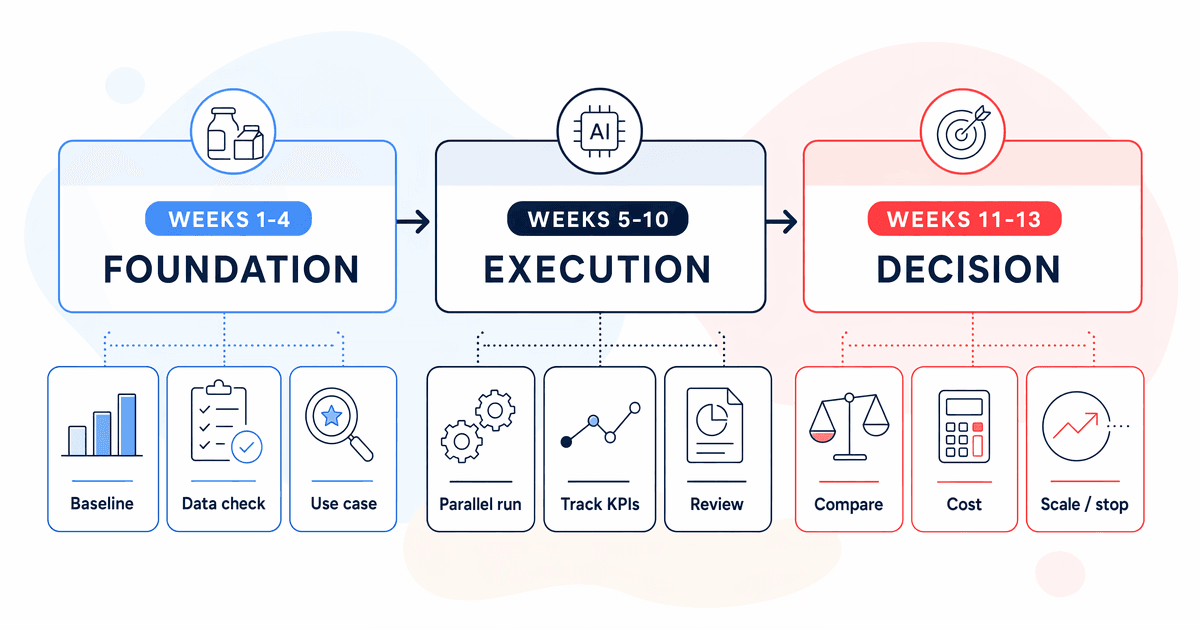
Every credible survey says the same thing: start narrow, measure properly, scale what works. Here's what that looks like in practice for a UK food & drink brand:
Weeks 1–4: Foundation
- Choose one use case (demand forecasting unless you have a stronger reason not to)
- Name one owner (2–3 days/week for the full 90 days)
- Establish your baseline metric (current forecast accuracy, current waste rate, current time-to-report)
- Consolidate the required data into an accessible format
- Select your approach: AI-as-a-service tool, specialist partner, or build (almost always the first two for a pilot)
Weeks 5–10: Execution
- Model trained and producing outputs
- Outputs reviewed against actuals weekly
- Exceptions and edge cases documented (these inform whether scaling is viable)
- Owner validates: does the AI output match FMCG reality? (A model that doesn't understand Christmas promo mechanics or seasonal launches isn't ready for production)
Weeks 11–13: Decision
- Compare pilot metrics against baseline
- Document: total cost (including internal time), measured improvement, remaining gaps
- Decision: scale, iterate, or stop
- If scaling: define what "operational" means — who owns it, what systems need connecting, what budget is required for year 1
The critical discipline: Decide the success threshold before the pilot starts. "Did forecast accuracy improve by 10+ percentage points?" is a success criterion. "Does it feel useful?" is not.
This pilot structure aligns with BCG's observation that frontrunners succeed by applying AI more deeply to a small number of priority processes, rather than spreading thin across many experiments. It also matches the three-filter framework we've detailed in choosing your first high-value AI use case.
What the next 12 months look like
Based on where the surveys and evidence point for 2026–2027:
Agentic AI will move from buzzword to first deployments. 47% of retail/CPG companies are already assessing agentic AI (NVIDIA, Jan 2026). Practical translation: AI systems that don't just recommend actions but execute them within defined rules — placing replenishment orders, adjusting promotional forecasts, flagging compliance exceptions. But independent ROI data for agentic AI in FMCG doesn't exist yet (see our full evidence review).
The "data tax" becomes undeniable. Schneider Electric projects preventable manufacturing losses rising from 15.2% to 29.14% by 2030. Brands that delay data foundations don't just miss AI opportunities — they face compounding operational inefficiency as market volatility increases. Every year you wait, the catch-up cost grows.
Consolidation over proliferation. Veeva (Jan 2026): 82% of CPG companies are consolidating legacy systems into unified platforms. The era of "buy another tool" is ending. The next phase is "connect what we have." That favours brands who focus on data architecture over individual AI applications.
The gap between AI-ready and AI-distant brands widens. Roland Berger (June 2026) frames this clearly: companies that continue applying AI within existing structures will reach a performance ceiling. Those that redesign workflows around AI-orchestrated processes access a different level of capability. For UK food & drink brands, this doesn't mean rebuilding from scratch — it means designing new processes (forecasting, replenishment, promo planning) with AI as a core component rather than an add-on.
The practical takeaway: if you haven't started a pilot by the end of 2026, you'll be competing against brands who have 12+ months of model training data that you don't have. AI compounds. Data compounds. The earlier you start — even imperfectly — the more advantage you accumulate.
Where to go next
This guide covers the landscape. The following resources go deeper on specific decisions:
- [AI use cases by department](/blog/ai-use-cases-fmcg-by-department) — Detailed breakdown for each function with costs, data requirements, and "skip this if" guidance
- [AI readiness self-assessment](/blog/ai-readiness-self-assessment-fmcg-uk) — 15-question scored diagnostic for UK food & drink brands
- [What the evidence actually shows](/blog/ai-fmcg-evidence-2026) — Every stat with its source, sample size, and methodology note
- [Choosing your first high-value AI use case](/blog/first-high-value-ai-use-case) — Three-filter framework for selecting where to start
- [AI platform rollout without chaos](/blog/ai-platform-rollout-without-chaos) — Phased deployment structure that avoids the pilot trap
- [AI vs. automation in FMCG](/blog/ai-vs-automation-fmcg) — When you need AI and when simpler automation is enough
- [AI agents for FMCG teams](/blog/ai-agents-for-fmcg-teams) — What agentic AI means in practice vs. vendor hype
- [AI for FMCG operations teams](/blog/ai-for-fmcg-operations-teams) — Production, maintenance, and supply chain AI in detail
Sources cited in this guide:
- BCG & The Consumer Goods Forum, "AI in CPG and Retail: How Winners Are Pulling Ahead," June 2026. Survey of 39 senior CPG and retail executives worldwide.
- NVIDIA, "State of AI in Retail and Consumer Packaged Goods," January 2026. Third annual survey, hundreds of industry respondents.
- Schneider Electric, "2026 Industrial AI in CPG Survey," April 2026. Research conducted by Censuswide among 1,453 executives across Food & Beverage and Life Sciences in 14 countries.
- McKinsey & Company, "Fortune or Fiction? The Real Value of a Digital and AI Transformation in CPG," October 2024. Analysis of 140+ use cases.
- Mondelez International / Databricks case study, June 2026. 20,000 models (3,000 in production) across sales, supply chain, and revenue growth management.
- Deloitte, "2026 Consumer Products Outlook," January 2026. Survey of 300 senior executives globally.
- Veeva Systems, "State of AI in Consumer Goods Report," January 2026. 150+ IT and functional leaders.
- Roland Berger, "AI Value Creation in Consumer Goods," June 2026.
- Infosys Knowledge Institute, "AI in CPG: Business Value Radar 2025," November 2025. 3,798 business leaders globally, 250 from CPG.