
The Bottom Line
Most "AI for FMCG" statistics you'll read this year come from vendors selling AI or consultancies selling AI strategy. That doesn't make them wrong — but it does mean the framing favours action over caution.
Here's what six major independent surveys actually found: 75% of CPG companies remain stuck in pilots. Only 13% have AI embedded in core operations. And 70% report current ROI under 20%. The opportunity is real — BCG estimates 220–350 basis points of EBIT improvement — but the gap between vendor promises and measured outcomes is wider than most conference decks suggest.
This post gives you the numbers you need to build an honest internal business case. Every stat includes its source, sample size, and methodology so you can judge its relevance to your business.
How to read AI statistics (and why most get this wrong)
Before you put any number into a board deck, check three things:
Who paid for the research? A survey commissioned by an AI vendor will attract respondents who are already invested in AI. The sample is self-selecting. That doesn't invalidate the data, but it shifts the baseline.
What's the sample size and composition? A survey of 39 senior executives at global CPG companies (BCG/CGF) tells you what Nestlé and Unilever are doing. A survey of 1,453 manufacturing decision-makers (Schneider Electric) tells you something closer to industry-wide reality — but it includes Life Sciences alongside Food & Beverage.
What does "using AI" mean in context? When NVIDIA reports 91% are "actively using or assessing AI," that includes companies who bought a ChatGPT licence for their marketing team. It doesn't mean 91% have AI in their supply chain.
With those filters in mind, here's what the data shows.
Adoption: who's actually using AI in FMCG?
The headline numbers vary dramatically depending on how you define "using."
| Source | Sample | Definition of adoption | Finding |
| BCG / Consumer Goods Forum (June 2026) | 39 senior CPG & retail executives | Scaling AI with significant business impact | 18% of CPGs; 45% of retailers |
| NVIDIA State of AI in Retail & CPG (Jan 2026) | Hundreds of industry respondents | Actively using or assessing AI | 91% |
| Schneider Electric (April 2026) | 1,453 executives (Food & Bev + Life Sciences, 14 countries) | AI embedded end-to-end in core operations | 13% |
| McKinsey CPG survey (2024) | CPG leaders (size not disclosed) | AI adopted in at least one business function | 71% (up from 42% in 2023) |
| Infosys AI Business Value Radar (Nov 2025) | 250 CPG leaders from 3,798 global sample | AI use cases generating tangible business value | 55% of use cases |
| Deloitte Consumer Products Outlook (Jan 2026) | 300 senior executives globally | Believe they are ahead of competition on agentic AI | 64% |
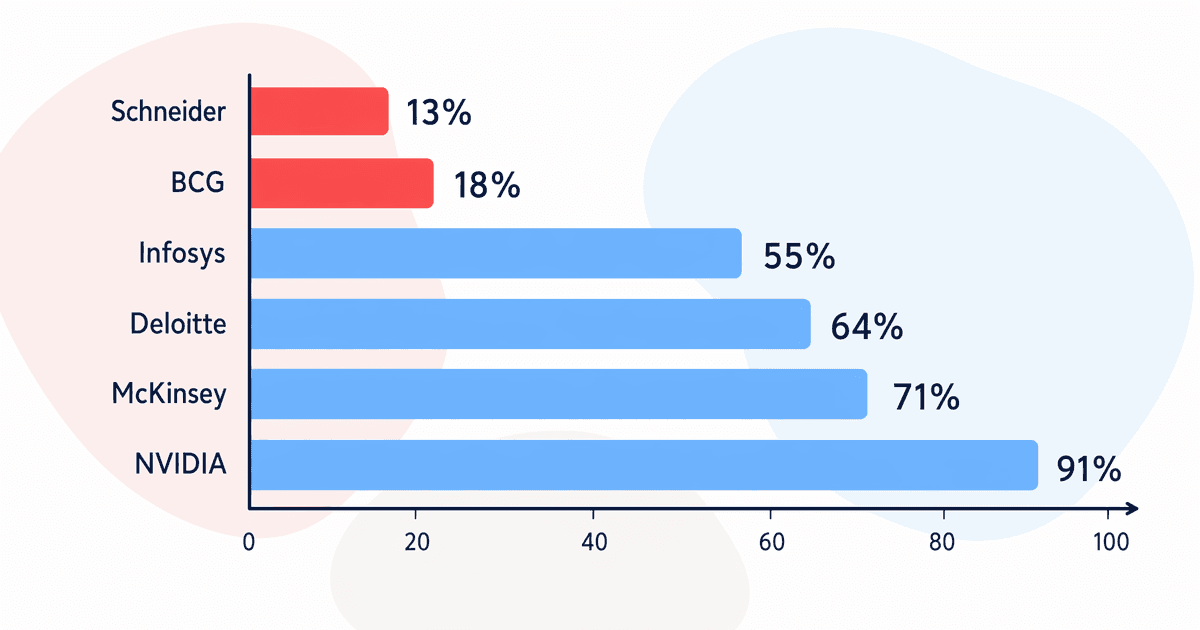
What this tells you: The gap between "assessing AI" (91%) and "embedded end-to-end" (13%) is enormous. Most FMCG companies have experimented. Very few have AI making operational decisions. If your competitors are talking about AI on LinkedIn, that doesn't mean they've deployed it in their supply chain.
In our conversations with UK food & drink brands, most fall somewhere between "we've experimented with ChatGPT" and "we've run one forecasting pilot." BCG's finding that 75% of CPGs remain in pilots is probably the most useful benchmark for evaluating where you stand.
Methodology note: BCG/CGF surveyed only 39 executives — senior but small. The Schneider Electric study (n=1,453, conducted by Censuswide, Feb–March 2026) is more statistically representative but mixes Food & Beverage with Life Sciences.
ROI: what are the measured financial outcomes?
This is where vendor marketing and measured reality diverge most sharply.
The bullish numbers
- 89% of respondents say AI has helped increase annual revenue (NVIDIA, Jan 2026). 30% report revenue increases of more than 10%.
- 95% say AI has helped decrease annual costs. 37% report cost reductions exceeding 10% (NVIDIA, Jan 2026).
- BCG estimates scaling AI across the demand value chain could deliver 220–350 basis points of cumulative EBIT for CPGs (June 2026).
- McKinsey estimates gen AI could increase traditional AI's economic impact by 15–40%, adding $160–270 billion annually in EBITDA for CPG companies globally (Oct 2024).
The measured reality
- 70% of CPG manufacturers report current AI ROI is under 20% (Schneider Electric, April 2026, n=1,453).
- Nearly a third (28.4%) see ROI of 5% or less (Schneider Electric).
- More than half of companies do not formally measure the ROI of their AI investments (BCG/CGF, June 2026).
- Only 13% have AI embedded end-to-end — meaning the 89% "revenue increase" figure likely captures marginal gains from narrow implementations, not operational AI (Schneider Electric).
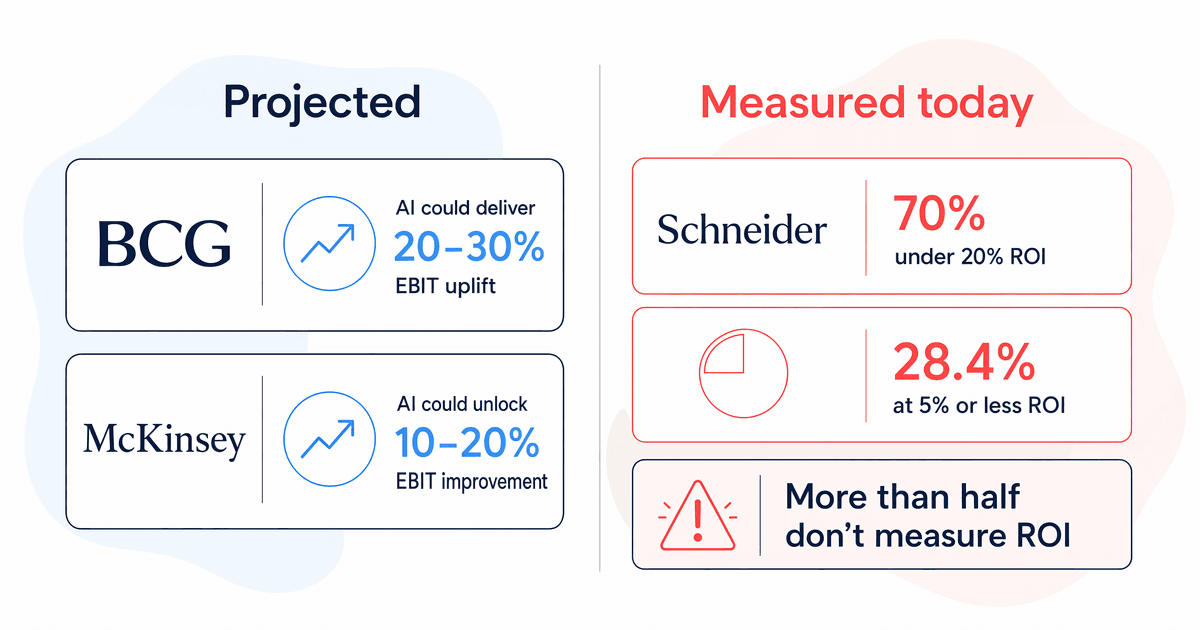
What this tells you: The potential value is real — nobody credible disputes that demand forecasting, pricing, and supply chain AI generate measurable returns. But the industry is still early. If you're building an internal business case, use the Schneider Electric figures as your "honest baseline" and the BCG estimates as your "upside ceiling." Don't tell your board that 89% of companies are seeing revenue increases without noting that most of them can't formally measure what AI contributed.
Where AI delivers (and where it doesn't yet)
The surveys converge on where AI creates measurable value today:
| Use case | Evidence level | Measured outcome | Source |
| Demand forecasting | Strong (independent) | Up to 50% error reduction; 2–3% waste reduction | McKinsey 2024; Mondelez/Databricks 2026 |
| Pricing & RGM | Strong (independent) | Frontrunner focus area; counterfactual modelling | BCG 2026; Mondelez |
| Supply chain ops | Good (mixed) | 5–20% logistics cost reduction | Duvo 2026; Schneider Electric |
| Sales execution | Good (single source) | 2–4% store-level sales uplift | Mondelez/Databricks 2026 |
| Marketing personalisation | Weak (vendor-sourced) | No independent ROI data | Vendor case studies only |
| Product development | Weak (intent only) | 49% call it strategic; 11% have scaled | BCG 2026; Deloitte 2026 |
| GenAI content | Weak (vendor-sourced) | 60–80% cost reduction claimed | ASquare Solutions 2026 |
High-evidence areas (multiple sources confirming ROI)
- Demand forecasting: McKinsey reports AI reduces forecasting errors by up to 50%. Mondelez (via Databricks, June 2026) measures 3–5% improvement in forecast accuracy, 2–3% reduction in finished goods inventory waste. BCG identifies this as a "frontrunner focus area."
- Pricing & revenue growth management: BCG names it one of three areas where frontrunners concentrate effort. Mondelez uses AI simulations before every price change to model brand switching, pack-size shifts, and volume impact.
- Supply chain operations: Duvo (March 2026) cites 5–20% logistics and supply chain cost reductions among early adopters. Schneider Electric: supply chain operational efficiency is the top pressure valve (51% of respondents).
- Sales execution: Mondelez reports SKU recommendation models deliver 2–4% increase in store-level topline sales, with sales rep effectiveness reaching ~80%.
Lower-evidence areas (vendor claims outpace independent measurement)
- Marketing personalisation: widely cited but ROI data comes primarily from AI vendors, not independent surveys.
- Product development acceleration: Deloitte (Jan 2026) names it as "most promising" but provides no measured ROI figures. BCG notes that 49% of CPGs see "idea to market" as strategically important for AI, yet only 11% have scaled it.
- Generative AI content: cost reduction claims of 60–80% are common (ASquare Solutions, Feb 2026) but sourced to vendor case studies, not independent measurement.
What this tells you: If you're choosing where to start, the evidence is clearest for demand forecasting. It's the use case with the most independent measurement, the most documented ROI, and the shortest path to a provable pilot. That's consistent with what we've written about choosing your first high-value AI use case.
The agentic AI evidence gap
"Agentic AI" appeared in every major 2026 survey. The data on actual deployment is thin:
- 47% of retail/CPG respondents are using or assessing agentic AI (NVIDIA, Jan 2026) — but only 20% say agents are active, with 21% expecting deployment within 12 months.
- 72% of CPG companies are "using, preparing, or planning to adopt" agentic AI for manufacturing (Veeva/State of AI in Consumer Goods, Jan 2026).
- 64% of CPG executives believe they are ahead of competitors on agentic AI adoption (Deloitte, Jan 2026). As Deloitte notes: "Surely not everyone can be above average."
- BCG (June 2026): agentic capabilities could expand the AI value opportunity to 1.7x current levels — but frames this as future potential, not current measurement.
What's missing: No survey published through 2026 provides measured ROI from agentic AI deployments in FMCG. The data captures intent and early experimentation, not proven financial outcomes. If someone shows you an agentic AI ROI figure for FMCG, check whether it's from a controlled pilot or a projection.
For context on what AI agents actually mean in day-to-day FMCG work (versus the vendor definition), see our breakdown of AI agents for FMCG teams.
The barriers aren't technology
Every major survey agrees: the blockers are organisational, not technical.
Schneider Electric's survey (n=1,453) ranks them:
- Skills gaps in AI or data science — 43.0%
- Legacy automation systems and infrastructure — 37.5%
- Lack of contextualised operational data — 36.3%
- Workforce resistance — 25.7%
- Cybersecurity or compliance concerns — 21.7%
Veeva's State of AI in Consumer Goods (Jan 2026, 150+ IT and functional leaders) found:
- 82% are actively consolidating legacy systems or transitioning to unified platforms
- Top three barriers: compliance and security (60%), cost and resource constraints (60%), integration complexity with existing systems (55%)
- 64% still use a mix of digital and manual processes for quality and compliance
What this tells you: If you're running a food & drink business on a combination of SAP, spreadsheets, and email — you're in the majority, not the minority. The first step isn't buying an AI tool. It's getting your spreadsheet reporting under control and establishing clean data foundations. That 6–12 month "data debt" paydown period isn't optional — it's what separates the 13% who've embedded AI from the 75% stuck in pilots.
Building your internal business case: the stats that matter
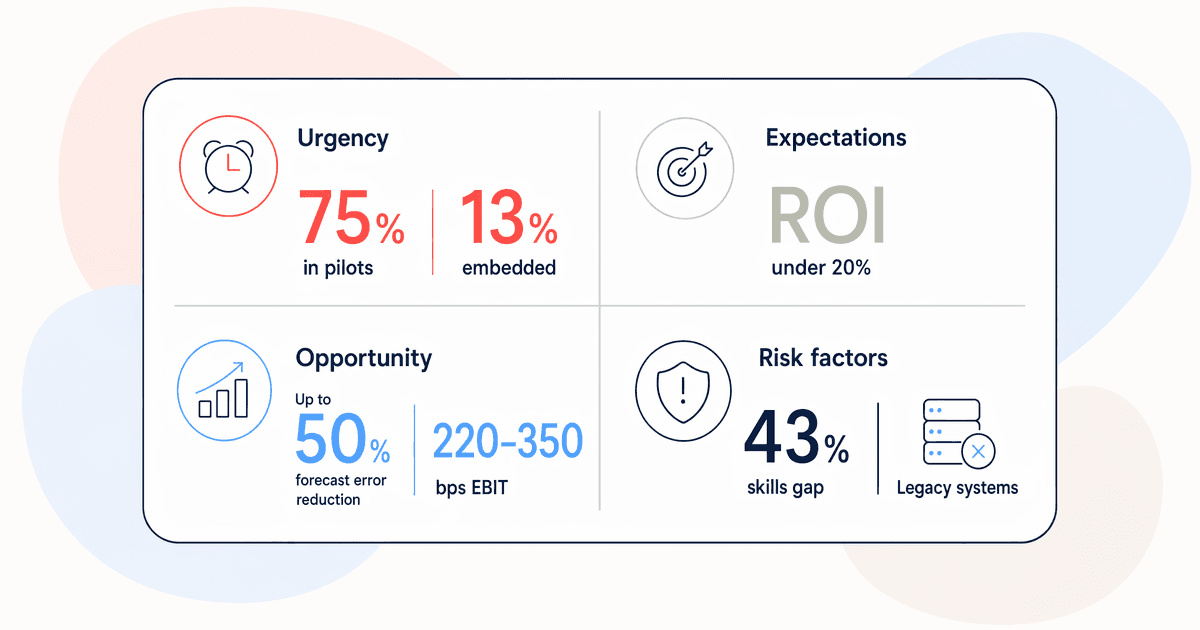
If you're preparing a board deck or a business case for AI investment, here are the figures that hold up to scrutiny:
For establishing urgency:
- 75% of CPG companies remain in pilots (BCG/CGF, June 2026, n=39 senior executives)
- 15.2% of manufacturing revenue lost to preventable inefficiencies today, expected to reach 29.14% by 2030 (Schneider Electric, April 2026, n=1,453)
- 90% plan to increase AI budgets in 2026 (NVIDIA, Jan 2026)
For setting realistic expectations:
- 70% report current ROI under 20% (Schneider Electric)
- More than half don't formally measure AI ROI (BCG/CGF)
- Only 13% have AI embedded end-to-end (Schneider Electric)
For scoping the opportunity:
- 220–350 basis points of cumulative EBIT improvement from scaling AI across the demand value chain (BCG, June 2026)
- AI reduces demand forecasting errors by up to 50% (McKinsey, 2024)
- 2–4% store-level sales uplift from AI-driven SKU recommendations (Mondelez/Databricks, June 2026)
- 5–20% logistics and supply chain cost reduction among early adopters (industry benchmarks, multiple sources)
For addressing risk:
- Top blocker is skills gaps (43%), not technology cost (Schneider Electric)
- 82% of CPG companies are still consolidating legacy systems (Veeva, Jan 2026)
- The "pilot trap" is real: success in controlled environments doesn't compound at scale without middleware investment and workflow redesign (BCG)
What this means for your business
The evidence points in one direction: AI creates measurable value in FMCG — particularly in demand forecasting, pricing, and supply chain operations — but most companies aren't capturing it because they haven't done the unglamorous foundation work first.
If you're a UK food & drink brand reading this, the honest picture is:
- You're not behind — 75% of CPGs (including brands much larger than you) are still in pilots
- The opportunity is real — but it's 220–350 basis points of EBIT improvement over time, not "10x overnight"
- Start with forecasting — it's the use case with the deepest evidence base and the clearest measurement framework
- Fix data first — every survey identifies data quality and legacy systems as blockers ahead of technology cost
- Measure from day one — more than half of companies can't prove their AI ROI because they didn't establish baselines before starting
Not sure whether your business has the data foundations to make AI work? Our AI readiness self-assessment for UK food & drink brands walks you through the five dimensions that actually matter.
For a broader view of how AI fits across your departments — not just the stats but the practical "what does this look like on Monday morning" — see our complete practical guide to AI for FMCG.
Sources cited in this article:
- BCG & The Consumer Goods Forum, "AI in CPG and Retail: How Winners Are Pulling Ahead," June 2026. Survey of 39 senior CPG and retail executives worldwide.
- NVIDIA, "State of AI in Retail and Consumer Packaged Goods," January 2026. Third annual survey, hundreds of industry respondents.
- Schneider Electric, "2026 Industrial AI in CPG Survey," April 2026. Research conducted by Censuswide among 1,453 executives (25% C-suite, 75% senior manufacturing decision-makers) across Food & Beverage and Life Sciences sectors in 14 countries. Data collected February–March 2026.
- McKinsey & Company, "Fortune or Fiction? The Real Value of a Digital and AI Transformation in CPG," October 2024. Analysis of 140+ use cases with expert interviews.
- Infosys Knowledge Institute, "AI in CPG: Business Value Radar 2025," November 2025. Survey of 3,798 business leaders globally, 250 from CPG.
- Deloitte, "2026 Consumer Products Outlook," January 2026. Survey of 300 senior executives from major consumer products companies globally.
- Veeva Systems, "State of AI in Consumer Goods Report," January 2026. Survey of 150+ IT and functional leaders at global CPG companies in the US.
- Mondelez International / Databricks case study, June 2026. 20,000 models (3,000 in production) across sales, supply chain, and revenue growth management.