
Vendors apply the term "AI agent" to everything from a chatbot button to a fully autonomous supply chain system. That's a problem. When every tool claims to be agentic, it's hard to know what you're actually buying or building.
The distinction matters practically. Basic automation, AI assistants, and AI agents solve different classes of problem. Deploy the wrong one and you'll either build something too brittle to last, or invest in infrastructure for a capability you don't need yet.
This article covers what AI agents actually are, where they sit relative to other automation approaches, and where they work (and don't) in FMCG.
The Bottom Line - AI agents reason toward a goal and take multi-step actions across systems. They don't follow a fixed script — unlike RPA - 62% of organisations are experimenting with AI agents, but only 23% are scaling them in even one function (McKinsey, 2025) - Traditional RPA fails 30–50% of the time over the long run as interfaces change (Ernst & Young, via Duvo, 2026) - The strongest FMCG use cases — demand forecasting, supplier portal management, trade promo exception handling — share one trait: high volume, clear rules, frequent exceptions - Gartner predicts 40%+ of agentic AI projects will be cancelled by end of 2027. Not because agents don't work, but because most teams start without stable data or clear decision governance
What Is an AI Agent, Actually?
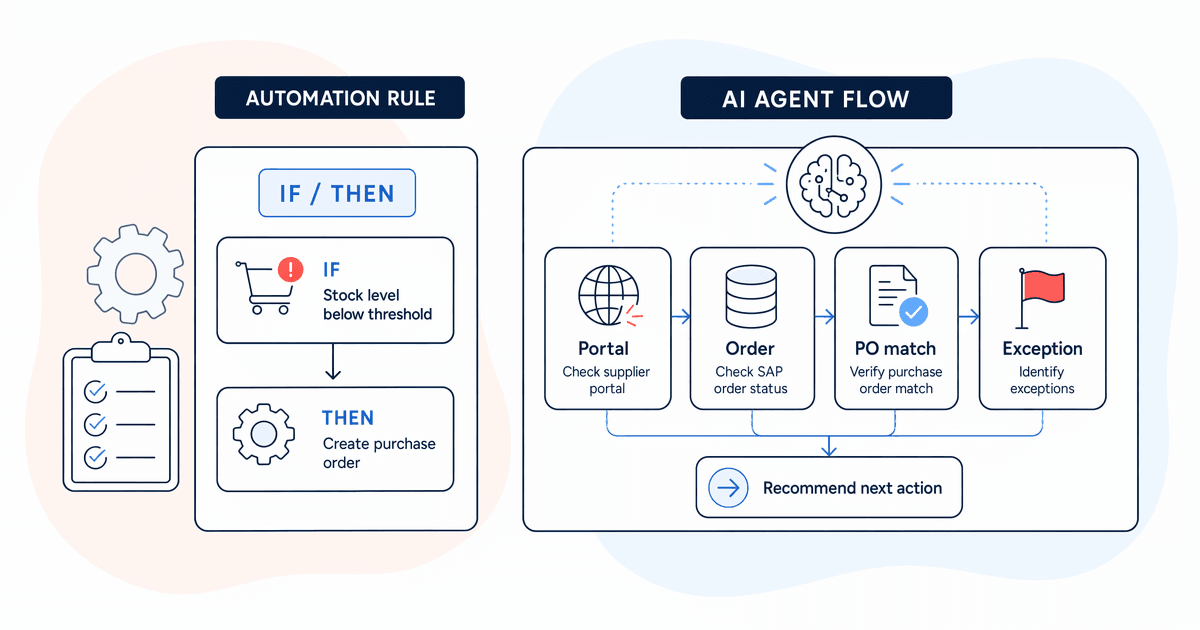
An AI agent is software that pursues a goal by deciding what to do next at each step — not by following a predetermined sequence. It uses a large language model (LLM) to reason about its objective, identify what actions are available, execute those actions across tools or systems, evaluate the results, and continue until the goal is met or it needs to escalate.
That's a real difference from what most teams mean when they say "automation." A basic automation system gets the instruction: do these steps in this order. An AI agent gets the instruction: achieve this outcome. Work out the steps yourself.
According to AWS, an AI agent independently chooses the best actions to perform to achieve a goal. You set the goal and the guardrails. The agent determines the path. This isn't a nuance — it's the entire architectural difference. It's why agents can handle exceptions and adapt to change in ways that rule-based automation can't.
Worth noting: The terminology is genuinely confusing right now because most vendors apply the word "agent" to everything. Gartner estimated in mid-2025 that only around 130 of the thousands of self-described agentic AI vendors actually deliver substantive agentic capabilities. The rest are rebranded chatbots or RPA tools with an AI wrapper.
How Do AI Agents Differ From Basic Automation and RPA?
Three meaningfully distinct categories exist here. They're not interchangeable.
Layer 1: Basic automation and RPA. Robotic Process Automation (RPA) automates the user interface. It records a sequence of screen actions — click here, type this, copy that field — and replays them at scale. UiPath, Blue Prism, and Automation Anywhere built large businesses on this model. It works well when the process is completely stable: same screens, same field positions, same data formats, every time.
The failure mode is brittle. When a screen changes, the bot stops. Ernst & Young research puts the long-run failure rate of traditional RPA at 30–50%. Breakage is triggered by interface updates, SAP version changes, or any deviation from the recorded script (Duvo, 2026).
Layer 2: AI assistants and copilots. These use LLMs to understand context, answer questions, summarise documents, and draft recommendations. They're reactive: you prompt, the assistant responds. They can cut the time spent locating information or preparing first drafts. But they don't act. Every decision still flows through a person. The assistant advises; you execute.
What Makes AI Agents Different From AI Assistants?
Layer 3: AI agents. Agentic systems combine LLM reasoning with the ability to act. They don't wait for prompts. They monitor conditions, evaluate options against defined constraints, execute decisions within set guardrails, and escalate only when they hit situations outside their authority.
According to IBM, AI agents use tool calling to get up-to-date information and optimise workflows. They create subtasks on their own to hit complex goals, without continuous human oversight. The human's job shifts from approving each action to setting parameters and handling the exceptions that genuinely need judgement.
The practical takeaway for consumer goods teams: RPA suits genuinely stable, single-system tasks that never change. AI assistants suit situations where you need faster access to information and better first drafts, but a human must stay in the decision loop. Agentic systems suit processes that span multiple systems, involve frequent exceptions, or shift often enough that the cost of human handling at every step is too high.
What Does an AI Agent Look Like in an FMCG Workflow?
Supplier portal management is a useful example. It's genuinely multi-step, involves multiple systems, and has the kind of variability that breaks RPA constantly.
A typical RPA approach to supplier confirmations works like this: the bot logs into the portal, navigates to open orders, copies the status column, pastes it into SAP, and sends a templated email. Change the portal's navigation or field names — which suppliers do, regularly — and the bot stops. The whole process halts until someone rebuilds the script.
An agent approach works differently. The agent receives the goal: process all outstanding supplier confirmations for this week's purchase orders. It navigates to the relevant portal, identifies open items, matches them against SAP purchase orders, flags discrepancies for human review, and completes confirmations. It adapts dynamically to variations in portal layout or data format. If SAP updates its interface, the agent adjusts rather than breaking.
One UAE-based FMCG distributor cut purchase order processing time from over a full day to ten minutes using this kind of supplier portal automation (Duvo, 2026). That's not exceptional performance — it's the expected outcome when the workflow is genuinely well-suited to agentic automation.
This is what Supply Chain Management Review means when it distinguishes "chatbot AI" from "agentic AI". The difference is execution authority. Agentic AI acts across ERP, WMS, and supplier systems to resolve exceptions rather than just advising planners (SCMR, 2026).
What we observe: The teams with the smoothest agent deployments drew a clear line — on paper, before building anything — between what the agent can do without human approval and what must always involve a person. That governance decision sounds administrative. In practice, it's the most important technical decision in the project.
Where Do AI Agents Create the Most Value in FMCG?
The strongest FMCG use cases share three traits: high volume, clear decision rules, and frequent exceptions that currently need human handling. McKinsey (2025) data shows AI-driven forecasting cuts supply chain errors by 20–50%, reduces stockout-related lost sales by up to 65%, trims warehousing costs by 5–10%, and improves administration costs by 25–40.
Five workflow categories meet that criteria in consumer goods:
Demand forecasting and replenishment. Agents ingest POS data, seasonal patterns, promotional calendars, and external signals continuously, updating forecasts and replenishment decisions without waiting for a weekly planning cycle. One global beverage company deployed six specialist agents — Orchestrator, Data Extractor, Data Cleaner, Forecast, Exception Finder, and Report Builder — that compressed planning cycles from 19 days to 11 hours and automated roughly 90% of the weekly forecasting workflow (CrewAI, 2026). Procter & Gamble's Azure ML implementation achieved a 15% drop in stockout rates and a 10% reduction in inventory carrying costs, with forecast accuracy improving by over 20% (Duvo, 2026). The practical point for any brand running weekly demand planning meetings: if those meetings are mostly about catching up with what already happened, an agent can handle the routine refresh. Your team focuses on the calls that actually need judgement.
Supplier portal management. As described above: agents navigate portals, match purchase orders, flag discrepancies, and complete confirmations without human coordination between each step.
Trade promotion exception handling. Rather than replacing promo planning, agents monitor running promotions against expected performance and flag anomalies — underdelivering mechanics, overlapping promo windows, cannibalisation signals — before they become margin problems. One North American personal care manufacturer deployed an agent with authority to adjust trade promotion rates across 4,800 retailer-SKU combinations, provided changes stayed within 12% of baseline spend and maintained contracted category share minimums. The system ingested syndicated POS data with a 90-minute lag, re-forecast demand every four hours, and transmitted revised trade terms to retailer systems via API without human approval (ColdAI, 2026). You don't need to be running 4,800 SKUs for the principle to apply. Any brand managing trade spend across multiple retailers can benefit from automated exception flags before a mechanics gap turns into a deduction dispute.
Operations reporting. UnifyApps (2026) estimates that Intelligent Operations Centre Agents cut manual metric reporting by up to 90% and enable 30% faster operational decisions. The agent assembles the report; your team reads and acts on it.
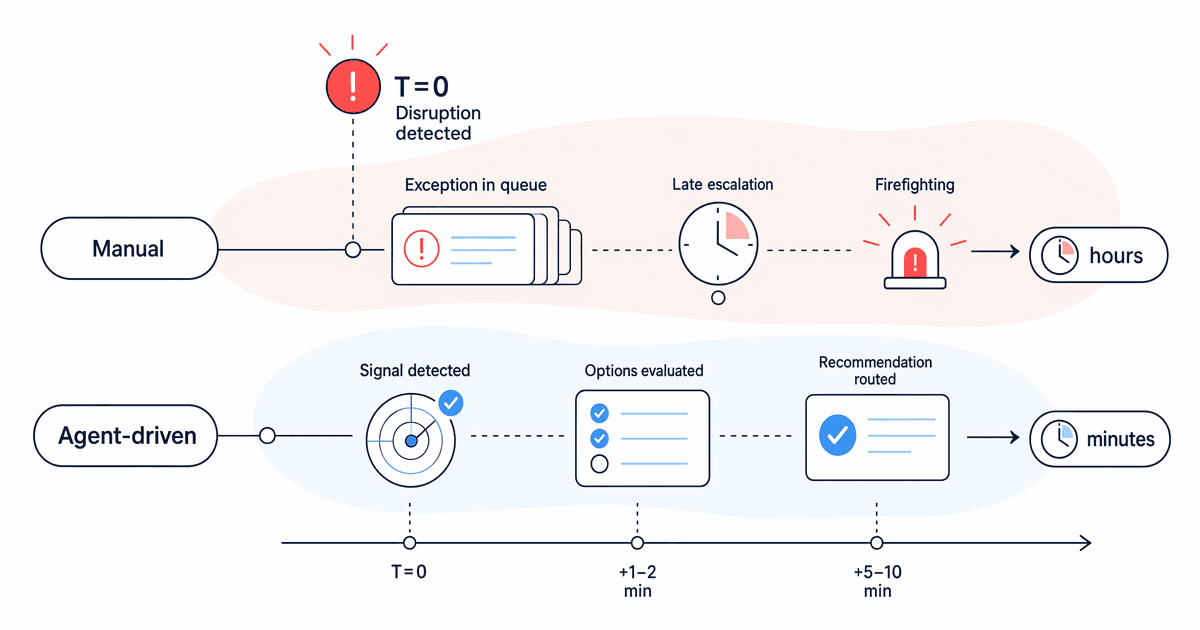
Exception routing. Most supply chain exceptions sit idle in queues for hours before anyone picks them up. Agents that monitor exception signals, evaluate urgency against defined service rules, and route to the right person immediately compress what SCMR calls the "execution tax": the cost of delays between detecting a problem and acting on it (SCMR, 2026).
Why Do So Many AI Agent Projects Fail?
Given those results, why aren't more FMCG teams scaling agents? Gartner (2025) predicts over 40% of agentic AI projects will be cancelled by end of 2027. The cited causes: escalating costs with unclear ROI, absent risk controls, and hype-driven deployment. MIT research cited by Fortune found 95% of generative AI pilots have failed to deliver measurable P&L impact.
That figure deserves care. It reflects how hard it is to operationalise these systems without clear decision ownership and governance. It's not a verdict on the technology itself.
The pattern behind most failures is consistent across multiple post-mortems. Teams deploy agents before the underlying data is reliable enough to act on. The agent generates recommendations that planners can't audit, because the data feeding the agent isn't trusted. Teams then fall back to spreadsheets and email. The agent stays visible but stops being decisive.
What we see: The readiness gap is almost never in the AI layer. It's nearly always in the data layer below it. Master data accuracy, lead time variability, and the consistency of inputs across ERP, WMS, and supplier systems matter more to agent performance than model selection. Fix the data first and most agents work. Skip that step and almost none do.
The SCMR (2026) post-mortem study of underperforming supply chain agent deployments found a consistent recovery pattern. In practice, the reset follows four steps: stabilise data, clarify decision rights, validate recommendations in shadow mode, then automate execution. Teams that tried to operate in all conditions before proving reliability in any specific condition failed reliably.
Agents also have structural limits. They perform well on constrained, task-level decisions: purchase order prioritisation, exception triage, supplier confirmation processing. They're not yet reliable for fully autonomous planning involving multi-objective tradeoffs, shifting priorities, and implicit rules no one has written down. McKinsey is explicit that the commercial case for agents depends on genuinely redesigning workflows around them — not bolting an agent onto a process built for human execution.
The adoption data tells the story plainly. McKinsey's November 2025 State of AI survey found that while 88% of organisations use AI in some form, only 23% are actively scaling AI agents in even one business function. Fewer than 10% are doing so across multiple functions (McKinsey, 2025). The gap between experimenting and scaling is where most teams are stuck. The reason is almost always governance and data quality — not the agents themselves.
If you're thinking through where your own operations sit on this spectrum, the AI vs. automation comparison we've published covers the decision framework for choosing between these approaches in more detail.
How Should an FMCG Team Actually Start?
Start with one high-volume, well-understood process — not your most complex workflow. The research points toward a consistent starting framework, regardless of platform or vendor. It's about sequencing the decisions correctly.
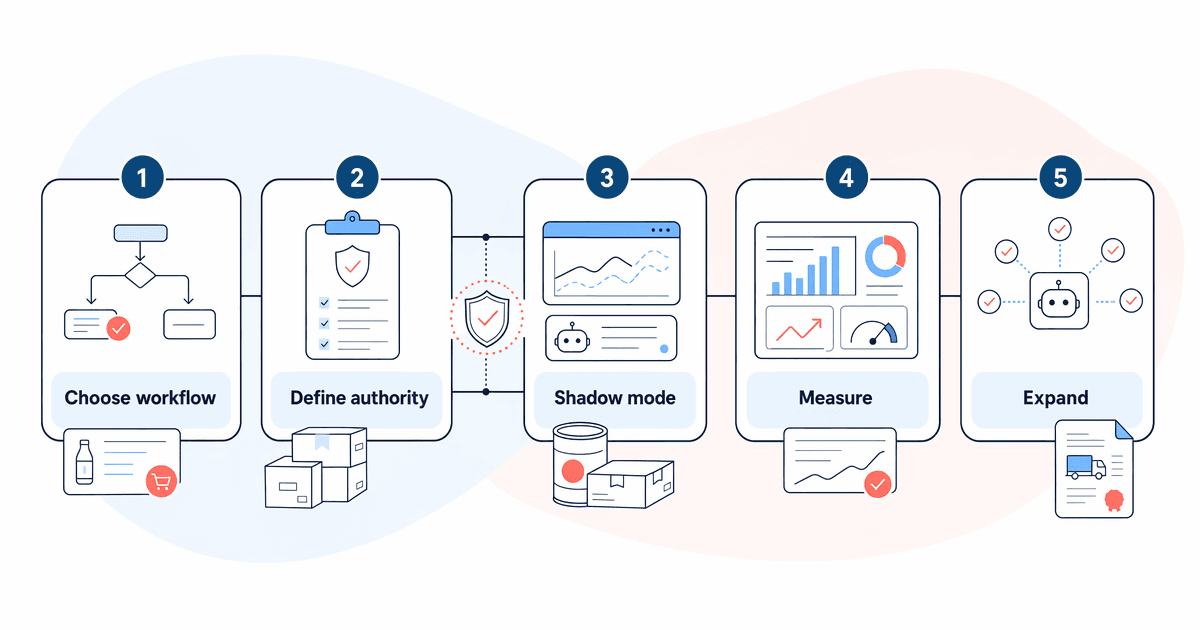
Step 1: Pick one well-scoped workflow. Not the full S&OP cycle. Choose a single process where the data inputs are clean, the decision rules are documented, and the failure modes are understood. Supplier confirmation processing, replenishment alerts, or trade promo exception flagging are typical starting points.
Step 2: Define decision authority before you build. Draw an explicit line between what the agent can do without approval and what always requires a human. Write it down. This is the governance decision that most failed projects skipped. According to SCMR, teams that define approval thresholds, confidence scoring, fallback logic, and escalation paths before deployment — rather than adding controls after trust is lost — are the ones that successfully scale (SCMR, 2026).
Step 3: Run in shadow mode first. Let the agent generate recommendations without acting on them. Compare its outputs against what your team actually decided. Validate reliability across a meaningful sample before switching on execution authority.
Step 4: Measure the right things. Not "is the agent running?" Measure touchless resolution rate (what percentage of cases did the agent close without human intervention), decision latency (time between detecting an issue and acting on it), and cost-to-serve impact. These connect agent performance to commercial outcomes.
Step 5: Expand authority incrementally. Once the first workflow is stable, extend the agent's decision scope or deploy a second agent on a connected workflow. Gartner recommends pursuing agents only where they deliver clear ROI in this early stage, and rethinking workflows from the ground up rather than automating a flawed process with smarter tooling (Gartner, 2025).
This is the same logic that applies to any process automation: understand the workflow clearly before you build anything. The approach is covered in more depth in our guide on turning a manual process into an automated workflow.
What's Realistic in the Next 12–18 Months?
Agents handling well-scoped operational decisions at high volume — with humans owning the exceptions and the strategic calls — is the realistic near-term picture for FMCG. Not fully autonomous supply chains. That's a longer horizon.
Gartner (2025) predicts that at least 15% of day-to-day work decisions will be made autonomously through agentic AI by 2028, up from 0% in 2024. It also predicts 40% of applications will embed task-specific agents by end of 2026, up from fewer than 5% at the start of 2025.
What's realistic now: meaningful reductions in the time between detecting an exception and acting on it, and in the manual coordination load sitting on your operations and commercial teams. BCG estimates that for companies investing in data infrastructure and agent governance now, the potential includes working capital reductions of up to 30% and EBITDA uplift of two to four percentage points (BCG, 2026). Those numbers are conditional on redesigning workflows properly — as is any meaningful operational improvement.
The organisations getting the most value aren't running the most pilots. They've chosen a specific process, stabilised the data underneath it, defined what the agent can and can't do, and built something production-grade rather than experimental. If you'd like to talk through where your own operations sit, get in touch with the BazBiff team.
Frequently Asked Questions
What is an AI agent in simple terms?
An AI agent is a software system that pursues a goal by deciding what to do next at each step, rather than following a fixed script. It uses a large language model to reason, plan, and act across multiple systems. You give it a goal and guardrails; it works out the steps, handles exceptions, and escalates only when it genuinely can't proceed.
How are AI agents different from RPA?
RPA records and replays a fixed sequence of UI actions. Change the screen layout and the bot breaks. Ernst & Young puts traditional RPA failure rates at 30–50% over time. AI agents don't record screens. They reason about goals and call APIs or tools. When something changes, they adapt rather than stopping (Duvo, 2026).
What is the difference between an AI agent and an AI assistant?
An AI assistant (copilot) answers questions and drafts recommendations, but a human still decides and acts. An AI agent monitors conditions, makes decisions, and executes actions within defined guardrails, without requiring a human prompt for each step. Your role shifts from deciding every action to setting parameters and managing exceptions that fall outside the agent's authority.
Where do AI agents actually work in FMCG operations?
The strongest consumer goods use cases are demand forecasting and replenishment, supplier portal management, trade promotion exception handling, and operations reporting. McKinsey data shows AI-driven forecasting reduces supply chain errors by 20–50% and cuts stockout-related lost sales by up to 65% (McKinsey, 2025). These workflows share a key trait: high volume, clear rules, and frequent exceptions that currently require human handling.
Why do so many AI agent projects fail?
Gartner predicts over 40% of agentic AI projects will be cancelled by end of 2027, citing unclear ROI, escalating costs, and immature risk controls (Gartner, 2025). MIT research cited in Fortune found 95% of generative AI pilots have not delivered measurable P&L impact. The common cause: unclear decision ownership and poor data quality before deployment, not the technology itself.
Agents Are a Capability, Not a Category
Treating AI agents as a product you buy, install, and switch on is the source of most disappointment. An agent is a capability: the ability to reason toward a goal and act within guardrails you define. Whether that delivers value depends entirely on whether you've identified the right process, prepared the underlying data, and built proper governance around what the agent can and can't do.
The teams getting the best results aren't the ones running the most experiments. They picked one specific, high-volume process. They defined the decision boundaries before building anything. They validated outputs before giving the agent execution authority. And they measured outcomes that connect to actual commercial performance — not just whether the system was running.
So the question worth asking isn't "should we use AI agents?" It's: which of our workflows has clean enough data, clear enough decision rules, and high enough volume that an agent could handle it reliably? And what would that free your team to do instead?
If you're working through that for your own business, talk to us. Explore more of our thinking on automation and AI for FMCG teams.
*All sources cited inline throughout this article.*