
One replaces repetitive tasks with rules. The other learns from data and makes predictions. They're not the same technology — and for FMCG brands, mixing them up is an expensive habit that most vendors have absolutely no incentive to correct.
If you've sat through a pitch in the last two years, you'll know what I mean. Everything is "AI-powered" now: automated invoice matching, rule-based reorder triggers, spreadsheet macros with a chatbot bolted on. The word has become a catch-all for anything digital that moves without a human pressing a button.
That conflation matters — not because labelling is important, but because the decision about which technology to invest in depends entirely on the problem you're trying to solve. Get that wrong and you end up with a sophisticated, expensive solution to a problem you don't have, while the actual problem runs quietly in the background costing you margin every week.
Here's the plain-English version: what each technology actually does, where each one earns its keep in an FMCG operation, and why the distinction is more valuable than anything most vendors will tell you.
TL;DR: Automation = fixed rules, predictable tasks. AI = variable inputs, probabilistic decisions. For most FMCG brands, automate first, then layer in AI once data foundations are clean. Gartner found 30% of AI projects are abandoned after proof of concept — usually because the underlying infrastructure wasn't ready.
What Automation Actually Is
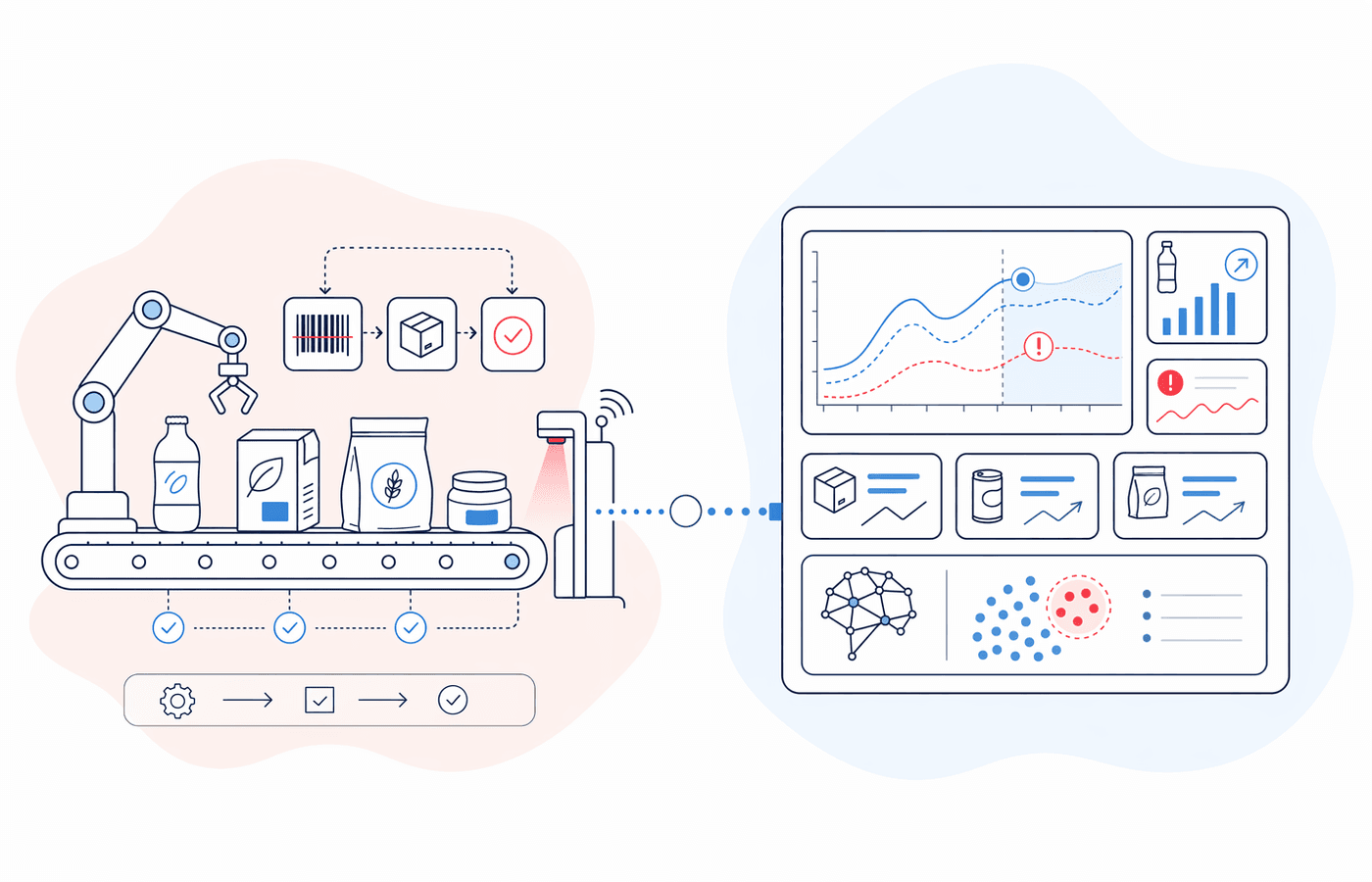
Automation follows rules. You define the logic — *if this, then that* — and the system executes it consistently, at speed, without needing to think or adapt.
In an FMCG operation, that covers a lot of ground:
- Production line monitoring — alerting engineers when fill-weight or headspace falls outside tolerance
- Invoice processing — matching purchase orders to delivery notes and routing exceptions to the right person
- Reorder triggers — raising a replenishment purchase order when stock drops below a fixed threshold
- Scheduled reporting — pulling weekly sales data into a formatted business review deck at 7am every Monday
- Order routing — sending confirmed customer orders directly to the warehouse management system without manual entry
These are deterministic processes. The rules don't change based on what the system observes over time — they do exactly what you told them to do, every single time. That's a feature, not a limitation. It's fast, reliable, and completely auditable.
Rockwell Automation's 2024 State of Smart Manufacturing report — surveying 158 CPG manufacturers across 17 countries — found that 86% of CPG manufacturers are already using or evaluating smart manufacturing technology of this kind.. Production monitoring sits at the top of CPG ROI rankings, and this isn't new territory. It's mature technology doing what it's been doing on factory floors for a decade, with better connectivity and lower implementation costs than five years ago.
The key constraint: automation can't handle ambiguity. It doesn't improve when circumstances change. If your demand pattern shifts because a competitor slashes price in week three of your promotional cycle, an automated reorder trigger has no idea. It fires on the number you set in January and keeps firing until someone manually changes it.
If you're evaluating a specific process, this walkthrough of converting a manual workflow to automated goes through the scoping questions in detail.
What AI Actually Is
AI makes probabilistic judgements based on patterns in data. It doesn't follow pre-set rules — it infers them from what it's observed, and it updates those inferences as new information arrives.
In FMCG, the high-value applications sit in exactly the places where context changes and fixed rules break down:
- Demand forecasting — weighing historical sales against promotions, seasonality, weather, and competitive signals to generate SKU-level volume predictions
- Promo optimisation — estimating the true uplift from different trade investments across retailers, timing windows, and mechanic types
- Price elasticity modelling — understanding how a price movement affects volume by product, pack size, and customer segment
- Supply chain anomaly detection — identifying the patterns in production data that precede a quality failure before it reaches QC
The difference from automation is that these problems don't have a fixed right answer. What sells next week depends on variables that didn't exist when you built your planning model. AI handles that complexity by building a dynamic model of how things relate to each other and updating it continuously — not by following a rule someone wrote on a Tuesday afternoon.
McKinsey's October 2024 CPG research quantified the value at stake across the CPG value chain and made a point worth holding onto: traditional AI's potential impact on CPG value creation is 2.5 to 7.0 times higher than generative AI. Worth remembering the next time a vendor leads with a chatbot as the main event.
Automation vs. AI: Five Key Differences
The differences collapse into five practical dimensions that should guide your investment decision. The data requirement row is the most underweighted — it's where most AI projects run into trouble.
| Dimension | Automation | AI |
| How it works | Follows fixed, pre-defined rules | Learns patterns from data; updates over time |
| Best suited to | Repetitive, predictable, high-volume tasks | Complex decisions with variability or ambiguity |
| Data requirement | Minimal — structured triggers and thresholds | Substantial — ideally 18–24 months of clean history |
| Adapts to change? | No — rules stay fixed until manually updated | Yes — model performance improves as data grows |
| FMCG use cases | Invoice matching, reorder triggers, report scheduling | Demand forecasting, promo ROI, price elasticity |
Neither is inherently better. They're tools for different jobs. The question is which job you actually have.
Where to Start with Automation
For a brand in the £20m–£80m revenue range, automation typically delivers faster and cleaner returns than AI — and for most operations at this scale, it's the right starting point.
You're probably running finance, production reporting, and procurement across a combination of ERP, spreadsheets, and email chains. There's real time and money to recover by automating the structured, rules-based parts of that workflow: order acknowledgements, stock variance reports, out-of-stock alerts, weekly sales dashboards.
McKinsey's June 2025 analysis projects that by 2030, around 30 to 35 percent of all current activities across consumer functions could be automated. For CPG manufacturing specifically, that figure rises to approximately 40 percent, driven by the concentration of manual, repetitive tasks on the production floor and in supply chain administration.
The one thing to do before you automate anything: map the process properly first. Many FMCG operators skip this step and automate a broken workflow. You end up with a faster, more consistent version of the same problem. The investment in process clarity before implementation pays back quickly.
Where AI Earns Its Keep
AI starts to earn back its cost when the decision you're trying to make has genuine complexity — when the right answer depends on multiple interacting variables and changes week to week.
Demand forecasting
Demand forecasting is the clearest example. Most FMCG brands are still running demand planning on spreadsheets or basic statistical models — and the forecast errors show it. McKinsey's October 2024 CPG research found that AI-driven demand forecasting reduces forecast errors by 20 to 50 percent compared to traditional methods, when implemented on clean, integrated data.
That accuracy gap has direct cash consequences. Fewer stockouts, lower safety stock, less promotional waste on lines you misjudged. Southern Glazer's Wine & Spirits — a large distributor rather than an FMCG manufacturer, but a useful proxy — reported a 10 percentage-point improvement in forecast accuracy over two years after switching to machine-learning forecasting, cutting inventory by around 7% while maintaining record fill rates, as reported by Consumer Goods Technology.
Trade promotion optimisation
Trade promotion optimisation is the other major opportunity for FMCG brands. Most brands at this scale are still making promo decisions based on historical sell-in data and what worked last time. AI-based modelling of promotional uplift by retailer, timing, mechanic, and product can materially shift the return on trade spend — which, for most brands, is the largest variable line item on the P&L after cost of goods.
Bain's June 2026 consumer products research found leading companies are already reporting ROI uplifts of 10 to 15 percent on commercial spend from business-driven AI investments, alongside 5 to 10 percent savings in COGS.
Why the Confusion Costs You
In 2024, 71% of CPG leaders reported adopting AI in at least one business function — up from 42% the year before (McKinsey, October 2024). That sounds like traction. In the same period, Gartner predicted at least 30% of generative AI projects would be abandoned after proof of concept by end of 2025 — due to poor data quality, unclear business value, or costs that couldn't be justified. BCG's October 2024 research put it plainly: 74% of companies had yet to show tangible value from their AI investments.
That divergence isn't a coincidence. A large share of those failed pilots were AI applied to problems that didn't need AI — automatable workflows dressed up as machine learning projects to get budget sign-off, or legitimate AI use cases deployed on top of data infrastructure too fragmented to support them. Gartner found that only 48% of AI projects make it to production at all, with a median eight months from prototype to deployment.
In our experience scoping AI and automation projects for FMCG brands in the £20m–£150m range, the single most common failure mode isn't a bad model — it's committing to an AI project before the data infrastructure is ready to support it. The model gets built on partial, inconsistent data and the accuracy gains never materialise.
For any FMCG brand, the practical consequence is this: if you don't know whether your demand planning problem needs better rules or a better model, you're likely to spend on the wrong thing. The vendor will tell you it's AI. The implementation partner will agree. Six months later you'll have a system that works perfectly — for a problem you didn't actually have.
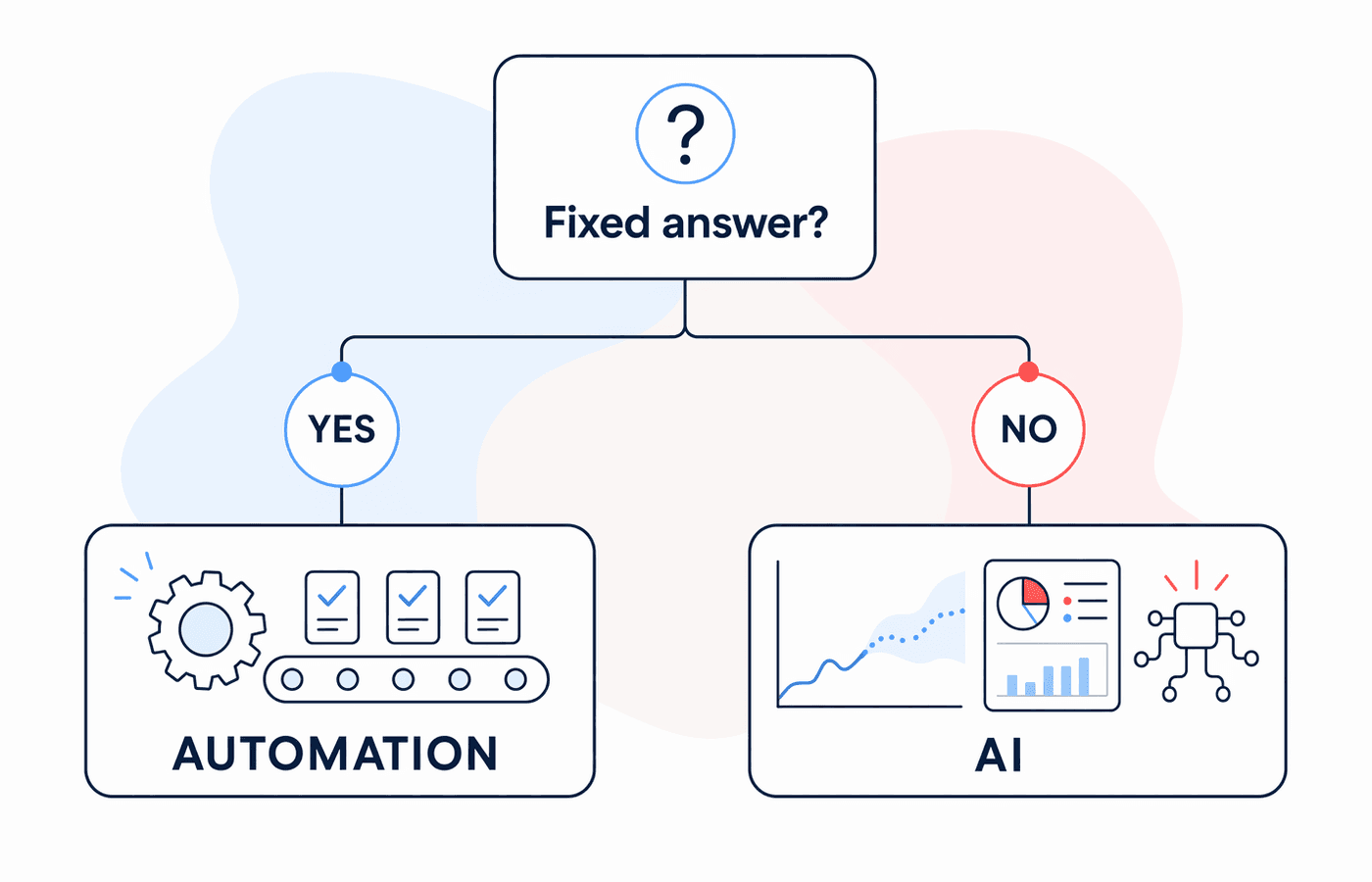
The diagnostic question to ask before you commit budget: *Is the right answer to this problem knowable in advance?* If yes, and the answer is consistent, you probably need automation. If no — if the right answer depends on variables that shift week by week — you need AI.
FAQ
Can automation and AI work together in the same operation?
Yes, and most effective FMCG operations use both. Automation handles the structured execution layer — order triggers, alerts, report scheduling. AI sits upstream, providing the demand forecasts and recommendations that inform those rules. They complement each other well; the issue is only when one is confused for the other at the budgeting or specification stage.
We're a £30m brand. Is AI genuinely realistic for us right now?
It depends on your data foundation, not your size. AI-driven demand forecasting needs at least 18 to 24 months of clean, SKU-level sales history integrated with promotional and supply data. If you have that — or a realistic path to it — the tools have become accessible enough. If you're still running your demand plan across disconnected spreadsheets and monthly ERP extracts, fix that first. AI won't fix a broken data architecture; it'll just surface the gaps faster.
Our ERP vendor says AI is already built into the platform. Does that count?
Healthy scepticism is appropriate here. Many ERP vendors use "AI" to describe statistical models or automation features that have been in the product for years. Before treating it as a box ticked, ask specifically: what does the model train on, how frequently does it update, and can it ingest external signals like promotional calendars, weather, or competitor pricing? A demand module that only reads internal sales history isn't doing much that a well-maintained ARIMA model couldn't.
How long before an AI investment shows a return?
McKinsey's June 2024 CPG research projects 6 to 10 percent incremental revenue uplift and 3 to 5 percentage-point EBITDA improvement over three to five years for comprehensive digital and AI adoption. For more targeted deployments — a demand forecasting tool or a promo optimisation model on a clean data set — meaningful accuracy improvements typically show up within two to three planning cycles. But factor in Gartner's finding that only 48% of AI projects reach production, with an average of eight months from prototype to deployment. The timeline tends to be longer than vendors quote and shorter than the cynics predict.
The Bottom Line
Automation replaces repetitive, rules-based work with consistent, fast execution. AI handles decisions where the right answer isn't fixed — it depends on data and changes over time.
For most FMCG brands, the highest-return sequence is:
- Automate the structured workflows first — production monitoring, reorder triggers, report generation, order routing. 86% of CPG manufacturers are already doing this (Rockwell Automation, 2024). Start here if you haven't.
- Apply AI where complexity lives — demand forecasting, promo optimisation, price elasticity. McKinsey data shows a 2.5–7x value advantage for traditional AI over gen AI in CPG — pick the right tool before you pick the vendor.
- Don't skip the data work. Gartner's finding that 30%+ of AI projects are abandoned after POC is mostly a data quality story. Before you buy, audit whether your data infrastructure can actually support an AI model.
The brands that are pulling ahead aren't the ones who spent the most on AI. They're the ones who were clear about which problem they were solving before they signed the contract.
Ready to work out which is right for your operation? Book an intro call →
Sources: [McKinsey & Company — Fortune or Fiction (October 2024)](https://www.mckinsey.com/industries/consumer-packaged-goods/our-insights/fortune-or-fiction-the-real-value-of-a-digital-and-ai-transformation-in-cpg); [McKinsey & Company — What It Takes to Rewire a CPG Company (June 2024)](https://www.mckinsey.com/capabilities/tech-and-ai/our-insights/what-it-takes-to-rewire-a-cpg-company-to-outcompete-in-digital-and-ai); [McKinsey & Company — From Blueprint to Breakthrough (June 2025)](https://www.mckinsey.com/industries/consumer-packaged-goods/our-insights/from-blueprint-to-breakthrough-how-ai-and-automation-can-transform-the-consumer-enterprise); [Gartner — 30% of GenAI Projects Will Be Abandoned (July 2024)](https://www.gartner.com/en/newsroom/press-releases/2024-07-29-gartner-predicts-30-percent-of-generative-ai-projects-will-be-abandoned-after-proof-of-concept-by-end-of-2025); [BCG — AI Adoption in 2024: 74% of Companies Struggle to Achieve and Scale Value (October 2024)](https://www.bcg.com/press/24october2024-ai-adoption-in-2024-74-of-companies-struggle-to-achieve-and-scale-value); Rockwell Automation — State of Smart Manufacturing (2024); [Bain & Company — Road Forward to Value Creation in Consumer Products (June 2026)](https://www.bain.com/insights/the-road-forward-to-value-creation-in-consumer-products/); Southern Glazer's Wine & Spirits via Consumer Goods Technology (2026).
About the author: BazBiff works with FMCG brands on AI strategy, workflow automation, and supply chain intelligence. Every article is written from direct implementation experience — not vendor slides. Learn more about BazBiff →