
The Bottom Line
- You don't need perfect data, a data science team, or a six-figure budget to start - Five dimensions matter: data accessibility, system connectivity, people, process clarity, budget - Score 8+/15 and you can pilot within 3 months; score 12+ and you're ready now - Top blockers are skills gaps (43%) and legacy systems (37.5%), not technology cost (Schneider Electric, 2026)
You need enough data in an accessible format, one person with bandwidth to own a 90-day pilot, and a clear idea of which problem you're solving first. This self-assessment helps you identify which of the five dimensions you're strong on, which you need to fix, and how long that fix typically takes.
Why most AI readiness tools don't work for food & drink brands
The readiness frameworks from BCG, McKinsey, and Roland Berger are designed for companies with dedicated data science teams, enterprise architecture functions, and AI programme budgets measured in millions. That's not your situation.
On the other end, generic UK SME readiness tools (there are several good ones from Red Eagle, AI-Si, and The AI Consultancy) ask about CRM and customer data — relevant if you're a B2B SaaS company, less useful if your "customer data" is a Tesco Supplier Portal login and a shared drive of promotional performance spreadsheets.
What's missing is a readiness assessment calibrated for the reality of running a UK food & drink brand: retailer data that arrives in different formats from each supermarket, production logs that may still be on paper, and an ERP that's either SAP (expensive to integrate) or a mix of Sage, Xero, and spreadsheets.
This assessment addresses that gap. It's based on the five dimensions that Schneider Electric's 2026 survey (n=1,453 CPG executives) identifies as actual blockers to AI deployment. Not theoretical maturity levels, but the practical gaps that stop real projects from working.
The 5 dimensions that actually matter
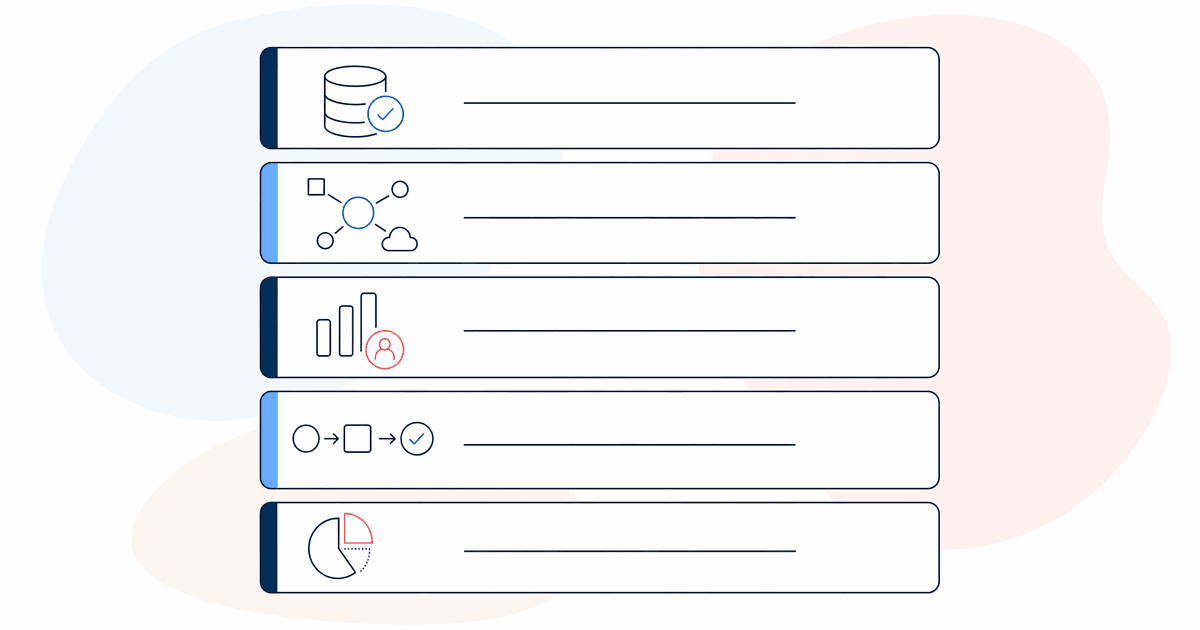
Every AI readiness model has its own axis labels. We've distilled this to the five that correlate with whether an FMCG pilot actually succeeds or stalls:
- Data accessibility — Can you get the data out of your systems in a usable format?
- System connectivity — Do your core systems talk to each other, or is your team the middleware?
- People & bandwidth — Does someone have capacity to own this alongside their actual job?
- Process clarity — Is the workflow you want AI to improve documented clearly enough that you could explain it to a new hire in 30 minutes?
- Budget realism — Can you commit pilot-level spend (£2,000–£5,000/month for 90 days) without needing a board paper?
Self-assessment: 15 questions
Score each question: 1 point if you can honestly answer "yes, today" — 0 points if it's aspirational, partial, or "we're working on it."
Dimension 1: Data accessibility
- Can you export 24 months of SKU-level sales data into a single spreadsheet or CSV within one hour?
- Are your production volumes and batch records in a searchable digital format (not paper logs, not PDFs of scanned paper)?
- Do you have promotional uplift data — even rough — for your last 12 months of promotional activity with major retailers?
What "yes" looks like in practice: Your sales data might live in different systems per retailer (Tesco TRS, Sainsbury's S4S, Asda InfoBay), but you can pull it into one place within an hour. Your production data might be in an ERP or even a well-maintained Google Sheet — it counts as long as it's structured and searchable.
Dimension 2: System connectivity
- Do your ERP/accounting system and your demand planning (even if it's a spreadsheet) share data without someone copying and pasting between them?
- Can you generate a weekly P&L by product or category without manual assembly from multiple sources?
- If a supply chain disruption happened today, could you see the stock impact across all SKUs within the same day?
What "yes" looks like in practice: You don't need an API connecting everything. You need systems that export cleanly and a process that refreshes data at least weekly without someone spending a full day on it. If your reporting is still bottlenecked on spreadsheets, this dimension is probably your weakest.
Dimension 3: People & bandwidth
- Is there one person in your business who could dedicate 2–3 days per week to owning an AI pilot for 90 days?
- Does your leadership team (MD, ops director, or commercial director) have a stated position on AI — even if it's "we need to investigate"?
- Has anyone on your team used AI tools (ChatGPT, Copilot, Claude, or similar) for work tasks in the last 3 months?
What "yes" looks like in practice: The pilot owner doesn't need to be technical. They need to be someone who understands the business process deeply, has authority to make small decisions without escalating everything, and won't get pulled away after week two. Often this is an operations manager or a commercial analyst.
Dimension 4: Process clarity
- Could you draw the demand forecasting workflow (however informal) on a whiteboard in under 10 minutes, including who touches it and what data feeds in?
- Do you know — in hours per week — how much time your team spends on the repetitive task you'd most like to automate?
- If you chose demand forecasting as your AI pilot, could you define "better" in measurable terms (e.g. "reduce forecast error from ±25% to ±15%")?
What "yes" looks like in practice: You don't need documented SOPs for every process. You need enough clarity on the target process that you could explain to an external partner what "good" looks like and how you'd know if AI improved it. If you're not sure which process to target, our guide to picking your first high-value AI use case walks through a three-filter framework.
Dimension 5: Budget realism
- Could you commit £2,000–£5,000 per month for 90 days to an AI pilot without needing full board approval?
- Do you have budget allocated (or allocatable) for external specialist support if needed — even 5–10 days of advisory time?
- Has your business invested in any technology improvement in the last 12 months (new system, integration, tool migration) that wasn't forced by a crisis?
What "yes" looks like in practice: The pilot budget isn't just the AI tool cost — it includes the opportunity cost of your pilot owner's time, any data preparation work, and potentially 5–10 days of external specialist time for setup and validation. If your last three tech investments were all fire-fighting (e.g. "we had to upgrade because the old system died"), you may struggle to protect pilot budget from being reallocated.
What your score means
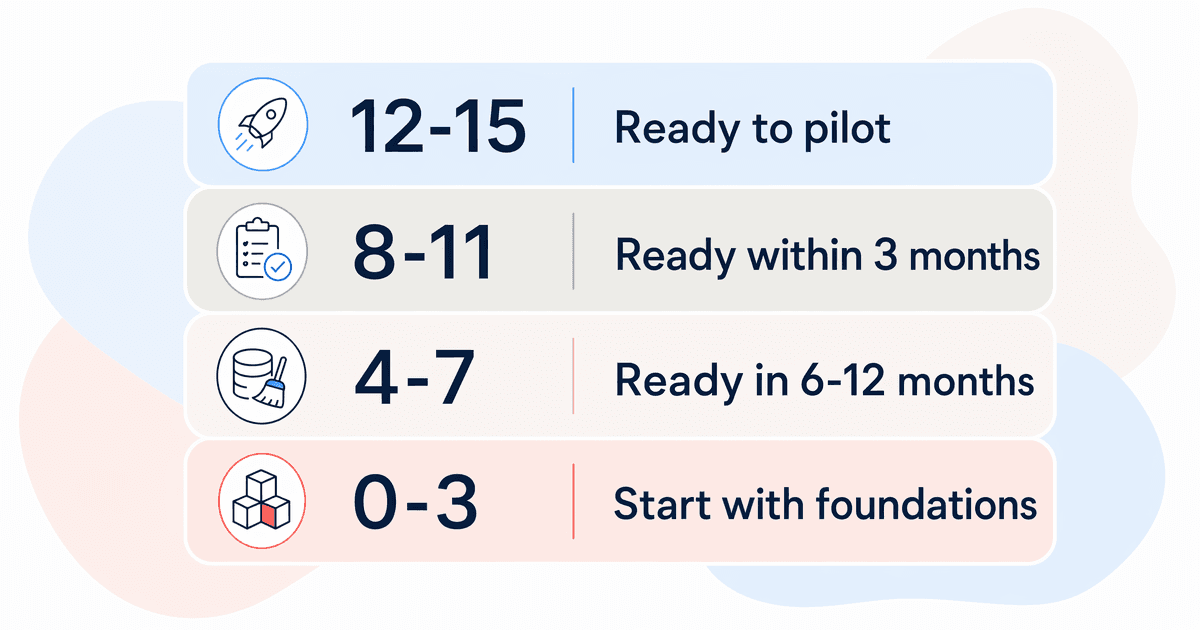
12–15: Ready to pilot. You have the foundations. The risk isn't readiness — it's choosing the wrong first use case or running a pilot without pre-agreed success metrics. Start with demand forecasting (deepest evidence base) and give it 90 days with clear KPIs. See our AI rollout guide for how to structure the first phase.
8–11: Ready within 3 months. You have most of what you need, with one or two gaps to close. Typically, this band means your data is accessible but not connected (Dimensions 1 and 2 mismatch), or you have budget and process clarity but no one with bandwidth to own it. Fix the weakest dimension first — it's usually faster than you think.
4–7: Ready within 6–12 months. You have significant gaps, most likely in data accessibility or system connectivity. The good news: 75% of CPG companies globally are in a similar position (BCG/CGF, June 2026). Your next step isn't "buy AI" — it's a focused data foundation project: consolidate your sales data sources, digitise your production logs, and establish a single reporting layer. That's a precondition, not a delay.
0–3: Start with foundations. AI isn't your next step — data infrastructure is. If production records are on paper, reporting takes days of manual assembly, and no one has bandwidth for anything beyond daily firefighting, the most valuable investment is getting your data house in order. This typically takes 6–12 months of focused work. Start with the highest-value data source (usually sales) and work outward.
The three most common gaps (and what to do about each)
Based on the survey evidence and the patterns we see working with UK food & drink brands, three gaps appear far more frequently than others. In the last dozen readiness conversations we've had, 9 out of 12 scored lowest on Dimension 1 (data accessibility) or Dimension 2 (system connectivity):
Gap 1: Data is there, but it's not accessible
What it looks like: You have 3+ years of sales data — but it's in 4 different retailer portals, 12 spreadsheets, and someone's email. Production data exists digitally, but only the person who set up the spreadsheet understands the column headers.
What it takes to fix: 4–8 weeks of focused data consolidation. Not a data warehouse project, just getting your core datasets (sales, production, inventory) into a single, documented, regularly updated format. This is boring work. It's also the single highest-leverage thing you can do before any AI conversation. We've seen brands complete this in 3 weeks when one person owns it full-time, and we've seen it take 4 months when it's squeezed between other priorities.
Who owns it: Typically a commercial analyst or operations coordinator with support from whoever "knows where the data lives."
Gap 2: Bandwidth exists on paper, nowhere in practice
What it looks like: Leadership agrees AI is worth investigating. In theory, someone could own a pilot. In practice, every capable person is already at 110% capacity running the day-to-day business. The pilot never starts, or starts and stalls after week two.
What it takes to fix: Ring-fence the time explicitly. This means removing something else from the pilot owner's plate for 90 days — not adding AI on top of everything. If you can't free up 2–3 days per week internally, you need external capacity (a specialist or fractional resource) to run the pilot while an internal person provides context and validates outputs.
Who owns it: The MD or ops director — because only they can authorise someone's time being reallocated.
Gap 3: No one can define what "better" means
What it looks like: The team knows forecasting is painful. They know too much time goes into promo reporting. But when asked "how would you measure whether AI improved this?", there's no baseline, no target, and no agreement on what success looks like.
What it takes to fix: 1–2 weeks of baselining. Measure the current state: forecast accuracy (MAPE or wMAPE), time spent on the task per week, error rates, or whatever maps to the process you're targeting. You can't prove ROI without a before-and-after measurement, and this is what BCG identifies as the reason more than half of companies can't prove their AI value.
Who owns it: The person closest to the process — often the one doing the work today.
When you're ready to run a pilot
If you scored 8 or above, or you've closed your primary gap, here's the minimum viable starting point:
- One use case — demand forecasting has the deepest evidence base across every major survey
- One owner — a named person with 2–3 days per week for 90 days
- One baseline — a measurable starting point (current forecast accuracy, current time-to-report, current waste rate)
- One success metric — agreed before the pilot starts, not after
- One budget ceiling — so the pilot doesn't creep into a programme before it's proven anything
That's the structure that separates the 18% who scale AI from the 75% who stay in perpetual pilots. Not more technology. Not a bigger vision. Just a focused test with a named outcome.
For a full picture of how AI fits across your business — beyond the readiness question — see our complete practical guide to AI for FMCG. And for the evidence behind these recommendations, including the specific ROI figures and methodology notes, see what the evidence actually shows.