
Buying licences is the easy part. Most organisations figure this out around week three of their rollout, when the platform is live, IT has provisioned seats, and usage is sitting somewhere between "a handful of enthusiasts" and "people quietly reverting to what they already knew."
The problem isn't the technology. It's everything that was supposed to happen before and after the technology arrived: the policy nobody wrote, the workflows nobody mapped, the data boundaries nobody explained. The result is either chaos (people using the tool however they see fit, often with company data) or stagnation (people ignoring a platform they were told would change everything).
You don't need heroic effort to avoid both outcomes. You need more process discipline than most technology teams plan for, and less of the launch-day fanfare that rarely moves the needle.
The Bottom Line - 83% of AI pilots stall due to change management gaps, not technology failures (QueryNow, 2026) - 70% of IT leaders have already identified unauthorised AI use in their organisations (ManageEngine, 2025) - Phased rollouts achieve 78% adoption vs 65% for big-bang launches (Fluidlabs, 2025) - 95% of GenAI pilot programmes fail to produce measurable financial impact: the gap is workflow integration, not model quality (MIT NANDA Initiative, 2025)
Why Do Most AI Platform Rollouts Fail Before They Start?
Most rollouts fail before the first workflow goes live. A 2025 MIT NANDA study found that 95% of generative AI pilot programmes fail to produce measurable financial impact, with failures stemming not from model quality but from poor workflow integration and misaligned incentives (MIT Enterprise AI Playbook, 2025). The technology is, in the researchers' words, "consistently the easiest part." Change management, data quality and reporting readiness, and process redesign account for 77% of the challenges practitioners actually face.
For FMCG brands, this plays out in a recognisable pattern. The board sees a competitor using AI. The MD asks IT to "get us on Copilot." Licences are purchased. A brief demo is delivered. Three months later, usage is patchy, nobody can point to a workflow that's actually improved, and the sceptics feel vindicated.
What went wrong isn't mysterious. The rollout skipped four prerequisites that separate deployments that stick from deployments that stall:
- A named owner with protected time (not a shared responsibility between IT and "the business")
- A data classification policy that tells people what can and can't go into AI tools
- A pilot workflow that's specific, measurable, and boring enough to survive scope creep
- A plan for people who are already using shadow AI (and they exist in your organisation right now)
Our observation: The organisations that struggle most with AI rollouts aren't the ones that move too slowly. They're the ones that move at the right pace technically but treat the people side as a communication exercise rather than a process change. Sending an all-staff email about a new AI policy isn't the same as making the AI tool easier to use correctly than incorrectly.
Staff functions (Legal, HR, Risk, and Compliance) are the most frequent source of project slowdowns at 35%, not end users (MIT Enterprise AI Playbook, 2025). Getting those functions involved early isn't bureaucracy. It's risk reduction. A deployment that Legal stops in month two costs more than a governance conversation in week one.
What's Shadow AI, and Why Is It Already Your Problem?
Shadow AI is more widespread than most leadership teams believe. A 2025 ManageEngine study of 700 IT decision-makers found that 70% had already identified unauthorised AI use in their organisations, while 78% of employees reported coworkers using unapproved tools (ManageEngine, 2025). Shadow AI means employees using unapproved tools: typically consumer versions of ChatGPT, Claude, or Gemini. In most cases, both the employees and their managers considered this unremarkable.
The risk isn't theoretical. A 2025 IBM-sponsored study found that while 80% of American office workers use AI in their roles, only 22% rely exclusively on employer-provided tools (IBM, 2025). Among employees using unsanctioned tools, 75% had shared sensitive information with platforms their company hadn't reviewed.
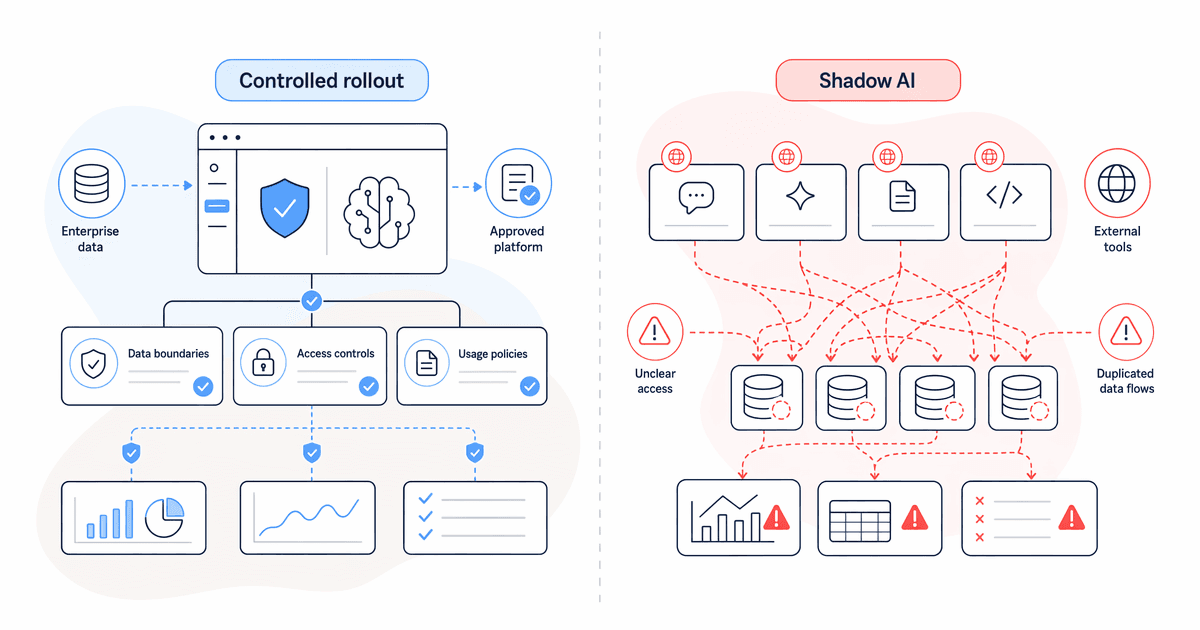
For an FMCG brand, the specific risk profile looks like this. A commercial manager pastes supplier pricing data into a consumer ChatGPT account to draft a range review presentation. A brand manager uploads an NPD brief to summarise it quickly. A finance analyst shares an unlaunched promotional P&L to generate commentary. None of these feel dangerous in the moment. None appear on any security audit until something goes wrong.
Shadow AI thrives when the official option is slower, more restricted, or less capable than the personal alternative. Your rollout needs to make the approved toolset the path of least resistance, not just the compliant one. (For context on how AI tools differ from the process automation you may already use, see our guide on AI vs automation in FMCG.)
According to a 2025 Cybernews survey of over 1,000 employees, 59% already use shadow AI at work. Critically, 52% said their employer provides approved AI tools, but only 33% said those tools fully meet their needs (Journal of Accountancy / Cybernews, 2025). That gap between "we have a tool" and "the tool works for what I actually do" is where shadow AI proliferates. Closing it is a process design problem, not a security policy problem.
How Do You Choose Which AI Platform to Roll Out First?
Start with the workflows you want to improve, not the platform features you find most impressive. In 2026, enterprise AI usage is concentrated across four main platforms: ChatGPT (36% of users, driving 55% of AI conversations), Copilot M365 (29%), Gemini (13%), and Claude (12%), according to LayerX Security analysis of 443 million employee work hours (LayerX Security, 2026). The right platform for your organisation depends less on market share and more on three practical factors.
Integration with existing tools. If your team lives in Microsoft 365, Copilot M365 has real advantages: it works inside Teams, Outlook, Word, and Excel without context-switching. If your workflows centre on Google Workspace, Gemini has equivalent benefits. ChatGPT and Claude work best as standalone tools for drafting, analysis, and research tasks where the output gets pasted elsewhere.
Data access requirements. A platform that can securely connect to your internal data (product specs, promotional calendars, supplier terms) delivers more workflow value than one that can only work with information pasted manually into a chat window. This is a capability and security question simultaneously. Resolve it before you purchase, not after.
What your team is already using. Recon Analytics data from early 2026 found that when employees are given only Copilot at work, 68% adopt it as their primary tool. When ChatGPT is also available, Copilot adoption drops to 18% (Recon Analytics, 2026). If your team is already habitually using ChatGPT personally, a Copilot-only mandate creates friction without solving the underlying usage pattern. The platform that feels most capable to your team will get used. The one that doesn't will get worked around.
Our observation: The platform selection conversation at most businesses fixates on licence cost and vendor relationships when the more useful question is: which workflows do we want to improve in the first 90 days, and which platform is best suited to those specific tasks? Start with the workflows. The platform choice follows from that.
Pick one platform for your first deployment. Build your prompt library and governance around it, and resist the temptation to run a multi-platform trial simultaneously. The average organisation in 2026 uses seven AI tools (ActivTrak, 2026). Consolidating to one sanctioned tool at the start prevents that sprawl from arriving before you've built the habits that make any single tool useful.
What Does a Phased Rollout Actually Look Like?
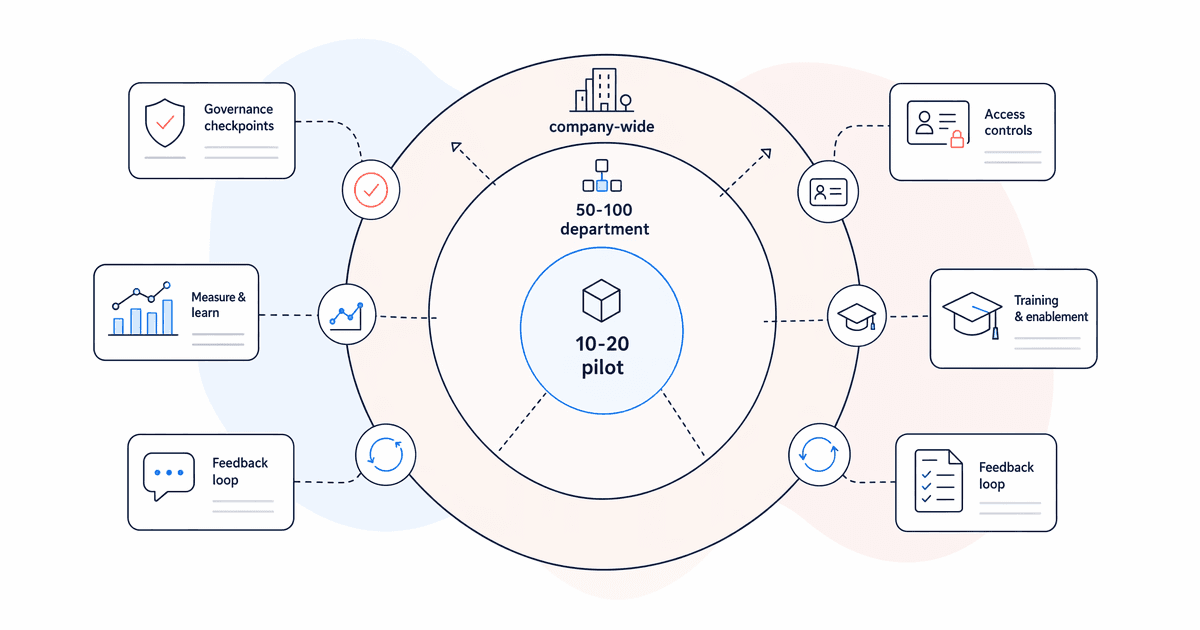
Phased deployments achieve 78% adoption rates compared to 65% for big-bang launches, and 69% completion rates compared to 54%, according to 2025 data analysed by Fluidlabs (Fluidlabs, 2025). The difference isn't magic. Phased rollouts build evidence before asking the whole organisation to change behaviour. Big-bang launches ask everyone to change at once, before anyone's built confidence in the tool.
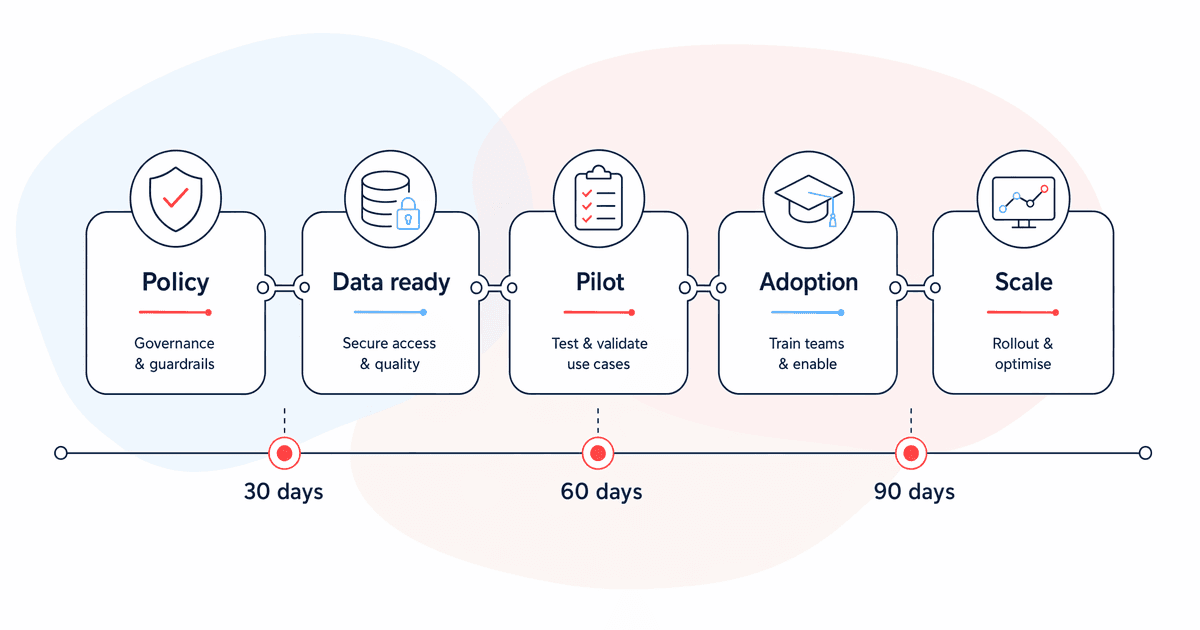
A workable 90-day structure for a business of 50 to 500 people:
Days 1 to 30: Foundations
- Appoint one named AI lead with at least eight hours per week protected for this work
- Conduct a shadow AI audit: find out what tools are already in use, by whom, and for what tasks
- Write a one-page data classification policy: what categories of information can go into AI tools, what can't
- Select your first three candidate workflows (high-frequency, low-exception, measurable output)
- Provision licences for the pilot group only (typically 10 to 20 people across two or three teams)
Days 31 to 60: First Workflow in Production
- Deploy the highest-priority workflow with the pilot group
- Record a baseline before deployment (time taken, error rate, output quality)
- Run weekly check-ins: what's working, what's producing poor outputs, where does the tool get overridden
- Build the first internal prompt guide: the specific prompts that work for this workflow
- Keep IT and Legal informed of what data is flowing through the platform
Days 61 to 90: Expand and Document
- Ship the second workflow
- Hold an all-hands session where the pilot team demonstrates what they built (peer demonstration works better than top-down training)
- Publish a one-page acceptable use policy written in plain language
- Record the 90-day impact: time saved, cycle time changes, quality improvements
- Select the next wave of workflows and teams
This structure mirrors what the FMCG companies that have scaled AI successfully actually did. Nestlé introduced NesGPT to North American offices in a phased rollout starting with a global pilot, and a year later reported employees saving an average of 45 minutes per week. The reported wins were accelerated content creation and less time searching for information (WorkLife / Nestlé, 2024). The implementation worked not because the tool was exceptional but because the use cases were specific and training was continuous rather than one-off. For a brand operating at a fraction of Nestlé's scale, that's the more important lesson: pick a specific task and prove it before you expand.
Reckitt's AI-enabled revenue growth management platform, RGMx, followed the same pattern on a larger scale. They started with data quality and governance, rolled out to major markets first, then extended to markets with less mature data capabilities using a simplified version (AI to ROI / Reckitt case study, 2026). The reported result was over $100 million in revenue gains across 35 markets. What's replicable for your operation isn't the scale: it's the sequencing. Get the data clean first. Embed the tool into existing workflows. Don't run it alongside them.
What Governance Does Your Business Actually Need?
The minimum viable governance stack is four things, none of which require a dedicated compliance team. A 2026 Netrio survey of 401 IT leaders found that 82% already have AI in production somewhere in their organisation, yet only 26% have AI that's scaled and governed consistently (Netrio, 2026). Governance sounds like a large-company problem. For a business of 50 to 500 people rolling out its first AI platform, it isn't. (This is the framework we use at BazBiff when working through rollouts with clients.)
A data classification policy (one page). Three tiers is enough: information that's fine to use freely in AI tools (public-facing content, generic market data), information that needs care (internal documents without sensitive data), and information that's off-limits (PII, supplier commercial terms, unpublished financials, anything under NDAs). The point isn't to create barriers. It's to make the default choice clear so people don't have to make judgement calls in the moment.
An acceptable use policy (one page, plain language). What the tool is sanctioned for, what it's not, who to contact with questions, and what happens if someone makes a mistake. Tone matters here: a policy that reads like a legal threat discourages people from reporting mistakes. The goal is to make people feel safe raising issues rather than hiding them.
A named AI lead. Not a committee. One person, accountable, with enough time to do the job. In the first 90 days, their role is workflow mapping, not IT administration. They're the person who knows which prompts work for promo commentary, which outputs from range review tasks need human review, and where the toolchain is being used in ways that weren't planned.
A usage audit cadence. Monthly, at minimum. Who's using the toolset, for what, how often? At this stage the question isn't whether usage is high. It's whether usage is happening in the sanctioned workflows rather than elsewhere, and whether any data classification issues are emerging.
The RSM Middle Market AI Survey 2025 found that 41% of businesses that had AI implementation issues cited data quality as the top problem (RSM, 2025). That's a governance problem upstream of the technology, and it's why a data readiness check before deployment is more valuable than most teams expect. You don't need perfect data to start, but you do need to know which data is clean enough to use. Our guide on turning a manual process into an automated workflow covers the data mapping step in detail.
How Do You Get Employees to Actually Use the Platform?
People are already using AI. The challenge isn't sparking adoption from scratch: it's redirecting existing behaviour toward the version your organisation actually controls. A 2026 Founder Reports survey of 2,078 workers found that 89% have used AI for work, with 38% using it daily, yet 44% say their employer has no clear AI policy or they're unsure one exists (Founder Reports, 2026).
Employee adoption of an official platform stalls for a specific reason: the sanctioned tool asks people to change how they work before it's shown the change is worth making. The fix isn't more training. It's earlier evidence.
Practical adoption levers that work:
Peer demonstration over top-down training. P&G provided a mandatory 10-minute training session followed by an acceptable use policy sign-off for their chatPG rollout (CIO Dive, 2023). That's a floor, not a ceiling. The more effective layer is internal case studies: teams showing other teams what they built and what it saved. Managers at companies requiring AI use report fixing AI-reliant output 57% of the time (Founder Reports, 2026), which tells you that quality guardrails matter as much as raw adoption rate. For most FMCG brands, one well-documented win on promo commentary or demand planning reporting is worth ten all-staff emails.
Embedded prompts, not blank canvases. A blank chat window requires people to know what to ask. A workflow with pre-built prompts for specific tasks (drafting a range review summary, writing a supplier briefing, creating promo performance commentary) requires only filling in the variables. Colgate's AI Hub gave teams a governed environment to build assistants tailored to specific tasks, scaling this principle across the organisation (PYMNTS / Colgate, 2025). You don't need an AI Hub to apply the same logic: a shared document with five tested prompts for your most frequent tasks gets you most of the way there.
Office hours, not one-off training. The AI lead should be available weekly for questions. IBM's research found that 60% of employees say hands-on learning would increase their AI usage (IBM, 2025). Hands-on learning requires someone available to answer questions in context, not a webinar recording from launch day that nobody re-watches.
A shared prompt library. Staff contribute prompts that work, organised by task (promo reporting, NPD brief drafting, demand forecast commentary, supplier briefing writing). This builds institutional knowledge around the tool rather than letting it sit with a handful of enthusiasts who eventually leave or move roles.
Our observation: The fastest adoption we see happens when the first demonstrated workflow saves a recognisable, specific amount of time on a task everyone finds tedious. Rollouts that struggle are the ones where the first use case is aspirational rather than operational: "let's use AI for strategy" rather than "let's cut the time spent on weekly promo commentary from three hours to 45 minutes."
What Are the Most Common Rollout Mistakes?
Only 26% of businesses have AI that's scaled and governed consistently, despite 82% already having AI in production somewhere (Netrio, 2026). The gap between "we're using it" and "it's working across the organisation" maps onto a set of mistakes that repeat across industries. They're consistent enough to plan around.
Treating AI as a technology project rather than a process change. The MIT Enterprise AI Playbook found that 61% of successful AI projects included at least one prior failure, and those failures shared a pattern: teams applied AI to broken workflows rather than redesigning the work first (MIT NANDA Initiative, 2025). AI doesn't fix a broken process. It automates the breakage faster.
Buying licences before mapping workflows. A 2026 iEnable analysis put it plainly: buying Copilot licences for 500 employees is a procurement decision, not an AI strategy (iEnable, 2026). Strategy means answering how those people will learn to use AI effectively, who manages the tools after deployment, and how you measure whether AI is actually improving outcomes. Licences expire if nobody uses them, and unused licences become the evidence sceptics cite in the next budget cycle.
Skipping the data readiness check. 41% of businesses that hit AI implementation problems cite data quality as the top barrier (RSM, 2025). If the data your team would use in an AI workflow (promotional sell-out data, demand forecast inputs, product master data) is messy, incomplete, or inconsistently formatted, the AI outputs will be too. Fixing obvious data problems before automating a workflow costs less than discovering them after.
Running a multi-team big-bang launch. Company-wide rollouts on day one compress the feedback loop to the point where nobody can diagnose what's going wrong. Phased rollouts let problems surface at a scale where they're fixable.
Ignoring the staff functions. Legal, HR, Risk, and Compliance aren't obstacles. They're stakeholders with legitimate concerns about liability, data protection, and process risk. Getting them involved in week one, rather than finding out they've blocked your rollout in month two, is basic risk management.
For more on how to identify and map the workflows worth automating, our guide on turning a manual process into an automated workflow covers the same principles. The difference is that AI platforms expand the range of tasks worth targeting: not just structured data tasks, but drafting, summarising, and commentary work that process automation alone can't touch.
Frequently Asked Questions
Why do most AI platform rollouts fail?
83% of AI pilots stall not because the technology fails but because change management is ignored, according to a 2026 QueryNow analysis (QueryNow, 2026). The three most common failure points are poor workflow integration, missing data governance, and staff functions (Legal, HR, Compliance) blocking deployment rather than end-user resistance (MIT Enterprise AI Playbook, 2025).
What is shadow AI and why does it matter for my rollout?
Shadow AI refers to employees using unapproved AI tools: ChatGPT personal accounts, consumer Gemini, and similar platforms without IT authorisation. A 2025 ManageEngine study of 700 IT leaders found 70% had already identified unauthorised AI use in their organisations (ManageEngine, 2025). Shadow AI creates data leakage risk and means your official rollout is competing with tools your staff are already comfortable with.
How long does an AI platform rollout take?
A well-structured phased rollout typically runs 90 days from policy to first production workflow to cross-team expansion. The variance is almost entirely organisational rather than technical: similar use cases take weeks at one company and years at another, depending on executive sponsorship and existing data readiness (MIT Enterprise AI Playbook, 2026).
Should we pick one AI platform or allow multiple?
Start with one approved platform for your first 90-day rollout. Standardising on a single tool builds a coherent prompt library, simplifies governance, and makes training reusable. Once adoption is proven, you can extend to a second platform for specific use cases. LayerX data from 2026 shows the average organisation already uses seven AI tools (LayerX Security, 2026) — consolidation at the start prevents that sprawl.
What data should not go into an AI platform?
Customer PII, supplier commercial terms, unpublished financial data, and anything covered by NDAs should be treated as off-limits for consumer-grade or unreviewed AI platforms until your data classification policy is in place. A 2025 Cybernews survey found 75% of employees using shadow AI had shared sensitive information with unapproved tools, most without realising the risk (Journal of Accountancy / Cybernews, 2025).
Rolling Out AI Well Is a Process Problem, Not a Technology Problem
Phased rollouts achieve 78% adoption versus 65% for big-bang launches, a gap driven almost entirely by how the deployment was planned, not by which platform was chosen (Fluidlabs, 2025). The organisations getting measurable returns from AI platforms started with workflows, not licences. They picked boring, specific, high-frequency tasks: weekly promo commentary, demand forecast write-ups, supplier briefing drafts. They ran phased rollouts with small pilot groups. They built governance early, not to slow things down, but to make the correct behaviour easier than the incorrect one. Adoption was an ongoing operational discipline, not a launch event.
The technology is genuinely good. The AI platforms available in 2026 can draft, summarise, analyse, and generate at a level that creates real time savings on real tasks. What they can't do is design their own integration into your workflows, write their own acceptable use policy, or persuade your team that the output is trustworthy before you've given them any reason to trust it.
The gap between a chaotic rollout and a clean one isn't technical capability. It's the work that happens in the 30 days before you provision the first seat and the 60 days after it. That's where the difference gets made.
If you're planning a rollout and want to work through the workflow mapping, data classification, or governance questions before you start, get in touch with the BazBiff team. We work through these questions with FMCG brands regularly, and the diagnostic conversation is usually more useful than it looks on paper.
You can also browse our other posts on AI and automation if you're still working out where AI fits relative to process automation in your business: the distinction matters more than most platform vendors will tell you.
*Sources for this article include peer-reviewed and institutional research (MIT NANDA Initiative 2025, Stanford Digital Economy Lab 2026), industry surveys with disclosed methodology (ManageEngine n=700, Netrio n=401, Founder Reports n=2,078, LayerX Security 443M+ hours, RSM middle market survey, IBM/Censuswide n=1,000, Fluidlabs 2025 deployment analysis), and practitioner case studies (Nestlé NesGPT, Reckitt RGMx, Colgate AI Hub, P&G chatPG). All statistics are cited inline with source, year, and link where available.*