
The Bottom Line
- 6 departments assessed: operations, supply chain, commercial, finance, marketing, quality - Start with demand planning: deepest evidence, lowest data barrier, fastest payback (up to 50% forecast error reduction per McKinsey) - Cost range: from £2,000/month (finance automation) to £30,000+ (production line predictive maintenance) - Each section includes "skip this if" honesty about where AI won't help yet
AI works differently in each department of an FMCG business, and in some, it doesn't work well yet at all. This guide covers six departments with one clear use case each, scaled for a UK food & drink brand (not P&G). For each: what AI does, what data you need to start, realistic cost range, and an honest "skip this if" callout.
Operations & production
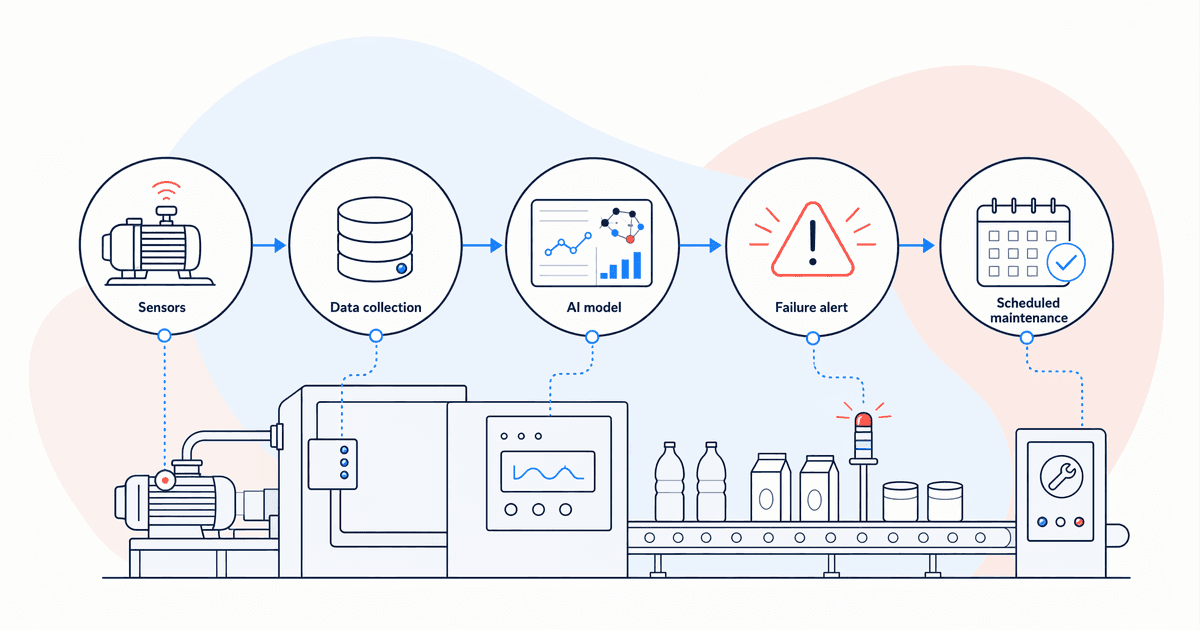
What AI does here: Predictive maintenance and production scheduling. AI models trained on equipment sensor data (vibration, temperature, acoustic patterns) predict failures before they cause unplanned downtime. Production scheduling AI optimises batch sequencing to minimise changeover time and waste.
What it requires:
- Digital production logs (not paper) covering 12+ months
- Sensor data from critical equipment (even basic PLC outputs count)
- Maintenance records in searchable format
Realistic cost range: £10,000–£30,000 for a 90-day pilot on one production line. Sensor retrofitting adds £5,000–£15,000 if your equipment isn't already connected.
Measured outcomes: Schneider Electric's 2026 survey (n=1,453 CPG executives) reports 15.2% of manufacturing revenue is currently lost to delays, downtime, rework, and quality deviations. Predictive maintenance typically recovers 10–25% of that loss in targeted areas.
Skip this if: Your production records are still on paper clipboards, your equipment predates PLCs, or your biggest production bottleneck is actually labour scheduling rather than machine failure. Fix the data foundation first — this use case needs digital inputs to function.
For a deeper look at how AI fits within ops teams specifically, see our full breakdown of AI for FMCG operations teams.
Supply chain & demand planning
What AI does here: Demand forecasting using historical sales data, promotional calendars, seasonality patterns, and external signals (weather, events, economic indicators). Also: automated replenishment triggers, stockout risk alerts, and promotional uplift prediction.
What it requires:
- 12–24 months of SKU-level sales data (from retailer portals, ERP, or consolidated spreadsheets)
- Promotional calendar with uplift history
- Basic inventory position data
Realistic cost range: £5,000–£20,000 for a 90-day demand forecasting pilot. Some AI-as-a-service tools for forecasting start around £500/month, but you'll need data preparation time (typically 2–4 weeks) before the model can train.
Measured outcomes: McKinsey (2024): AI reduces demand forecasting errors by up to 50%. Mondelez/Databricks (June 2026): 3–5% improvement in forecast accuracy, 2–3% reduction in finished goods inventory waste from 3,000 production models. For a brand carrying £2m–£10m in inventory, even a 2–3% reduction in waste is £40,000–£300,000 annually.
Skip this if: You sell fewer than 50 SKUs through fewer than 3 channels with minimal seasonal variation. Simple products with predictable demand don't generate enough complexity for AI to outperform a well-maintained spreadsheet model. You're paying for AI's ability to handle complexity. If you don't have complexity, you don't need it.
This is the strongest starting point. BCG (June 2026) identifies demand forecasting as one of three areas where AI frontrunners concentrate effort. It has the deepest evidence base, the most accessible data requirements, and the clearest measurement framework. In our experience, brands with 100+ SKUs across 3+ retailers see the clearest gains here because that's where manual forecasting genuinely can't keep up.
Commercial & trade (sales, promotions, pricing)
What AI does here: Trade promotion effectiveness analysis (which promotions actually generated incremental volume vs. cannibalised your own sales), dynamic pricing recommendations, and SKU-level sales opportunity identification per store or region.
What it requires:
- Retailer POS data (ideally weekly, by store or at least by region)
- Full promotional calendar with mechanic details (% off, multibuys, gondola end, etc.)
- Baseline sales data for non-promoted periods
- Price architecture across your range
Realistic cost range: £15,000–£40,000 for a trade promotion analysis project. This is typically a one-off analytical exercise before becoming an ongoing capability. Revenue growth management (RGM) AI tools from specialist vendors range £3,000–£10,000/month but require significant data onboarding.
Measured outcomes: Mondelez uses AI to simulate every price change before execution — modelling brand switching, pack-size shifts, and volume impact. At the mid-market level, trade promotion analysis typically reveals that 30–50% of promotional spend generates zero incremental volume. Recovering even a fraction of wasted promo spend delivers strong ROI.
Skip this if: You have fewer than 3 major retailer accounts, your promotional mechanics are simple (price-only, no complex multibuy), or you don't have historical POS data at sufficient granularity. This use case requires a meaningful volume of promotional activity to analyse. If your reporting is still bottlenecked on spreadsheet assembly, fix that before attempting promo analysis.
Finance & reporting
What AI does here: Automated report generation from multiple data sources, anomaly detection in financial data (catching errors before month-end close), cash flow forecasting, and invoice/PO matching for reconciliation.
What it requires:
- Accounting data in a structured system (Sage, Xero, NetSuite, SAP)
- Recurring reporting templates that currently require manual assembly
- At least 12 months of transaction history
Realistic cost range: £2,000–£8,000 for report automation projects using AI-powered tools (many existing tools like Power BI, Excel Copilot, or bespoke automations). Anomaly detection in financial data: £5,000–£15,000 for implementation with ongoing costs under £1,000/month.
Measured outcomes: UnifyApps (May 2026) reports AI-driven bank reconciliation delivers up to 75% faster reconciliation and up to 40% faster close cycles. For a brand where monthly reporting currently takes a finance team 3–5 days of manual assembly, AI can reduce this to hours — freeing capacity for analysis rather than assembly.
Skip this if: Your finance team is two people and your biggest pain point is cash flow, not reporting speed. AI helps most when there's volume and repetition — if you're closing 50 invoices a month, the automation ROI is marginal. If you're closing 500+, it's significant.
Marketing & consumer insight
What AI does here: Content generation (packaging copy, social media, product descriptions across markets), consumer sentiment analysis from reviews and social listening, and campaign performance prediction.
What it requires:
- Historical campaign performance data
- Consumer review data or social mentions
- Brand guidelines in a format AI can reference
- Clear approval workflows (AI generates, humans approve)
Realistic cost range: £1,000–£5,000/month for AI content tools. Sentiment analysis projects: £5,000–£15,000 for setup with ongoing costs dependent on volume. Many marketing teams are already using ChatGPT or Claude informally — the cost here is formalising it with governance, not introducing it.
Measured outcomes: Independent measurement is weaker here than in supply chain. The commonly cited "60–80% cost reduction in content production" (ASquare Solutions, Feb 2026) comes from vendor case studies, not independent surveys. Deloitte (Jan 2026) names marketing and product innovation as the "most promising" areas but provides no measured ROI figures. BCG notes that only 11% of CPGs have scaled AI in "idea to market" despite 49% considering it strategically important.
Skip this if: You're a B2B-heavy brand where marketing means trade shows and buyer presentations, not consumer-facing campaigns. Also skip if you have no governance framework for AI-generated content. The risk of publishing incorrect claims or non-compliant copy is real in food & drink, where health claims and allergen statements are regulated. For customer-facing automation (triage, retailer comms), see our customer service automation guide instead.
Quality & compliance
What AI does here: Automated compliance checking (ingredient declarations, allergen labelling, health claims against EFSA-approved wording), HACCP log monitoring and exception alerting, and traceability search acceleration for recalls.
What it requires:
- Digital compliance records (HACCP logs, batch records, supplier certificates)
- A clear regulatory framework to check against (EU/UK retained food law, EFSA claims register)
- Structured product data (ingredients, allergens, nutritional values per SKU)
Realistic cost range: £10,000–£25,000 for compliance automation setup. Traceability acceleration: £5,000–£15,000 depending on current system maturity. Some specialist tools (e.g. for label compliance checking) available at £500–£2,000/month.
Measured outcomes: Veeva (Jan 2026): 64% of CPG companies still use a mix of digital and manual processes for quality and compliance. The case for AI here is less about ROI and more about risk reduction — a faster recall trace (under 15 minutes vs. hours/days) and automated compliance checking reduce regulatory exposure. L.E.K. Consulting (April 2026): 45% of brand owners have implemented smart, connected packaging, expected to reach 88% by 2028.
Skip this if: Your compliance records are already fully digital and your team handles compliance checks in under an hour. AI adds most value when there's volume (hundreds of SKUs, multiple markets with different regulations) or when manual checking is error-prone due to complexity. A 20-SKU brand with UK-only distribution may not need this yet.
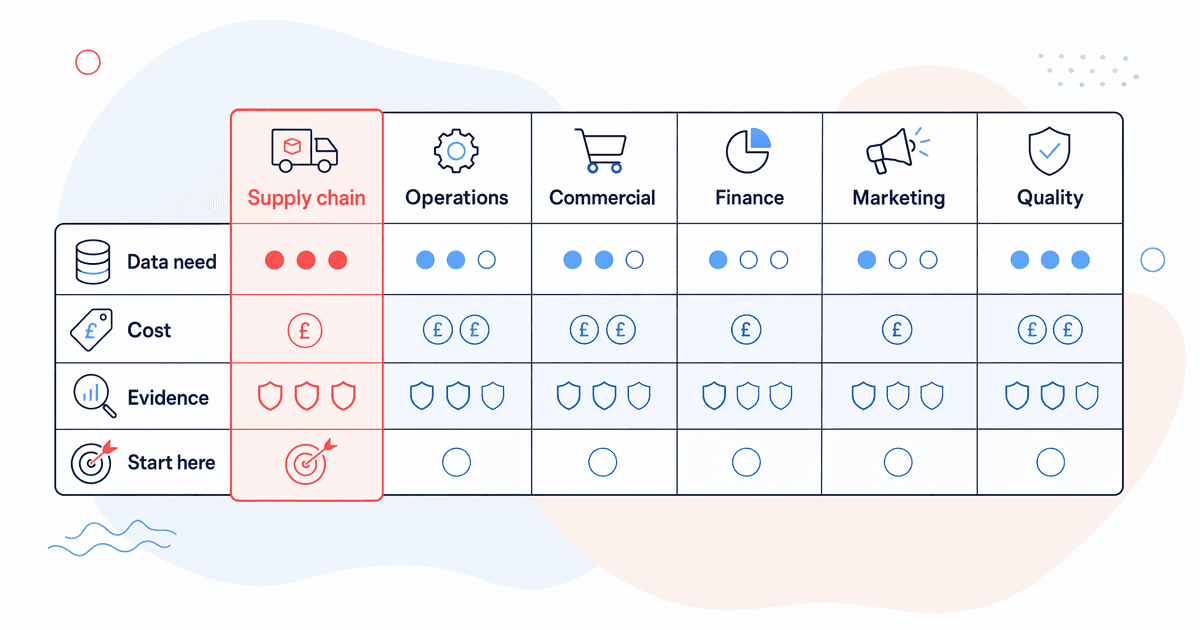
| Department | Evidence strength | Data requirement | Cost to pilot | Best for |
| Supply chain & demand planning | Strong | Medium (12–24mo sales data) | £5,000–£20,000 | Most brands. Start here. |
| Operations & production | Good | High (sensors + digital logs) | £10,000–£30,000 | Brands with connected equipment |
| Commercial & trade | Good | High (weekly POS + promo history) | £15,000–£40,000 | Brands with heavy promo activity |
| Finance & reporting | Moderate | Low (structured accounting) | £2,000–£8,000 | Quick wins, low risk |
| Marketing | Weak | Medium (campaign + consumer data) | £1,000–£5,000/mo | Brands with governance in place |
| Quality & compliance | Low | Medium (digital HACCP + batch records) | £10,000–£25,000 | Multi-market brands |
How to pick your first department
If the question is "where do we start?", the evidence answers it consistently:
Start with supply chain / demand planning if:
- You have 12+ months of SKU-level sales data in any structured format
- Forecasting is currently manual or spreadsheet-based
- You experience either stockouts or overstock regularly
- You want the shortest path to measurable, defensible ROI
Start with operations / production if:
- Your equipment already has sensor connectivity
- Unplanned downtime is costing you measurably (track it for 4 weeks if you don't know)
- You have digital production records
Start with finance / reporting if:
- Monthly reporting takes 3+ days of manual assembly
- You want a quick win with low risk and visible time savings
- Your team is already comfortable with AI tools (Copilot, ChatGPT)
The decision framework we've written about in choosing your first high-value AI use case applies here: filter by data availability, measurability, and business impact. Pick one department, one use case, one 90-day pilot.
For the full picture of how these departmental use cases fit into a broader AI strategy — including the evidence behind each one — see our complete practical guide to AI for FMCG.