
Most FMCG operations teams aren't short of data. They're short of time to do anything useful with it. Planners spend hours reconciling spreadsheets. Maintenance managers react to breakdowns rather than preventing them. Quality checks rely on sampling rates that guarantee some defects get through.
AI doesn't fix any of that by magic. Applied correctly, across the right workflows, it does something more valuable: it shifts your team's effort from data handling to decision-making. That's what they were hired for.
This guide covers the five areas where AI delivers the clearest operational returns for FMCG teams, what the evidence actually shows, and what needs to be in place before any of it works.
*Last updated: June 2026*
The Bottom Line - FMCG manufacturers lose 15.2% of mean manufacturing revenue to delays, downtime, rework, and quality deviations (Schneider Electric, 2026) - AI demand sensing cuts forecast error (MAPE) from 25–40% down to 8–15%, directly reducing both overstock and out-of-stocks (AppWrk, 2026) - Predictive maintenance reduces unplanned downtime by 20–25% and cuts operational costs by 10–18% annually (Worldmetrics, 2026) - Only 13% of CPG manufacturers have AI embedded across core operations today, which means the opportunity gap is still very wide (Schneider Electric, 2026)
What Is the Real Cost of Operational Inefficiency in FMCG?
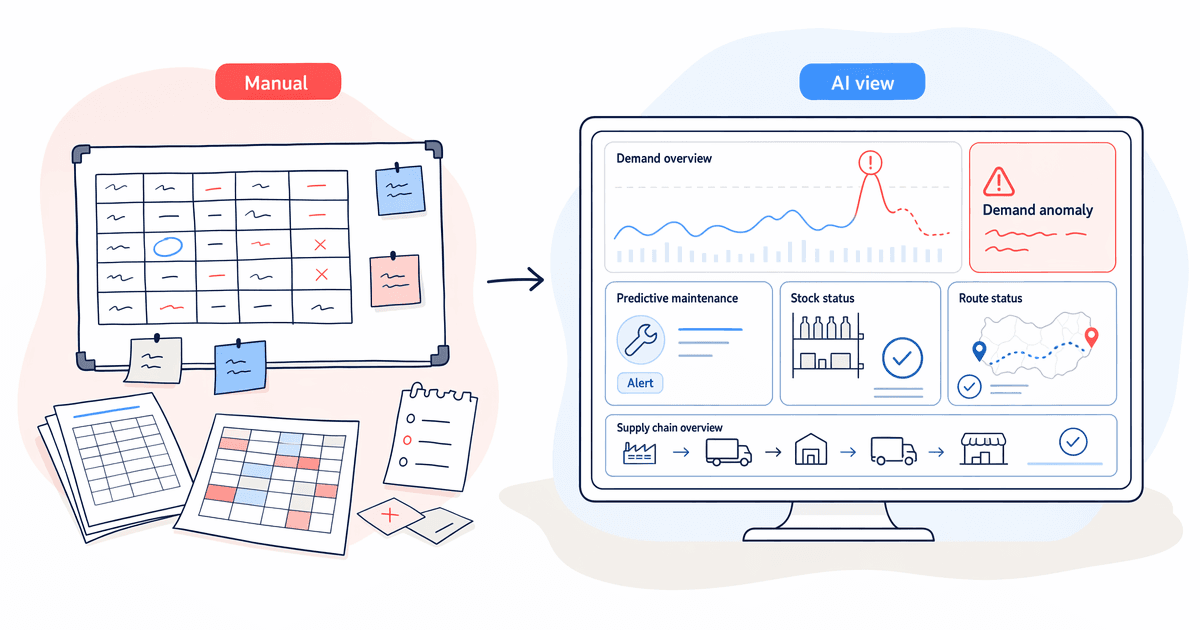
The starting point matters, so let's be specific. A 2026 Schneider Electric survey of CPG manufacturers found that inefficiencies — manufacturing delays, unplanned downtime, equipment failure, quality deviations, and suboptimal asset use — account for 15.2% of mean manufacturing revenue. That's not margin erosion at the edges. For a brand doing £50m in revenue, it's £7.6m a year leaving through holes in operational performance.
The same survey found that only one in eight CPG manufacturers (13%) has AI embedded across core operations and decision-making. By 2030, that figure is expected to triple to 37%. The gap between where most FMCG operations teams are today and where the industry is heading represents both a competitive risk and a real recovery opportunity.
The barriers aren't primarily technological. Skills gaps in AI or data science (43%), legacy systems (38%), and a lack of contextualised operational data (36%) are the three most commonly cited obstacles. These are solvable, but they require deliberate sequencing — not just a technology purchase.
Our observation: The brands that get the most from AI aren't those that deploy the most sophisticated models. They're the ones that invested in clean, connected data first. P&G's supply chain work (which now runs 80% of planning touchlessly) was built on a unified data lakehouse that eliminated app-centric silos before any AI was layered on top. Without that foundation, the models have nothing reliable to learn from.
How Does AI Improve Demand Forecasting for FMCG Teams?
AI demand sensing cuts forecast error dramatically. Traditional demand forecasting processes historical sales in weekly or monthly batches, using a limited set of variables. AI demand sensing replaces this with real-time, multi-signal models that ingest point-of-sale data, promotional calendars, weather patterns, social media velocity, and macroeconomic indicators simultaneously, outputting SKU-level forecasts updated daily or hourly.
The accuracy improvement is substantial. McKinsey research indicates AI-enabled supply chains reduce forecasting errors by up to 50% in some consumer goods categories. Applied measurement puts forecast MAPE at 25–40% for traditional methods versus 8–15% for AI demand sensing (AppWrk, 2026).
That accuracy gap has a direct financial translation. Lower MAPE means less safety stock required, reducing working capital tied up in inventory. It means fewer out-of-stocks, recovering lost sales. It means fewer end-of-life write-offs, recovering margin. Conservative estimates put the combined value of a 15-point MAPE improvement at 3–5% of net revenue — a figure that typically exceeds the total cost of implementation within the first operational year.
The demand forecasting use case also has the strongest adoption signal. ABI Research's 2025 supply chain survey found that 91% of supply chain leaders plan to use AI or generative AI for demand forecasting over the next two years, making it the most widely planned AI application across the industry alongside decision support.
What we see in practice: The demand forecasting use case tends to surface a secondary problem quickly. If your data lives across an ERP, several retailer portals, and a handful of broker spreadsheets, even the best forecasting model will produce unreliable outputs. The AI doesn't hide bad data; it amplifies the inconsistencies, making the data quality problem visible in a way that manual processes often obscure. That's uncomfortable, but it's useful.
Can AI Reduce Production Downtime and Maintenance Costs?
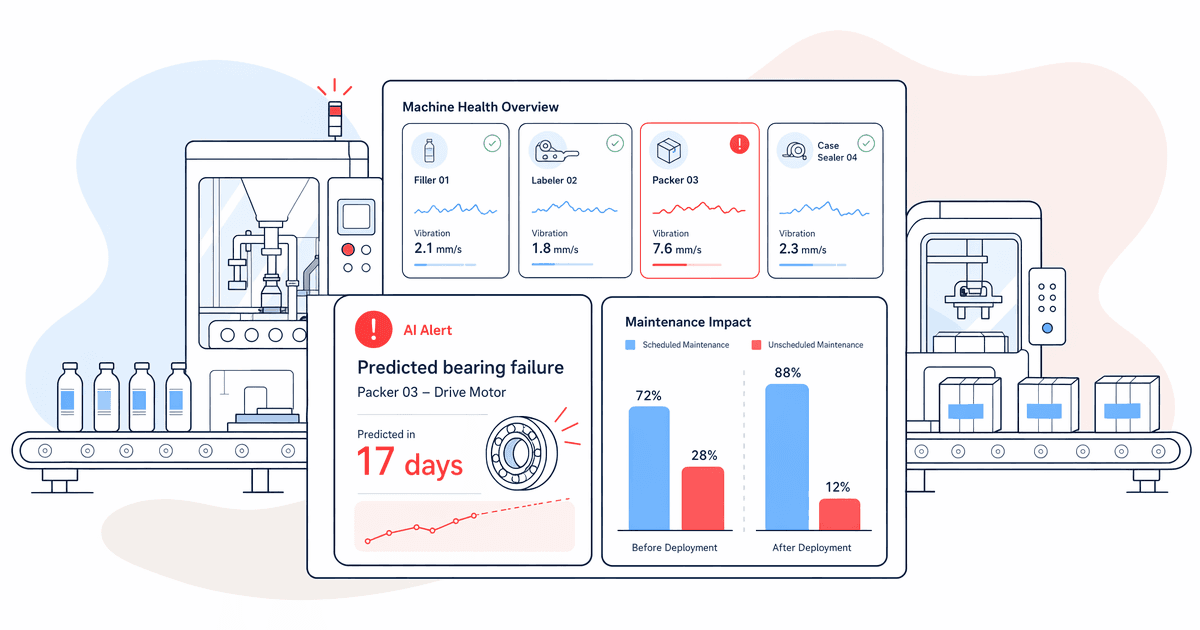
Yes, and predictive maintenance is now the fastest-growing AI application in manufacturing. The Augury 2026 State of Production Health report (drawing on 501 manufacturing executives across the US and EU) found predictive maintenance adoption grew more than 20 percentage points year-on-year, with more than half of executives now able to quantify its business impact. Deloitte's research puts the upside clearly: predictive maintenance can increase asset uptime by up to 25% and labour productivity by as much as 20%.
The Unilever Indaiatuba factory in Brazil — one of the world's largest laundry detergent powder facilities — provides a well-documented example of what this looks like in practice. Before AI deployment, unplanned downtime ran at 8.2% of total operating time. After deploying Amazon SageMaker on data from 50,000+ IoT sensors across compressors, HVAC, and packaging equipment, the facility achieved a 45% reduction in maintenance costs from a $5.1m baseline. It also delivered a 15% reduction in energy consumption and a 21% reduction in manufacturing defects from a parallel quality analytics system. Critically, production planning freeze time dropped from 14 days to 1 day — a 92% compression in planning cycle time that compounded the operational flexibility gains from the maintenance system.
Worldmetrics' aggregated industry data confirms these aren't outlier results. Across FMCG manufacturers, AI predictive maintenance reduces production downtime by 20–25% and cuts overall operational costs by 10–18% annually (Worldmetrics, 2026).
The mechanism is specific. Traditional maintenance is either calendar-based (scheduled regardless of equipment condition) or reactive (after failure). AI predictive maintenance monitors real-time sensor data — vibration, temperature, acoustic signatures — and flags anomaly patterns that precede failures. Maintenance windows get scheduled during natural production gaps, not interrupting active runs.
How Is AI Changing Quality Control in FMCG Production?
Sixty percent of FMCG manufacturers already use AI for quality control, according to Worldmetrics 2026 data — making it the second most widely deployed AI application in the sector after supply chain optimisation. The primary technology is computer vision, which performs defect detection at line speed across 100% of output. Statistical sampling can't do that.
Nestlé, operating across more than 400 factories, has embedded computer vision into production lines to flag fill-weight deviations, packaging misalignments, and label errors before products move downstream. The key distinction from traditional quality inspection is completeness. A sampling approach catching 5% of units might miss a systematic defect that emerges in a specific production window. Computer vision at 100% coverage closes that gap.
The business case compounds beyond defect reduction. In the Unilever Tinsukia deployment, a generative AI system analysing consumer feedback at 97% classification accuracy identified quality issues from post-market data and fed corrections back to production parameters. The result: a 21% reduction in manufacturing defects and a 73% improvement in customer satisfaction scores. The loop from consumer signal to production adjustment, which previously took weeks of manual analysis, became near-real-time.
For FMCG operations teams, this represents a structural shift in what quality control can mean. It stops being a catch-and-reject function at the end of the line and starts becoming a continuous signal that informs both current production and future process design.
The overlooked connection: Quality control AI and demand forecasting AI share a dependency: both require clean, categorised historical data. Brands that invest in AI-driven quality inspection often find the structured defect data it generates becomes an input into their manufacturing process optimisation models. The value compounds across use cases rather than remaining siloed.
What Does AI Mean for Supply Chain Visibility and Planning?
Supply chain visibility has historically meant knowing what was in your warehouse three days ago. AI shifts this to knowing what's likely to be missing from your warehouse in 10 days — and giving planners the decision support to act before the shortage materialises.
The Augury 2026 report found that CPG has concentrated its AI investment heavily in supply chain optimisation (61%) and prescriptive analytics (71%), the highest rates in the study across all industries. This reflects where the highest recoverable value sits for consumer goods manufacturers: the gap between what a brand thinks is happening in its distribution network and what's actually happening.
P&G's supply chain work with OMP illustrates what a mature deployment looks like. With OMP's Unison Planning handling 80% of planning touchlessly, P&G has maintained greater than 98% shelf availability throughout — a direct signal that touchless planning, done on a solid data foundation, strengthens service performance rather than straining it. The projected 50% reduction in planner effort isn't headcount reduction; it's redirection. Planners spend less time manipulating data and more time on the exceptions that genuinely require human judgment.
For brands at an earlier stage of their AI journey, the supply chain visibility entry point is typically more modest: connecting existing systems into a single data layer, automating the reconciliation work that currently happens manually in spreadsheets, and surfacing exception alerts rather than requiring planners to hunt for anomalies. If your operations team spends significant time each week compiling stock availability or promo performance data, that's worth examining. We've written about this pattern in more detail in our post on why spreadsheet reporting becomes a growth bottleneck.
How Are FMCG Operations Teams Using AI for Day-to-Day Workflows?
Beyond forecasting and manufacturing, AI is improving the daily work of operations teams through workflow automation — targeting the administrative tasks that consume the most time relative to the decision value they deliver.
Grupo Bimbo, one of the world's largest bakery companies, deployed AI agents within Microsoft Copilot Studio to automate audit planning workflows. Risk and control matrices that previously took two full days to generate can now be produced in seconds and refined in under half a day. The result: a 20% reduction in overall audit planning time (Microsoft Customer Stories, 2026). At Dabur India, AI-led use cases — including automated Excel analysis, PowerPoint creation, and supply chain planning support — are delivering productivity improvements of 10–20% across functions. The company's CIO describes the approach deliberately: tools positioned as "digital colleagues" rather than replacements, embedded into daily workflows before more complex AI applications are introduced.
The pattern that emerges across these examples is consistent with what the manual-to-automated transition looks like in practice: identify the highest-frequency, lowest-exception tasks; automate the data handling; redirect human effort to the exception and the judgment call.
For an FMCG operations team, the typical candidates include daily stock availability reporting, promotional performance dashboards, supplier scorecard compilation, distributor replenishment order generation, and cross-functional planning pack preparation. None of these require complex AI. They require well-designed automation, with AI handling the variance and anomaly detection that rules-based systems miss.
It's worth being precise about where AI adds value that rules-based automation doesn't. The distinction between AI and rules-based automation matters here: rules-based workflow automation handles the predictable, structured steps, while AI earns its place where patterns are variable, data is noisy, or the task requires interpretation. In operations, that typically means demand signals, anomaly detection, and exception prioritisation — not the structured data transfer between systems, which automation handles well enough on its own.
What Needs to Be in Place Before AI Works?
AI delivers on the promise when the data foundation is right. When it isn't, it amplifies the problem. P&G's supply chain work was built on eliminating 35 siloed planning processes, standardising on a single data model, and creating a unified data lakehouse before layering AI on top. The lesson from that case isn't about scale; it's about sequencing. Data architecture first, AI second.
For most FMCG operations teams, the practical checklist before deploying AI looks like this:
- Connected systems — Your ERP, WMS, demand planning tool, and retailer data feeds need to be accessible from a single layer. Not integrated in the sense of a full ERP replacement, but connected enough that data can flow and reconcile automatically.
- Clean historical data — AI models learn from history. If your historical records are incomplete, inconsistently categorised, or broken across system migrations, the model learns the noise as well as the signal. Three to five years of clean data is a reasonable starting expectation for forecasting applications.
- Process clarity — AI automates decisions; it doesn't make unclear processes suddenly clear. Before automating a planning workflow, you need to understand it well enough to describe it explicitly. Automating an unclear process produces unclear results faster.
- A defined use case — "We want to use AI in operations" isn't a use case. "We want to reduce our demand forecast MAPE from 35% to under 15% for our top 50 SKUs" is. Starting with a specific, measurable target narrows the scope and makes the evaluation credible.
Kraft Heinz's experience is instructive on what happens when the use case is clear and the data is ready. AI-powered automation across their supply chain saved approximately $700m in 2023, with a further $173m in Q1 2024 alone — figures that reflect not just efficiency gains but the compounding effect of better forecasting on inventory levels, waste reduction, and logistics cost.
Frequently Asked Questions
What is the biggest operational benefit of AI for FMCG companies?
The biggest documented benefit is in demand forecasting accuracy. AI demand sensing reduces forecast MAPE from 25–40% (traditional methods) to 8–15%, according to AppWrk 2026 research. This directly reduces both overstock write-offs and out-of-stock lost sales, which represent the largest recoverable cost in FMCG operations.
How much can AI reduce production downtime in FMCG manufacturing?
AI-powered predictive maintenance reduces unplanned production downtime by 20–25%, according to Worldmetrics 2026 industry data. Deloitte's research puts asset uptime improvement at up to 25% and labour productivity gains at up to 20%. Documented deployments, such as Unilever's Indaiatuba factory, show maintenance cost reductions of 45% from baseline.
Is AI only practical for large FMCG brands?
No. While early deployments were led by Nestlé, Unilever, and P&G, cloud-based platforms and modular tools have made the underlying technology accessible to brands at earlier stages of AI adoption. The key requirement isn't scale; it's having clean, connected operational data. Brands with disconnected systems need to address that foundation before any AI layer will work reliably.
How long does it take to see ROI from AI in FMCG operations?
Predictive maintenance results typically appear within 60–90 days of sensor commissioning. Quality inspection improvements emerge at a similar pace. Supply chain AI applications require one full seasonal cycle for calibration, with meaningful improvements visible within 6–9 months. Workflow automation tools, such as AI agents for reporting or audit planning, can show measurable time savings within weeks.
What should FMCG operations teams do before implementing AI?
P&G's approach is instructive: they unified siloed planning processes into a single data model before adding AI. Without clean, connected data, models can't learn reliably. The practical starting point is identifying one specific, measurable use case — not "use AI in operations," but "reduce forecast MAPE for top SKUs to under 15%" — and confirming the data needed to pursue it is available and trustworthy.
AI in FMCG Operations: Where Do You Start?
The evidence is consistent. AI reduces forecast error by up to 50%, cuts downtime by 20–25%, lowers operational costs by 10–18%, and redirects planner and operations team effort from data handling to decision-making. The brands deploying it at scale aren't doing so because it's interesting. They're doing it because the recoverable margin is real and measurable.
The 13% of CPG manufacturers that have AI embedded across core operations aren't operating in a different industry. They've prioritised the data foundation and the sequencing. The 87% that haven't are carrying a cost that compounds with every new SKU, every new retailer, and every year that forecast error and unplanned downtime go unaddressed.
The right starting point isn't a technology decision. It's a diagnostic question: where is your operations team spending time that produces data rather than decisions? That's the workflow that AI or automation should target first.
If you want to work through what that looks like for your team, start the conversation here. You can also browse the rest of our operations and automation thinking on the blog.
*Statistics and findings cited in this article are sourced from industry surveys and published research with disclosed methodology: Schneider Electric 2026 Industrial AI in CPG Survey; Augury State of Production Health 2026 (n=501); ABI Research Supply Chain AI Survey 2025; AppWrk CPG AI analysis 2026; Worldmetrics FMCG AI industry aggregation 2026; Deloitte predictive maintenance research; McKinsey supply chain AI research. Case study figures for Unilever, P&G, Grupo Bimbo, Dabur, and Kraft Heinz are drawn from publicly available corporate disclosures and partner case studies, cited inline.*