
Nobody sets out to build a customer service function that takes nearly 15 hours to send a first response. Yet that's the industry average. A November 2025 CXM analysis by Konnect Insights found the average first response time across FMCG brands was 14 hours and 52 minutes. Customers expect acknowledgement within three minutes on digital channels (Salesforce State of Service Report, 2023). That's a gap of roughly 298 times slower than expected.
The problem isn't primarily staffing. It's volume combined with poor routing. FMCG customer service teams handle 461 tickets per day on average. Order status queries, deduction dispute emails, promo claim verifications — all of it lands in the same inbox. The most complex questions queue behind the simplest ones. The result is a sector NPS of -32.44% (Konnect Insights, 2025). More customers leave interactions dissatisfied than satisfied across the whole sector.
AI doesn't fix this by replacing your team. It fixes it by separating what needs a human from what doesn't. The 80% that doesn't require human input gets handled at a speed no team can match.
The Bottom Line - FMCG brands average a 14-hour 52-minute first response time against a customer expectation of 3 minutes (Konnect Insights, 2025; Salesforce, 2023) - AI agents can handle 80–90% of CPG support volume autonomously, while generic chatbots resolve only 15–25% (AI Genesis, 2026) - Hybrid AI and RPA models reduce FMCG operational support costs by 30–50% and improve first-contact resolution by 20–25% (Mas Callnet, 2026) - 75% of consumer complaints to manufacturers arrive via digital channels, making automated response structurally viable for most inbound volume (CCMC CPG Complaint Handling Study, 2024)
What Does FMCG Customer Service Volume Actually Look Like?
At 461 daily tickets (Konnect Insights, 2025), your team is processing a new query roughly every two minutes. And that's before you add the B2B trade layer on top of consumer complaints.
The query mix is what makes FMCG customer service genuinely hard. You're receiving inbound contacts from at least three distinct groups: end consumers with product questions, retail buyers raising operational issues, and distributors chasing order confirmations, scheme clarifications, and delivery updates. Each group uses different language. Each expects a different response time. Each routes to a different internal owner. When all three land in the same inbox, triage breaks down fast.
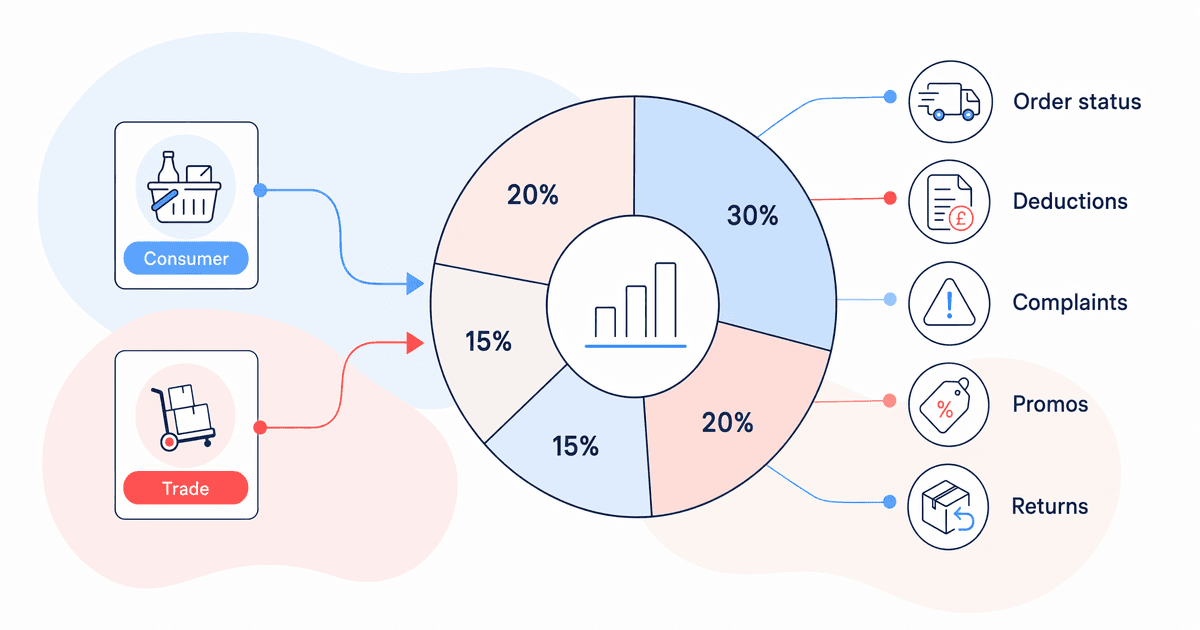
What we observe: In FMCG trade customer service, order status and delivery queries are almost always the single largest category — often 40–50% of total volume. Promo claim verification and scheme clarification queries come second. Returns and short-shipment complaints are third. Together, these three categories make up roughly 80% of inbound volume. All three are amenable to automation.
The CCMC 2024 CPG Complaint Study (co-sponsored by Colgate, PepsiCo, Purina, KraftHeinz, and Kellanova) surfaces a critical multiplier. For every complaint a manufacturer receives, approximately 16 problems exist in the market. Only 25% of consumers with a problem complain to the manufacturer. The other 75% go back to the retailer instead. Your visible complaint volume is the tip of a much larger iceberg of distributor and retailer dissatisfaction that builds quietly until a ranging review makes it visible.
75% of those consumer complaints that do reach manufacturers arrive via digital channels: chat, email, website, or social media (CCMC, 2024). That's the structural opportunity. A digital-first complaint channel is exactly where automated response works best. The format is already structured for machine-readable intake and response. Phone-based complaints are far harder to route automatically at scale.
Why Does a Nearly 15-Hour Response Time Cause Disproportionate Damage?
The 14-hour 52-minute average isn't just slow. It's slow in a category built on the promise of reliability. 60% of FMCG customers churn after just one or two negative service interactions (PwC Future of CX Survey, 2024). In a sector where purchase cycles are weekly and brand switching requires zero friction, a slow response doesn't feel like a minor inconvenience. It signals unreliability about the product itself.
For B2B trade relationships the stakes are higher. A retailer chasing confirmation of a delivery window — or the status of a deduction query — isn't a consumer expressing mild frustration. They're a commercial partner deciding whether this supplier makes their operational life easier or harder. The Konnect Insights November 2025 data shows customers reporting repeated follow-up contacts just to get basic status updates. Inconsistent communication tone across channels amplifies the frustration, even when issues are eventually resolved.
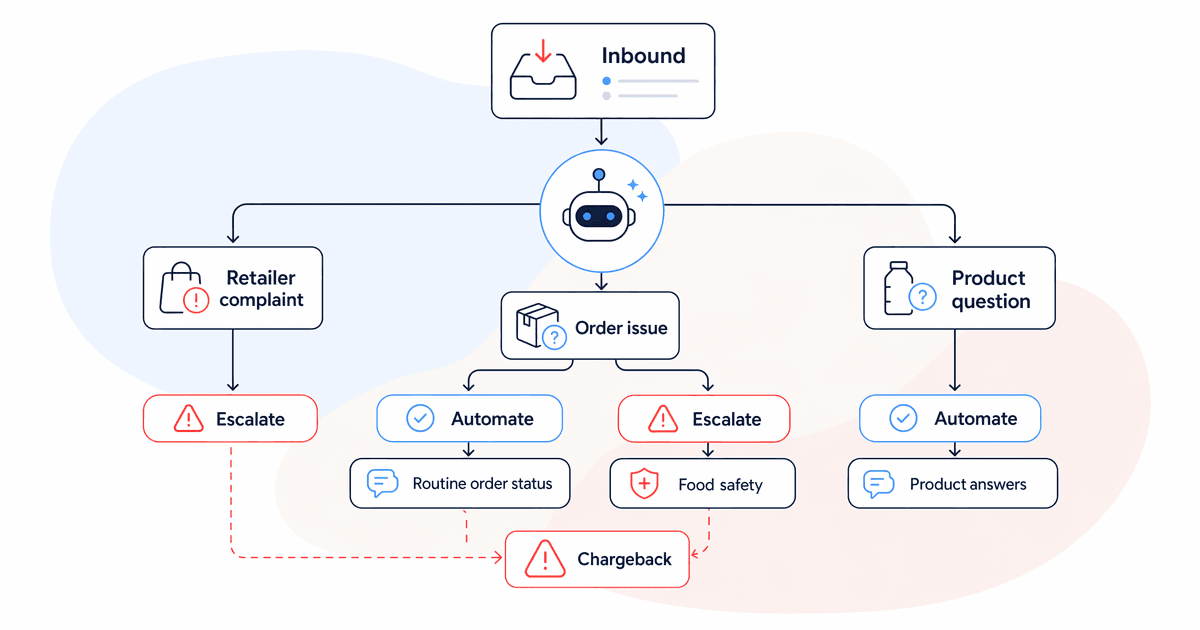
What we've seen: The brands where response time damage compounds fastest are those with manual inbox triage. When every query — from "where's my order?" to "we're short 24 cases on this invoice" — lands in the same queue and gets worked by the same person, the urgent drowns behind the routine. An automated routing layer that instantly identifies and escalates the retailer dispute or the food safety flag changes the dynamic completely, even before you've automated any responses.
The sector NPS of -32.44% (Konnect Insights, 2025) is the downstream result of this pattern. When a customer's first interaction after a problem is half a day of silence, they've already formed a verdict before your response arrives. Automation doesn't just speed up the response. It changes the shape of that first impression entirely.
What Is the Right Triage Framework for FMCG Customer Service Automation?
The most effective approach is a three-tier triage that matches automation depth to query complexity. Generic chatbots achieve only 15–25% resolution rates in CPG environments (AI Genesis, 2026). The reason is almost always the same: no triage logic, no live data, no account context.
Tier 1: Automate fully. Order status queries, delivery tracking, promotional scheme eligibility checks, stock availability, and FAQ responses all belong here. They're high volume and low complexity. They need zero human judgement if the AI agent has live ERP and WMS access. This tier typically covers 60–70% of total inbound volume.
Tier 2: Automate with human review. Trade deduction disputes, returns processing, short-shipment complaint logging, and promo claim verification sit here. Automation handles the intake, document extraction, initial classification, and draft response. A human reviews and approves before anything is confirmed. You capture the efficiency gain without removing the human judgement that commercial relationships need.
Tier 3: Human only. Food safety complaints, chargeback disputes, and significant retailer relationship escalations stay with people. Not because automation couldn't handle them technically, but because these interactions carry legal, commercial, or reputational weight that warrants human accountability. The value of automation in Tier 3 is flagging and routing: identifying these queries instantly and escalating with full context.
The Tier 1 / Tier 2 boundary matters more than it sounds. A returns query that looks like Tier 1 might become Tier 2 the moment a lot number appears in the message. That lot number is a potential quality flag requiring QA involvement. Effective triage systems set escalation rules at the query-content level, not just the query-type level.
How to Apply the Three Tiers in Practice
| Tier | Query Types | Automation Mode | Typical Volume Share |
| 1 – Automate fully | Order status, delivery tracking, FAQ, scheme checks | AI responds without review | 60–70% |
| 2 – Automate + review | Deduction disputes, returns, promo claim verification | AI drafts, human approves | 20–30% |
| 3 – Human only | Food safety, chargebacks, retailer escalations | AI flags and routes only | 5–10% |
A well-configured triage layer means your team stops touching most inbound queries. They spend their time on the fraction that genuinely needs them. That's what drops a 15-hour response time to 15 minutes for the majority of contacts. For teams still using spreadsheets to track query volumes and response metrics, the triage layer also creates the structured data you need to report on performance properly.
For context on where AI agent logic adds value versus simpler automation rules doing the routing, the AI vs automation in FMCG article covers that distinction in detail.
How Are FMCG Brands Handling Trade Deduction Disputes With AI?
Trade deduction management is one of the highest-friction areas of FMCG customer service. A retailer takes a deduction from a payment for a promo funding claim, a damaged-goods allowance, or a pricing discrepancy. Your team then has to locate the original agreement, the delivery proof, the invoice, and the pricing terms — and compare all of that against the retailer's claim document before deciding whether to accept, dispute, or request more information.
Conventional OCR captures claim documents with only around 60% accuracy, according to Capgemini's December 2025 analysis of FMCG supply chain practices. That means 40% of manually processed claim documents are misread at intake, before anyone reviews the substance of the claim. Agentic AI extracts data from multiple formats — emails, scanned documents, hand-written notes, ERP-submitted files — and validates against agreed terms. It adapts to the inconsistent formats different retailers use rather than breaking on anything outside a fixed template.
Henkel's implementation shows what this looks like at scale. The company (Persil, Schwarzkopf, Dial, Purex) operates across 79 countries with high volumes of diverse claim documentation and policies that differ by country and trade agreement. The solution Henkel co-developed with SAP, announced in August 2025, automates document retrieval from a central inbox, determines reason codes and location codes, and integrates processed claims into Henkel's business performance data for real-time visibility (SAP News, 2025). What previously required considerable manual effort per claim is now handled automatically at the classification stage.
If you're running a smaller brand — not 79 countries — the principle still applies. A claim that takes a month to resolve manually holds cash for a month. An AI system that approves straightforward claims automatically and routes only the disputed ones to human review compresses that cycle from weeks to days. The financial impact shows up directly in your deductions ledger.
According to the Capgemini research, 82% of global consumer products executives believe supply chains need to change significantly to meet evolving market challenges (Capgemini Research Institute, 2025). Trade claims processing is one of the most tractable places to start. The documents are structured, the validation rules are definable, and faster resolution has a directly measurable financial return.
What Does Effective Retailer and Distributor Communication Look Like With AI?
The B2B communication layer in FMCG is chronically underserved by standard customer service approaches. Retailers and distributors don't want to call a general helpline. They want to message through a channel they already use, get a live answer based on their account, and move on. The growing preference is WhatsApp and similar messaging platforms, especially in markets where smartphone penetration is high and email is slow.
Badho's implementation in India is one of the more instructive examples of scale. The B2B FMCG platform built an AI-powered WhatsApp chatbot (Badho.AI) serving 800,000+ retailers and 10,000+ distributors (Auriga IT, case study). Users get immediate access to order status, wallet balances, payment information, and account details through the WhatsApp interface they were already using informally. Support volume that previously required manual agent handling was automated, and every query was captured in a structured support flow rather than lost in informal conversations.
PepsiCo's approach shows what happens when you unify global contact center operations around AI. The company partnered with PwC to deploy Salesforce Agentforce across worldwide call centers, automating routine tasks including order placement, and shifting contact centers from cost centers into channels that support revenue generation (Salesforce, June 2026). The point isn't just faster responses. It's changing what a contact center does at all.
The channel choice matters as much as the automation logic. An AI agent embedded in WhatsApp reaches distributors where they already spend their day. The same agent deployed only on a web portal creates a separate step that distributors won't take for routine queries. The brands achieving high deflection rates build the automation around the channel their trade partners already use — not around the brand's preferred infrastructure.
Field sales teams benefit from the same logic. A field rep visiting a retailer who can check that account's last three order statuses, pending scheme credits, and open complaints via a quick AI query — without calling back to head office — can have more substantive conversations. They can resolve issues on the spot rather than logging them for follow-up. Customer service shifts from a reactive function into a commercial enabler.
Why Do Generic Chatbots Fail, and What Makes a Custom AI Agent Different?
Generic chatbots achieve only 15–25% resolution rates in CPG and FMCG environments (AI Genesis, 2026). That means 75–85% of queries still require human handling. You've added a technology cost layer without meaningfully reducing workload. This is the deployment pattern that creates chatbot scepticism inside customer service teams — because the experience confirms the suspicion that "AI doesn't work here."
The failure mode is specific. A generic chatbot can answer "what are your opening hours?" It can't answer "where is order 44827 and will it arrive before the promotional window closes?" — because it has no connection to your order management system. It can't answer "I'm short 48 units on this invoice: is this a picking error or a stock issue?" — because it has no context on the account, the order, or the inventory position. In FMCG trade customer service, nearly every non-trivial query is account-specific and order-specific. Without live data integrations, the bot is just an FAQ layer with extra cost.
What a Custom AI Agent Can Do That a Chatbot Cannot
Custom-trained AI agents are connected to the ERP for live order and inventory data, the CRM for retailer and distributor account history, the WMS or TMS for delivery and fulfilment status, and any distributor management platform you use. When a query comes in, the agent retrieves the relevant account data, applies the right context, and gives an answer specific to that retailer's order. A generic "please check your order confirmation email" response isn't an option.
The integration is the product. The AI logic that interprets the query is table stakes. What separates a 15% resolution rate from an 80–90% resolution rate is whether the agent can access live, account-specific data and act on it. For a closer look at how we approach building these integrations for FMCG operations teams, see about us.
For the distinction between where AI agents add value versus simpler workflow automation, the AI vs automation in FMCG post covers the decision framework in detail.
What Does Implementation Actually Look Like for an FMCG Brand Starting From Scratch?
The path to automating FMCG customer service doesn't require ripping out existing systems or a six-month project. The practical approach is layered, starting with the highest-volume, lowest-complexity query type and building from there.
A dairy brand in India processed 15,000+ monthly queries from retailers, logistics partners, and end customers — covering expiry queries, delivery complaints, and scheme clarifications. Working with DialDesk's CX engine, they implemented cloud IVR to auto-route B2B versus B2C calls, CRM integration that pulled distributor details in under two seconds, and chatbots handling 38% of total daily queries (DialDesk, 2025). Over four months: first-call resolution up 26%, average handle time down 40%, CSAT up 24%.
Those aren't exceptional results from an exceptional implementation. They're what happens when you automate query types that were never complex to begin with — they just needed proper routing. The 38% chatbot deflection rate is below the 80–90% ceiling that purpose-built agents with full ERP integration can reach (AI Genesis, 2026). Even so, it changed the team's capacity without additional headcount.
Here's the practical implementation sequence:
- Map the query mix. Categorise three months of inbound contacts by type, account type, and resolution path. Identify which categories are purely data retrieval and which need human judgement.
- Prioritise by volume and ease. Order status queries are almost always the highest-volume, lowest-complexity category. Start there.
- Connect the live data. The ERP integration is non-negotiable for anything beyond FAQ. Without it, resolution rates stay low.
- Define escalation triggers. Specify exactly which query content — lot numbers, allergen mentions, chargeback language, named retail buyer contacts — automatically routes to a human with full context.
- Set measurable targets. First response time, deflection rate, first-contact resolution, and CSAT are the four metrics that matter. Baseline them before launch.
- Expand by tier. Once Tier 1 is stable, move to the hybrid Tier 2 approach for deduction disputes and promo claim processing.
The same logic that applies to any manual process being converted to an automated workflow applies here: map the process first, automate second. Automating a broken routing process just produces broken automation faster.
Frequently Asked Questions
What types of FMCG customer queries can AI automate fully?
AI agents can fully automate order status and delivery tracking, scheme and promotional eligibility queries, FAQ responses, stock availability checks, and return request intake. These tier-1 queries represent the highest volume of inbound contacts for most FMCG brands and require no human judgement to resolve accurately. The one condition: the agent needs live ERP and WMS integration.
Why do generic chatbots fail in FMCG customer service?
Generic chatbots achieve only 15–25% resolution rates in CPG and FMCG environments (AI Genesis, 2026). They fail because they lack product-specific data, ERP integration for live order status, and the ability to interpret trade-specific language around deductions, schemes, and distributor accounts. Custom-trained agents connected to live systems perform three to four times better on resolution rate.
How does AI handle trade deduction disputes in FMCG?
AI handles deduction disputes by automatically extracting and classifying claim documents, validating pricing and delivery data against agreed terms, and routing approved or flagged claims without manual intervention. Conventional OCR captures claim documents with only ~60% accuracy (Capgemini, 2025). Agentic AI adapts to varying formats, languages, and document types, which significantly reduces the error rate at intake.
What results do FMCG brands see from automating customer service?
Documented outcomes include a 26% increase in first-call resolution, a 40% reduction in average handling time, a 24% improvement in CSAT, and operational cost reductions of 30–50% with hybrid AI and RPA models (DialDesk, 2025; Mas Callnet, 2026). Danone automated 93% of campaign questions and achieved 83% self-service for out-of-hours contacts via Gupshup's platform.
What systems does AI need to integrate with for FMCG customer service?
Effective automation requires integration with four core systems: the ERP (for live order and inventory data), the CRM (for retailer and distributor account history), the WMS or TMS (for delivery and fulfilment status), and any distributor management platform in use. Without these integrations, AI agents can only handle generic queries. The live data connections are what enable accurate, account-specific responses at the query volumes FMCG brands face.
Why Doesn't Hiring Solve the Volume Problem?
461 daily tickets doesn't become manageable by adding another person to the queue. The arithmetic doesn't work: each new hire handles more volume, but the query mix stays the same. Most of it is still routine, data-retrieval questions that a connected system could answer in seconds. The response time problem persists because the throughput ceiling is still human.
The question isn't whether to automate FMCG customer service. It's which query types to automate first, what data integrations to prioritise, and where to draw the line between automated response and human account management. The brands getting this right are seeing first-response times drop from hours to minutes, handling time fall by 40%, and CSAT scores improve — not by replacing their teams, but by redirecting them away from order-status queries and toward the commercial conversations that actually need a person.
If your customer service function is running above a 4-hour average first response time, or if your team is spending the majority of their day answering questions that live in your ERP, the approaches we cover across our blog give a practical starting point for thinking through the architecture. And if you want to look at what a triage layer built around your specific query mix and systems could look like, get in touch. It's usually a shorter conversation than the implementation that follows.
*Sources for this article include industry CXM reports (Konnect Insights, November 2025 FMCG CXM Report), large-scale consumer complaint studies (CCMC CPG Complaint Handling Study, 2024, co-sponsored by Colgate, PepsiCo, Purina, KraftHeinz, and Kellanova), vendor-published case studies and capability benchmarks (AI Genesis 2026, Mas Callnet 2026, DialDesk 2025, Auriga IT case study, Gupshup/Danone case study), brand announcements (SAP/Henkel August 2025, Salesforce/PepsiCo June 2026), and analyst research (Capgemini Research Institute, December 2025). Vendor-sourced outcome figures are presented as examples from published case studies, not as guaranteed results. All statistics are cited inline with source, year, and link where available.*