
Every month, the same ritual. Your finance team of three or four people disappears into a five-day close process: reconciling bank transactions, matching invoices, accruing for unbilled items, pulling reports from four different systems, consolidating everything into management accounts, and writing the commentary that explains what happened.
According to UnifyApps (2026), AI-driven bank reconciliation now delivers up to 75% faster matching and up to 40% faster close cycles. But only 18% of CPG companies have scaled AI beyond pilots (BCG, 2026). The gap between what's possible and what most FMCG finance teams actually use is still enormous.
This post covers what AI can genuinely help with in your month-end close, what still needs a human, and how to get from a 5-day close to a 3-day close in six months.
practical guide to AI for FMCG
The Bottom Line - AI reconciliation delivers up to 75% faster matching (UnifyApps, 2026), but only for repetitive data-matching tasks - 40-60% of close time is data assembly, not analysis: automate the assembly first - A realistic target: move from a 5-day to a 3-day close within 6 months - Judgement calls (accruals, strategic commentary, disputed claims) still need humans
What does month-end actually look like for a 2-5 person team?
Small FMCG finance teams spend 3-5 days on month-end close, yet only 18% of CPG companies have scaled any AI or automation to help (BCG, 2026). The bottleneck isn't complexity. It's volume and repetition across disconnected systems.
The typical close at a £30m-£80m food or drink brand follows the same sequence every month:
Days 1-2: Pull bank statements. Export reports from the ERP, the stock system, and the e-commerce platform. Match invoices to purchase orders. Chase missing delivery notes. Reconcile bank transactions line by line.
Days 3-4: Accrue for goods received but not yet invoiced. Accrue for retailer promotional deductions not yet confirmed. Post adjustments. Consolidate multiple entity or channel figures into a single view.
Day 5: Produce the management accounts pack. Write the commentary. Review with the FD or MD. Submit.
In our experience, roughly 60% of that timeline is pure data assembly: downloading, matching, copying between systems. The remaining 40% is the analysis and judgement work that actually requires a qualified human. Most teams know this instinctively. They just haven't separated the two categories clearly enough to act on it.
Does that ratio hold for your team? If you're spending more than half your close days on data gathering rather than analysis, you're a strong candidate for what follows.
Citation capsule: According to BCG (2026), only 18% of CPG companies have scaled AI beyond pilots. For the 82% still running manual close processes, the majority of month-end time is spent on data assembly rather than the financial judgement work that actually requires human expertise.
What can AI actually help with in month-end close?
AI-driven reconciliation delivers up to 75% faster matching and 40% faster close cycles (UnifyApps, 2026). Three specific areas deliver real value today: invoice matching, anomaly detection, and narrative generation. Everything else is either premature or marketing fluff.
Invoice matching and reconciliation
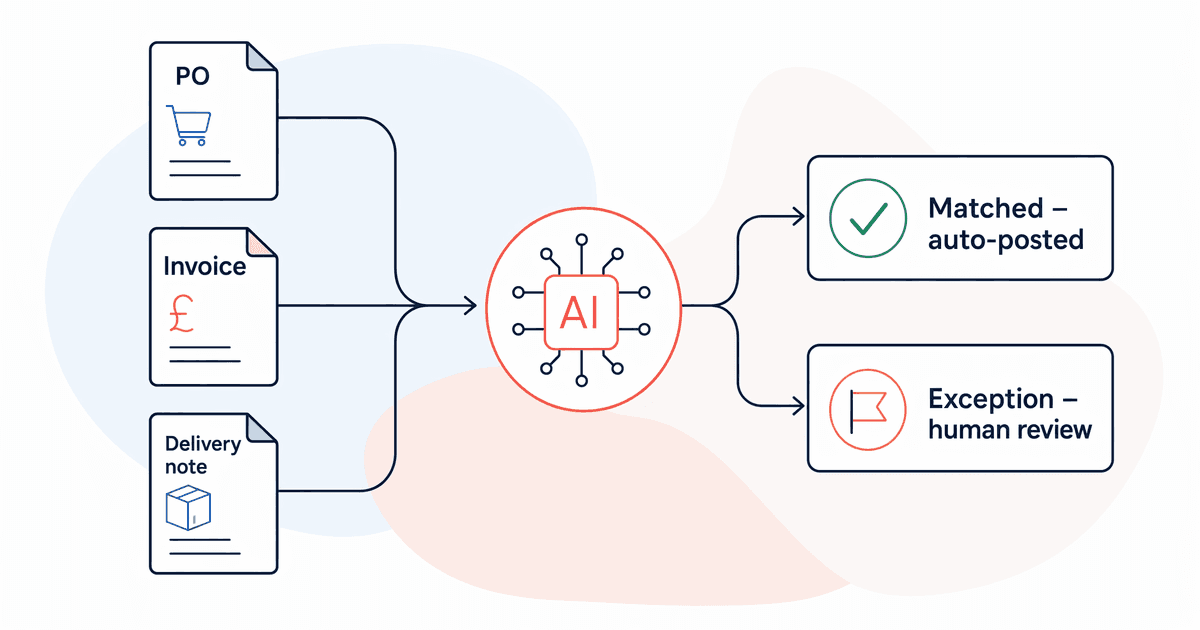
AI matches purchase orders to invoices to delivery notes across systems, flagging discrepancies for human review instead of requiring manual line-by-line checking. It works best when invoice volume exceeds 200 per month, which is where manual matching becomes genuinely error-prone.
The value isn't just speed. It's consistency. A human checking 300 invoices on Day 4 of close, tired and under pressure, will miss things. An AI matching engine won't get tired at 4pm on a Thursday.
What this looks like in practice: the system flags "Invoice from Supplier X is £340 higher than the PO" or "Delivery note shows 480 cases but invoice shows 500." Your team reviews exceptions rather than checking every transaction.
Anomaly detection
AI flags unusual transactions, unexpected variances, and missing accruals. It catches the errors that slip through when you're rushing to close by Day 5.
Examples specific to FMCG finance:
- A raw material cost 22% higher than the rolling average, without a corresponding price increase notification from the supplier
- A retailer promotional deduction that doesn't match any agreed activity in the trade spend tracker
- A missing accrual for a regular monthly service that usually posts by the 3rd working day
We've seen teams catch five-figure errors in promotional accruals purely because anomaly detection flagged a gap that the usual month-end checklist missed. When you're running through the same process at speed, pattern-breaking is harder for humans than for machines.
Narrative generation
AI auto-drafts management account commentary based on variance analysis. "Revenue up 8% vs budget, driven by promotional performance in Tesco. Gross margin down 0.4pp due to packaging cost inflation on SKU range X." The finance director reviews and edits rather than writing from scratch.
This isn't about replacing judgement. It's about eliminating the blank-page problem. Most FDs spend 2-3 hours writing commentary that's 70% factual description and 30% strategic interpretation. AI handles the 70%. Humans add the insight.
Citation capsule: UnifyApps (2026) reports AI-driven bank reconciliation delivers up to 75% faster matching. For FMCG finance teams processing over 200 invoices monthly, AI matching across purchase orders, invoices, and delivery notes eliminates the manual line-by-line checking that consumes Days 1-2 of a typical close.
What can't AI help with yet?
Despite the 75% reconciliation speed gains reported by UnifyApps (2026), several month-end tasks remain firmly in human territory. AI can't replicate the contextual knowledge that lives in your finance team's heads.
Judgement-based accruals
How much should you accrue for a disputed retailer claim? Tesco says you owe £18,000 in promotional over-delivery. Your commercial team says it was £12,000. The right accrual depends on negotiation history, relationship context, and commercial judgement. No AI model has that information.
Strategic commentary
"What does this mean for next quarter?" requires understanding of pipeline conversations, market dynamics, and board priorities that aren't captured in any system. AI can describe what happened. It can't explain what it means for your strategy.
Relationship context
Why did that supplier charge 15% more this month? Maybe it's a raw material price increase. Maybe it's a penalty for a short-notice order change your ops team requested verbally. That context lives in email threads and phone conversations, not in transaction data.
Verbal agreements not in the system
FMCG runs on relationships. Half the commercial agreements that affect your P&L were discussed on a call or at a trade show. Until those get documented in a system, no AI can account for them.
The pattern we see most often: teams try to apply AI to everything at once and get disappointed when it can't handle the judgement calls. The better approach is to clearly separate "data processing" tasks from "human judgement" tasks, then apply AI only to the first category. This sounds obvious. In practice, most teams haven't drawn that line explicitly.
Citation capsule: While only 18% of CPG companies have scaled AI (BCG, 2026), the limitation isn't technology availability. It's that judgement-based work like disputed accruals, strategic commentary, and relationship context still requires human expertise that AI cannot replicate.
Step 1: How do you map your close timeline?
Most FMCG finance teams find that 40-60% of their close time is data assembly, not analysis (UnifyApps, 2026, confirms AI delivers most value on the assembly tasks). Before changing anything, document what actually happens on each day of your current close.
Create a simple table with three columns: Task, Day, and Category (Data Processing or Human Judgement).
Be honest about what's really happening. The "official" close process and the actual close process often differ. Who's manually downloading bank statements at 7am on the 1st? Who's copying figures between Excel workbooks? Who's sending chase emails for missing invoices?
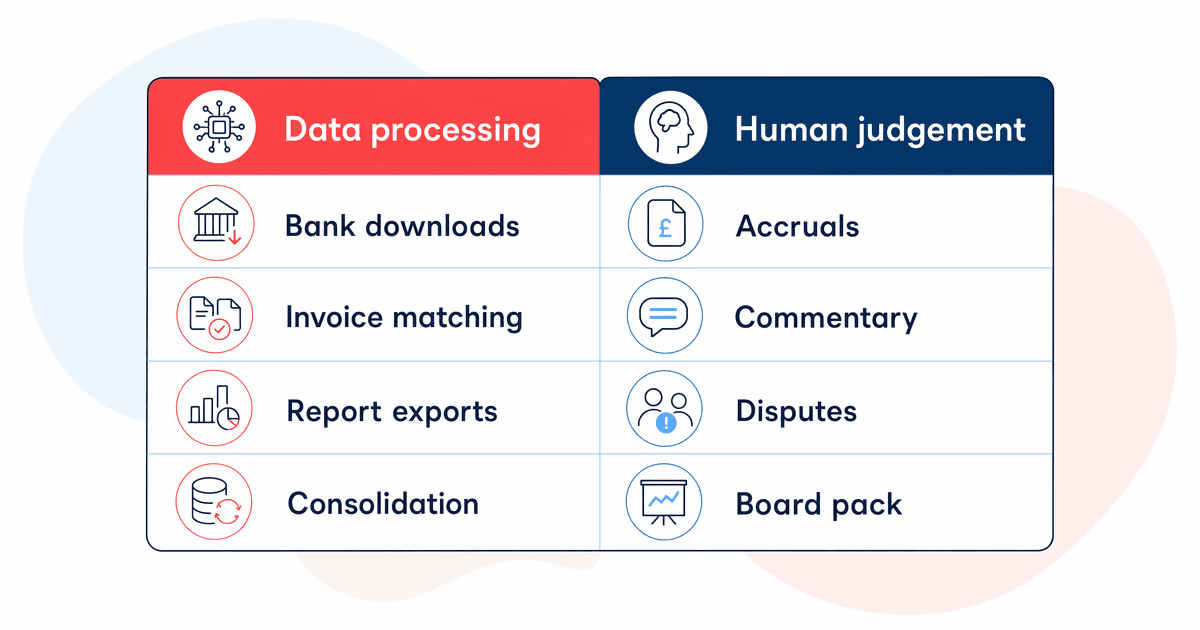
Once you've mapped it, total up the hours in each category. In our experience with brands at this revenue range, the split is usually 55-65% data processing and 35-45% judgement work. That data processing portion is your automation target.
Step 2: Why should you automate data assembly before adding AI?
Before introducing AI, automate the raw data flows. This is less exciting but more impactful as a first step. BCG (2026) found that companies succeeding with AI at scale had already automated their basic data pipelines first.
What "automate data assembly" means in practice:
- Scheduled bank feeds: your accounting system pulls bank data automatically overnight, not manually downloaded each morning
- Automated report exports: your ERP emails or pushes daily sales, stock, and purchase reports to a shared location at 6am
- Templated Excel workbooks: your consolidation workbook refreshes from data connections rather than requiring manual copy-paste from five different exports
- Automated chase emails: missing supplier invoices flagged and chased by template email on Day 2, not Day 4
This alone can save 1-2 days from your close. No AI required. Just removing the manual data gathering that eats up your first two days.
Why do this before AI? Because AI matching tools need clean, consistent, automatically-arriving data to work with. If your bank data is manually downloaded at different times, if your ERP exports are inconsistent, the AI layer on top won't perform reliably.
Citation capsule: BCG (2026) research shows that the 18% of CPG companies who have successfully scaled AI first automated their underlying data pipelines. For FMCG month-end close, this means scheduled bank feeds, automated ERP exports, and templated workbooks must be in place before AI matching adds value.
Step 3: How do you add AI for matching and anomaly detection?
Once data arrives automatically, AI adds value by matching transactions across sources, flagging exceptions, and surfacing what needs attention. UnifyApps (2026) reports up to 75% faster reconciliation at this stage, because the AI has clean data to work with.
Tools to consider
Built-in AI in your existing platform: Xero, Sage, and NetSuite all now include AI-powered bank matching and suggested categorisation. If you're already on one of these, start here. It's included in your subscription and requires no additional integration.
Standalone AI finance tools: Trullion (lease and revenue accounting AI), Vic.ai (invoice processing and coding), FloQast (close management with AI matching). These make sense when your invoice volume is high enough to justify the additional cost, typically 300+ invoices per month.
The decision point: if your current platform's built-in AI handles 80% of your matching needs, don't add another tool. The integration overhead isn't worth the incremental gain.
What to expect in the first month
Don't expect 75% faster reconciliation on Day 1. AI matching tools need 2-3 months of historical data to learn your patterns. Month 1 will feel slower as you train the system and correct its mistakes. By Month 3, it should be handling the routine matches autonomously and only surfacing genuine exceptions.
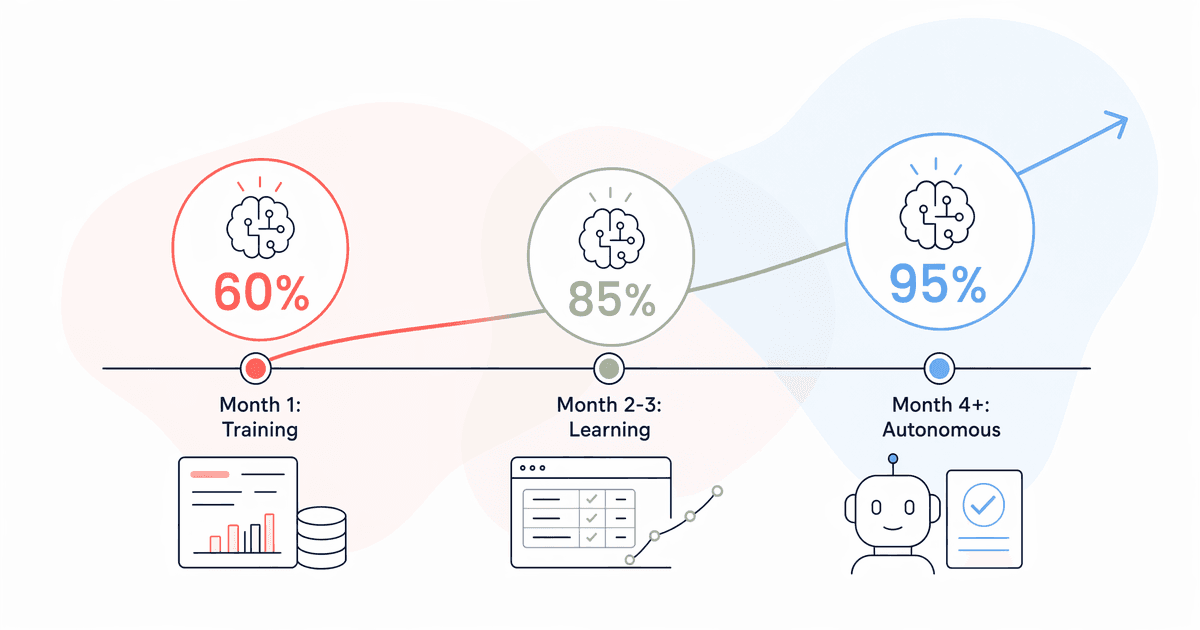
The pattern we see most often with AI matching: teams get frustrated in Week 2 because the tool flags too many false positives. This is normal. The system is being cautious. As you mark correct matches and dismiss false flags, it calibrates. Push through the first 8 weeks.
Step 4: What does a 3-day close look like?
If you're currently at 5 days, a realistic target with automation plus AI is 3 days within 6 months. UnifyApps (2026) reports up to 40% faster close cycles, which maps closely to a 5-day to 3-day reduction.
Here's what the target state looks like:
Current close (5 days) vs Target close (3 days)
| Day | Current 5-Day Close | Target 3-Day Close |
| Day 1 | Download bank statements. Pull ERP reports manually. Start bank reconciliation line by line. | Data arrives automatically overnight. AI matches 85%+ of bank transactions. Team reviews exceptions only. |
| Day 2 | Continue reconciliation. Match invoices to POs manually. Chase missing invoices. | Resolve AI-flagged exceptions. Finalise invoice matching. Post routine accruals from templates. |
| Day 3 | Finish matching. Start accruals. Post adjustments. | Produce management accounts. AI drafts variance commentary. FD reviews, edits, and finalises. |
| Day 4 | Consolidate reports. Start management accounts. | - |
| Day 5 | Write commentary. Review. Submit. | - |
What's automated: bank feeds, transaction matching, report consolidation, first-draft commentary.
What's still human: exception resolution, judgement-based accruals, strategic commentary, final review.
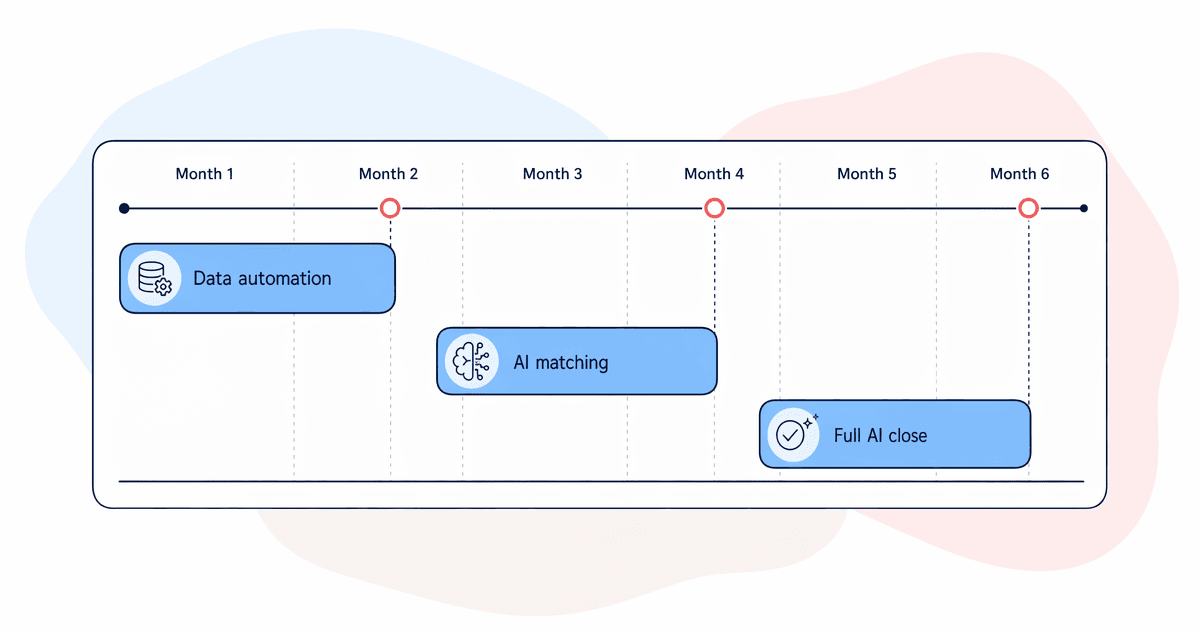
The 6-month roadmap
Months 1-2: Map your close. Automate bank feeds and report exports. Build templated workbooks.
Months 3-4: Activate AI matching in your accounting platform. Train the system. Accept the initial learning period.
Months 5-6: Add anomaly detection. Introduce narrative generation for commentary. Target your first 3-day close.
The teams that achieve this fastest have one thing in common: they designate one person as the "close automation owner" for 2-3 hours per week during the project. Without that ownership, the initiative stalls after Month 2 when the initial enthusiasm fades and the day job takes over.
Citation capsule: UnifyApps (2026) reports AI enables up to 40% faster close cycles. For a typical 5-day FMCG month-end close, this translates to a 3-day target achievable within 6 months by automating data assembly first, then layering AI matching and anomaly detection on clean, automatically-arriving data.
FAQ
Can AI fully automate month-end close for a small FMCG team?
No. AI handles data matching and pattern detection well, but month-end close requires human judgement for accruals, strategic commentary, and decisions involving context not captured in any system. A realistic expectation: AI automates 40-60% of close tasks (the data processing portion), freeing your team to focus on the 40-60% that genuinely needs human expertise.
What's the minimum team size and invoice volume where AI close automation makes sense?
AI matching delivers clear value when invoice volume exceeds 200 per month (UnifyApps, 2026). Below that threshold, the setup and training time may not justify the gain. For team size, even a 2-person finance team benefits, because the time saved on matching translates directly into fewer late nights and more capacity for analysis.
How much does AI-powered close automation cost for a mid-size FMCG brand?
Built-in AI features in Xero, Sage, or NetSuite come with your existing subscription. Standalone tools like Vic.ai or FloQast typically cost £500-£2,000/month depending on transaction volume. The ROI calculation is straightforward: if your finance team saves 2 days per month, that's 24 person-days per year freed for higher-value work.
practical guide to AI for FMCG
What to do this week
You don't need to buy anything or sign up for a new platform. Start with three actions:
- Map your current close: List every task, which day it happens, and whether it's data processing or human judgement. This takes 30 minutes and gives you the foundation for everything else.
- Check your bank feed: Is your accounting system pulling bank data automatically, or is someone downloading a CSV each morning? If it's manual, automate it today. Every modern accounting platform supports scheduled bank feeds.
- Count your invoices: If you process over 200 invoices per month, you're above the threshold where AI matching delivers measurable value. If you're under 200, focus on the data assembly automation first, then revisit AI in 6 months when volume grows.
The 82% of CPG companies that haven't scaled AI (BCG, 2026) aren't failing because the technology doesn't work. They're failing because they skip the foundation. Get data arriving cleanly and automatically. Then let AI do what it's good at: matching patterns at speed. Keep the judgement calls where they belong, with your team.