
Most AI sales content talks about chatbots and lead scoring. That's irrelevant if you're a National Account Manager selling into Tesco or managing 40 distributor relationships. According to BCG (2026), CPG companies seeing real AI returns focus on demand forecasting, pricing, and operational optimisation, not generic "sales enablement" tools.
The actual value for FMCG sales teams sits in three specific areas: recovering revenue lost to invalid trade deductions, predicting distributor churn before it happens, and forecasting at account level rather than by gut feel. None of these replace the relationship work your NAMs do. They replace the admin your NAMs hate.
The Bottom Line - AI helps FMCG sales teams with data-heavy admin, not relationship selling - Trade deduction recovery alone can reclaim 15-30% of written-off revenue - Distributor churn signals appear 4-8 weeks before manual detection - Account-level forecasting reduces errors by up to 50% (McKinsey) - Start with trade deductions if write-offs exceed £100k/year
Where Does AI Fit in FMCG Sales (and Where Doesn't It)?
BCG's 2026 analysis found that CPG AI frontrunners concentrate investment on demand forecasting, pricing, and transport optimisation. Sales relationship management barely registers. That tells you something: AI works on the structured, repetitive data problems, not the human ones.
Nobody's automating the buyer meeting. The half-day you spend at Sainsbury's HQ building a case for a range extension, reading the room, adjusting your pitch mid-sentence: that's pure human skill. AI can't do it. It shouldn't try.
What AI handles well is the work that happens before and after those meetings. Validating whether a deduction claim matches the delivery record. Spotting that a distributor's orders have dropped 20% over six weeks. Forecasting what a retailer will order next month based on two years of pattern data rather than a NAM's best guess.
The pattern we see most often: sales teams spending 30-40% of their time on admin that could be automated, while the relationship work that actually drives growth gets squeezed into whatever hours remain.
Citation capsule: BCG's 2026 CPG AI study found that frontrunner companies focus AI investment on demand forecasting, pricing, and transport optimisation rather than sales relationship management, with these areas delivering measurable ROI within 12 months (BCG, 2026).
What AI replaces vs what it supports
Think of it in two buckets. AI replaces: manual deduction review, spreadsheet-based forecasting, ad-hoc distributor reporting. AI supports: meeting preparation (surfacing relevant account data), negotiation (providing accurate cost-to-serve figures), range reviews (predicting volume impact of delistings).
The distinction matters. If a vendor tells you their AI tool will "automate your sales process," ask which part specifically. If the answer is vague, walk away.
practical guide to AI for FMCG
How Does Trade Deduction Management Leak Revenue?
UK food brands typically lose 1-5% of gross revenue to trade deductions, many of which are invalid claims from retailers for short deliveries, quality issues, or promotional funding that doesn't match agreements. For a £50m brand, that's £500k-£2.5m in deductions, with a significant portion recoverable.
Most brands handle this manually. Someone in finance or commercial ops pulls the deduction report, eyeballs the big ones, disputes a few, and writes off the rest because chasing a £200 claim isn't worth the time. The problem isn't any single deduction. It's the cumulative effect of thousands of small claims that nobody has capacity to review.
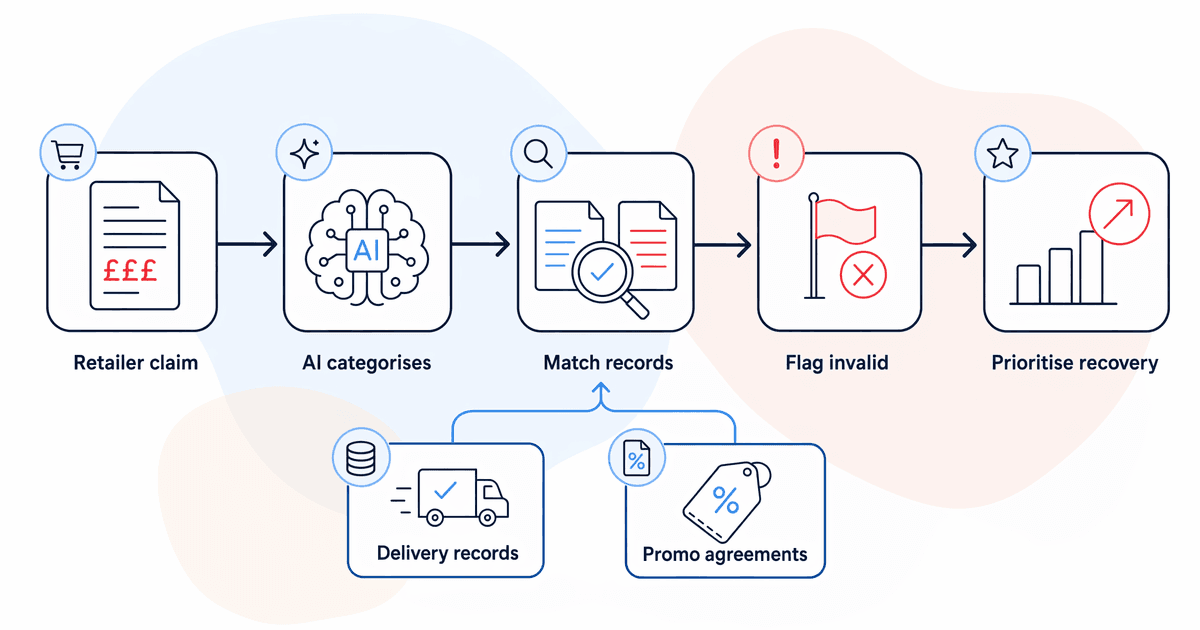
What AI does with deductions
AI handles trade deductions in three steps. First, it categorises each deduction by type: short delivery, quality claim, promotional over-claim, pricing dispute. Second, it matches each claim against your delivery records and promotional agreements. Did the delivery actually arrive short? Does the promo funding claimed match what was agreed? Third, it prioritises which claims to dispute based on value and historical win rate.
The prioritisation step is where most value sits. Not every invalid deduction is worth disputing. Some are too small. Some retailers have near-zero reversal rates regardless of evidence. AI learns which fights to pick, which is something a manual reviewer can't do across thousands of claims.
Realistic recovery numbers
We've seen brands recover 15-30% of previously written-off deductions after implementing AI-driven review. That's not 15-30% of all deductions (many are valid). It's 15-30% of the ones you were already writing off without challenge.
For a brand with £1.5m in annual deductions writing off £600k, that's £90k-£180k recovered. Not life-changing, but consistent, and it compounds year on year as retailers learn you're catching invalid claims.
Citation capsule: UK food brands lose 1-5% of gross revenue to trade deductions, with AI-driven categorisation and matching against delivery records recovering 15-30% of previously written-off claims, typically £90k-£180k annually for a £50m-revenue brand.
Can AI Predict Distributor Churn Before It Happens?
McKinsey research shows AI can reduce forecasting errors by up to 50%. That same pattern-recognition capability applies to distributor behaviour. If you sell through wholesalers like Brakes, Bidfood, or regional independents, AI can flag declining order patterns 4-8 weeks before a distributor drops you entirely.
The pattern is consistent. A distributor orders reliably for months. Then order frequency dips. Then order values shrink. Then silence. By the time a NAM notices manually (usually when quarterly numbers look soft), the distributor has already sourced a replacement product. The relationship is over.
How early warning works
AI monitors order frequency, order value, and product mix by account. It establishes a baseline for each distributor, then flags deviations. A distributor who ordered weekly and has shifted to fortnightly gets flagged. One whose average order value has dropped 25% over six weeks gets flagged.
In our experience, the 4-8 week early warning window is enough time for a NAM to make a call, understand the issue, and intervene. Maybe the distributor had a bad batch. Maybe a competitor offered better terms. Maybe their end customers shifted. You can't fix what you don't know about.
What intervention looks like
Early warning isn't useful without a response framework. When AI flags a distributor at risk, the NAM needs context: what changed, when, and what might explain it. Good systems surface the declining pattern alongside any related data, such as recent quality claims, delivery issues, or pricing changes that coincided with the drop.
The goal isn't to save every relationship. Some distributors churn for reasons you can't influence. The goal is to know early enough to make an informed decision: invest in saving the account, or redirect energy elsewhere.
Citation capsule: AI pattern matching flags declining distributor order patterns 4-8 weeks before complete churn occurs, identifying the shift from consistent ordering to declining frequency that human review typically misses until quarterly reporting reveals the gap.
How Does Account-Level Sales Forecasting Differ from Demand Planning?
McKinsey's CPG research indicates AI reduces forecasting errors by up to 50% (McKinsey). Account-level forecasting is distinct from SKU-level demand planning. Demand planning asks: how many units of SKU X will we sell next month? Account forecasting asks: what will Tesco order versus what will Sainsbury's order?
That distinction matters for production allocation. If Tesco's orders are trending 10% above forecast while Sainsbury's are flat, you need to shift allocation. If a retailer's orders drift consistently below committed volumes, that's an early warning of a delist or range reduction, weeks before the buyer calls to deliver the news.
What account forecasting enables
Three things become possible with reliable account-level forecasts. First, production allocation: you stop over-producing for accounts that are declining and under-producing for accounts that are growing. Second, early delist detection: consistent under-ordering against forecast signals trouble. Third, negotiation preparation: you enter annual reviews with data on actual ordering patterns versus commitments.
Why gut-feel forecasting fails at scale
A NAM managing five accounts can forecast reasonably well by instinct. They know the buyers, they sense the patterns. But scale that to 20-40 accounts across multiple retailers, wholesalers, and food service operators, and gut feel breaks down. You miss the slow declines. You over-weight the last conversation you had. You confuse seasonal dips with structural shifts.
AI doesn't replace the NAM's judgement. It provides a baseline forecast that the NAM can adjust based on qualitative information: upcoming promotions, buyer conversations, competitive moves. The combination of algorithmic baseline plus human adjustment consistently outperforms either approach alone.
Citation capsule: AI-driven account-level forecasting reduces prediction errors by up to 50% according to McKinsey, enabling early detection of retailer delistings and more accurate production allocation across customer accounts (McKinsey).
What Data Do You Need to Get Started?
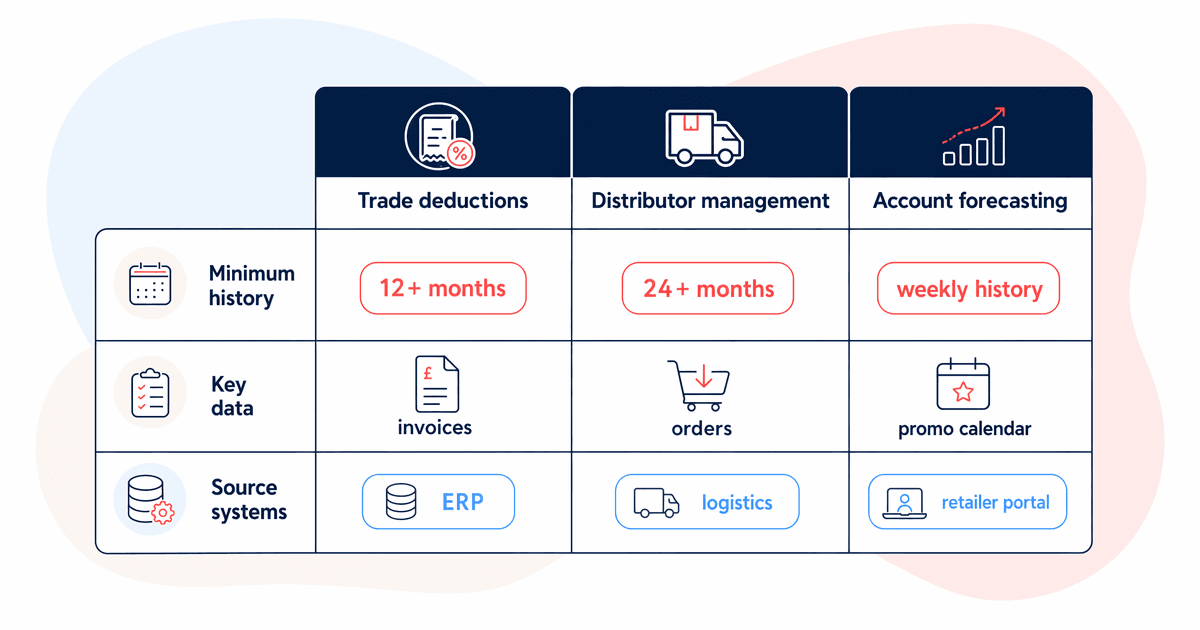
Each application has specific data requirements, but the good news is most brands already have what's needed. The bad news is it's rarely in one place. Invoice data lives in your ERP, promotional agreements in spreadsheets or email, delivery records in your logistics system, and deduction history in your finance platform.
Data requirements by use case
Trade deductions: Invoice data, proof of delivery records, promotional agreements (including agreed funding rates and mechanics), and 12+ months of deduction history with outcomes (disputed, recovered, written off). The history matters because AI needs to learn which claim types and which retailers have high reversal rates.
Distributor management: Order history by account going back 24+ months. You need enough history to establish seasonal baselines. A distributor who orders less in January might just have seasonal dip, not churn signals. Without two years of data, you can't distinguish the two.
Account forecasting: Retailer order history (ideally at weekly granularity), your promotional calendar, and seasonal pattern data. If you can add external signals like category growth data from Nielsen/Circana, the models improve, but they're not essential to start.
The integration challenge
The pattern we see most often isn't missing data. It's data that exists in five different systems with no common identifier linking them. Your ERP uses one customer code, your logistics system uses another, and your promotional planning spreadsheet uses the retailer's name in three different spellings.
Before any AI project, you need a data mapping exercise. Which systems hold what, how do they connect, and what's the minimum integration needed to get started? Often, a weekly CSV export from each system into a shared location is enough for a pilot. You don't need a full data warehouse on day one.
What Does This Cost and Where Should You Start?
For context, BCG (2026) found that CPG AI leaders see measurable returns within the first year. But costs vary significantly depending on whether you buy a platform or build from existing tools. Here's the realistic range for a UK brand in the £20m-£150m revenue bracket.
Cost breakdown by application
Trade deduction management: £2,000-£8,000/month for dedicated platforms like HighRadius or Adesso. These handle categorisation, matching, and dispute workflow out of the box. Custom-built alternatives using your existing data infrastructure cost less monthly but require £15k-£30k upfront in development.
Distributor analytics: £1,000-£3,000/month for dedicated tools, or often buildable from existing BI platforms (Power BI, Looker) with added statistical models. If you already have a BI tool with your order data flowing in, the incremental cost is primarily analyst time to build the models.
Account forecasting: Often available as a feature within existing demand planning tools (Anaplan, o9, Blue Yonder). If you're already paying for demand planning software, check whether account-level forecasting is included or an add-on before buying something separate.
Where to start
Start with trade deductions if your annual write-offs exceed £100k. The ROI calculation is simple: if you recover 20% of £100k in write-offs, that's £20k against a tool cost of £24k-£96k per year. The maths works at write-offs above roughly £150k for the cheaper tools.
If your write-offs are lower, start with distributor analytics, particularly if you sell through 20+ distributor accounts. The cost is lower and the value comes from retained revenue rather than recovered revenue.
Account forecasting is typically the third priority unless you're already experiencing frequent production allocation issues driven by inaccurate customer-level forecasts.
We've found that brands often overestimate the complexity of getting started. A three-month pilot on trade deductions, using historical data to validate what the AI would have caught, costs almost nothing beyond analyst time and proves the business case before any platform commitment.
Citation capsule: Trade deduction AI platforms cost £2,000-£8,000/month, with ROI achievable when annual write-offs exceed £150k, while distributor analytics can be built from existing BI tools for £1,000-£3,000/month, making it the lower-cost entry point for most mid-market FMCG brands.
FAQ
How much revenue can AI recover from trade deductions?
Most UK food brands write off 1-5% of gross revenue in invalid trade deductions. AI-driven categorisation and matching typically recovers 15-30% of those write-offs. For a brand doing £50m with 3% deductions, that's £225k-£450k recovered annually. The key is having 12+ months of deduction history for the model to learn from.
What data do I need before implementing AI for FMCG sales?
For trade deductions: 12+ months of invoice data, delivery records, promotional agreements, and deduction history. For distributor management: 24+ months of order history by account. For account forecasting: retailer order history, promotional calendar, and seasonal patterns. Most brands have this data scattered across ERP, invoicing systems, and spreadsheets.
How far in advance can AI predict distributor churn?
AI flags declining order patterns 4-8 weeks before a distributor drops your brand. The signal is a shift from consistent monthly ordering to declining frequency. By the time most NAMs notice manually, the distributor has already sourced a replacement. Early detection gives you a window to intervene or reallocate resources.
What to Do Next
The common mistake is trying to implement all three simultaneously. Pick the area with the clearest revenue impact for your business. If you're writing off more than £100k annually in trade deductions, start there. If distributor churn is your bigger pain point, start with order pattern analytics.
Whatever you choose, the first step is the same: map your data. Identify which systems hold the relevant information, how they connect, and what a minimum viable data feed looks like. A pilot using historical data, validating what AI would have caught, proves the business case without platform commitment.
For a broader view of where AI fits across your commercial, operations, and supply chain teams, see our AI use cases by department breakdown or the practical guide to AI for FMCG.