
Only 11% of consumer packaged goods companies have actually scaled AI into their "idea to market" workflows, despite 49% identifying it as strategically important (BCG, 2026). That gap tells you something. Most FMCG marketing teams know AI could help with retailer activations, but haven't found a practical way to apply it.
This guide is for the marketing team of 1-3 people running 8-12 retailer campaigns per year. You're handling Tesco Clubcard promotions, Sainsbury's Nectar offers, and Asda media slots, and you're probably paying an agency £5,000-£20,000 per campaign for work you could partly do in-house with the right AI setup.
We've written separately about broader marketing AI use cases, but this post focuses specifically on retailer activation execution.
practical guide to AI for FMCG
The Bottom Line - AI adds execution capacity to small marketing teams, not strategy replacement - First-draft creative production time drops 60-70% with proper AI tooling - Post-campaign reporting shrinks from a full day to roughly 2 hours - At 8-12 campaigns/year, the agency fee savings alone justify the setup time - Only 11% of CPGs have scaled this (BCG, 2026), so early movers gain a real edge
What Does the FMCG Marketing Reality Look Like at This Scale?
At brands doing £20m-£150m revenue, the marketing team is typically 1-3 people handling everything from NPD launches to trade show stands. Deloitte (January 2026) identified marketing and product innovation as the "most promising" AI application areas for CPG companies, and the reason is obvious: these teams are capacity-constrained, not capability-constrained.
The workload problem
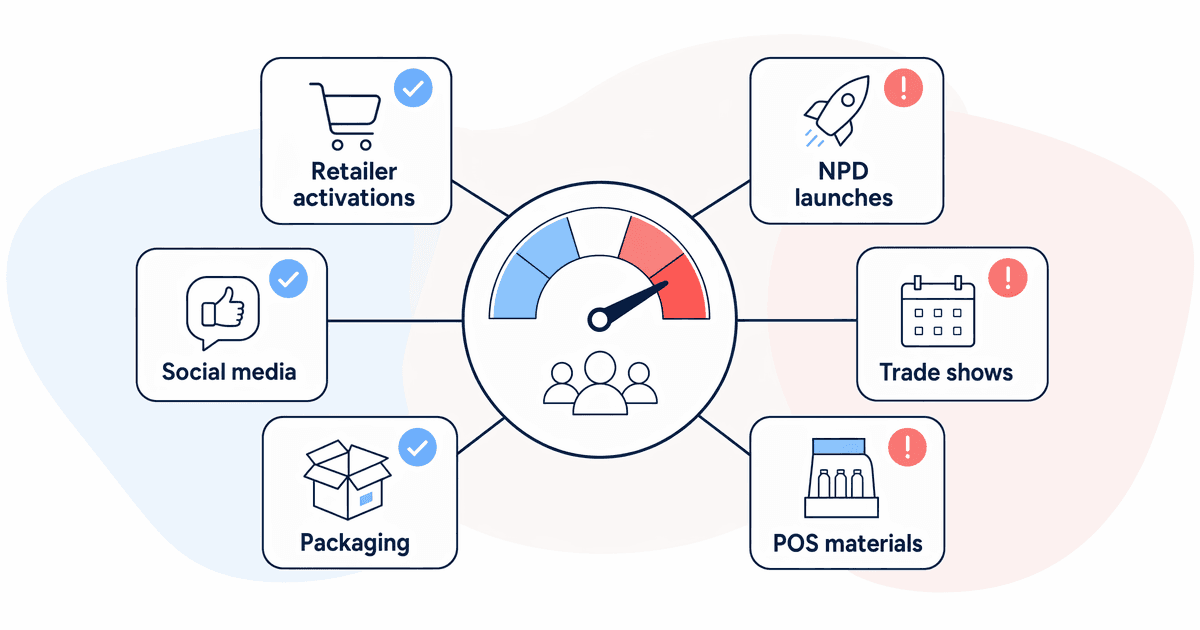
A typical year involves 8-12 retailer activations across multiple grocers. Each requires specific creative assets, performance tracking, and post-campaign reporting. Add NPD launches, social media, packaging updates, and point-of-sale materials on top.
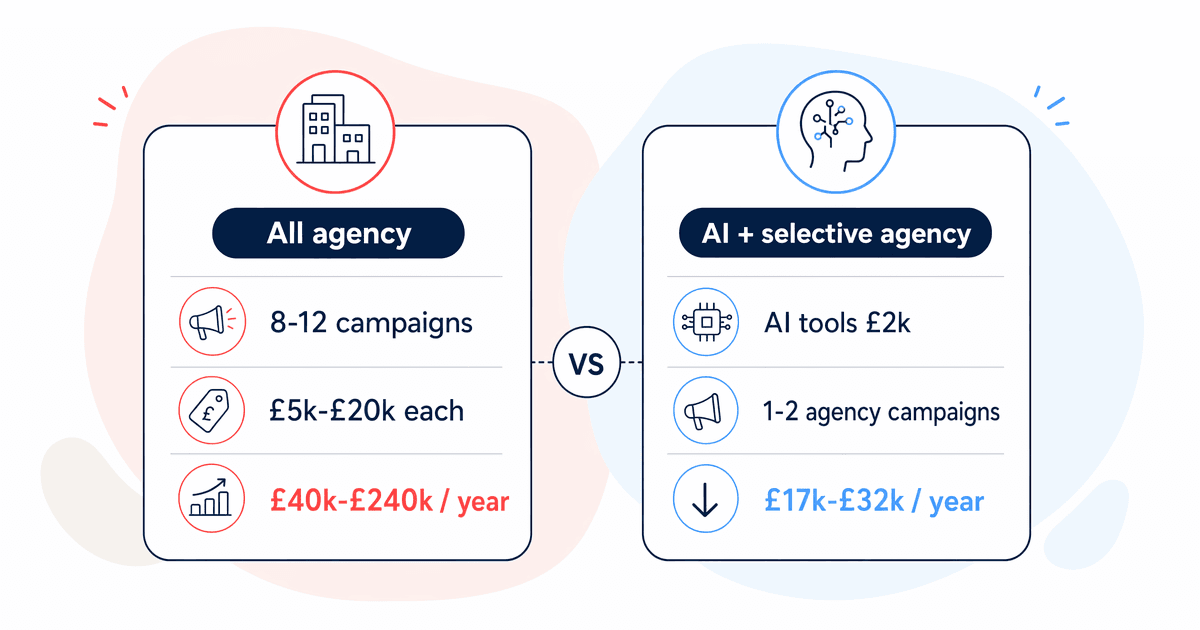
The maths on agency outsourcing is straightforward. At £5,000-£20,000 per campaign across 8-12 annual activations, you're spending £40,000-£240,000 on execution work. Most of that budget goes to tasks AI can now handle as a first draft: copy, resizing, data crunching, and report formatting.
The pattern we see most often: brands hit a ceiling where they need more campaigns than their team can physically produce, but can't justify a full-time hire or continued agency spend at this volume.
What you're actually producing per activation
Each retailer campaign needs: shelf wobblers at specific dimensions, gondola end headers, digital assets for retailer media platforms (Citrus Ad for Tesco, Nectar 360 for Sainsbury's), social support posts, and internal sell-in documents. That's 15-25 individual assets per activation before you've done any analysis.
Citation capsule: Only 11% of CPG companies have scaled AI into marketing workflows, while 49% consider it strategically important, according to BCG's 2026 analysis of CPG retail AI adoption. This implementation gap suggests most mid-market FMCG brands haven't yet operationalised AI for routine execution tasks like retailer activation production.
What Does AI Replace in Retailer Activation (and What Doesn't It Touch)?
AI replaces execution capacity, not strategic thinking. In our experience, the split is roughly 60% of the hours in a campaign are production tasks that AI accelerates, while 40% remain firmly human. Understanding that boundary stops you over-investing in tools that can't actually help with the hard parts.
AI handles these tasks well
- First-draft creative copy: Promotional headlines, product descriptions, social captions adapted to each retailer's tone
- Image resizing and adaptation: Taking base creative and outputting it at 12 different specifications
- Post-campaign data analysis: Turning raw EPOS exports into structured performance comparisons
- Performance reporting: Generating formatted reports with executive summaries and recommendations
These stay human
- Retailer relationship strategy: Which buyer to approach, when to pitch, how to position your brand
- Activation selection: Deciding between a Clubcard promotion or a gondola end based on your category dynamics
- Media slot negotiation: Pricing conversations, timing, placement preferences
- Creative direction: The strategic choice of what message to lead with, what visual identity to reinforce
We've found that teams who try to use AI for the strategic layer end up with generic campaigns that underperform. The brands getting results use AI purely as a production multiplier, keeping the thinking human and the making fast.
How Do You Generate Creative Assets with AI?
Retailer activations need format-specific assets, and AI tools now handle first-draft production at quality levels that need only light human editing. The 60-70% reduction in first-draft production time comes from eliminating the blank-page problem and automating format adaptation.
Visual asset generation
For shelf wobblers, gondola end headers, and digital display assets, these tools produce usable first drafts:
- Canva AI (Magic Design): Best for teams without design backgrounds. Feed it your brand assets and it generates format-specific layouts
- Adobe Firefly: Better for teams with existing Adobe workflows. Integrates with your existing asset libraries
- Midjourney: Useful for hero imagery and lifestyle shots, though you'll need to composite these into retailer templates
The key is maintaining a brand asset library that AI tools can reference. Upload your logo variants, brand colours, product photography, and approved font files once. Then each generation starts from your identity, not from scratch.
Promotional copy generation
Text AI (Claude, ChatGPT) drafts promotional copy adapted to each retailer's requirements. The technique that works: feed it the retailer's brand guidelines document, your product brief, and 2-3 examples of approved past copy. It produces copy in the right tone and length.
In our experience, the first-draft copy needs about 20 minutes of human editing per retailer. Mostly trimming, sharpening claims, and ensuring compliance with specific promotional regulations (price-marked pack rules, HFSS restrictions where applicable).
Citation capsule: Deloitte's January 2026 CPG sector analysis identified marketing and product innovation as the "most promising" areas for AI application, noting that production-level tasks like creative asset generation and campaign reporting are where mid-market teams see the fastest payback from AI tools.
How Do You Adapt Assets Across Different Retailers?
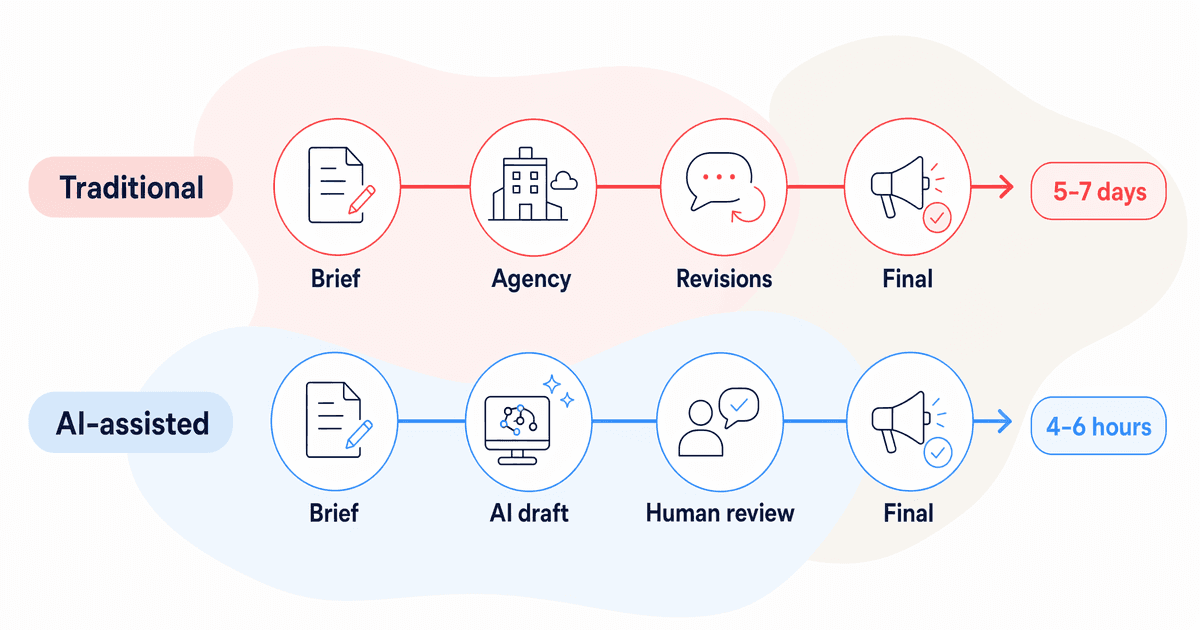
Each UK grocer has different creative guidelines: Tesco's brand book, Sainsbury's template requirements, Asda's digital specifications. What used to take a designer 2 days per retailer now takes approximately 2 hours of review and adjustment when AI handles the initial adaptation.
The retailer specification challenge
Tesco Clubcard promotions need assets in specific dimensions with particular colour restrictions. Sainsbury's Nectar offers use different templates entirely. Asda's media platform has its own format requirements. Your base creative needs adapting 3-4 times minimum.
The AI adaptation workflow
- Create base creative once (either AI-generated or human-designed)
- Feed AI the retailer guidelines document for each grocer
- Generate adapted versions with adjusted copy length, resized images, and retailer colour restrictions applied
- Human review for compliance, brand consistency, and anything that looks off
The trick is building a guidelines library. Download and store each retailer's brand books, template files, and specification documents. When you need adaptations, the AI has the reference material to work from.
Does this produce pixel-perfect agency-quality work every time? No. But it produces 80% quality at 20% of the time cost, and your 20 minutes of polish gets it to publishable standard.
How Does AI Handle Campaign Performance Analysis?
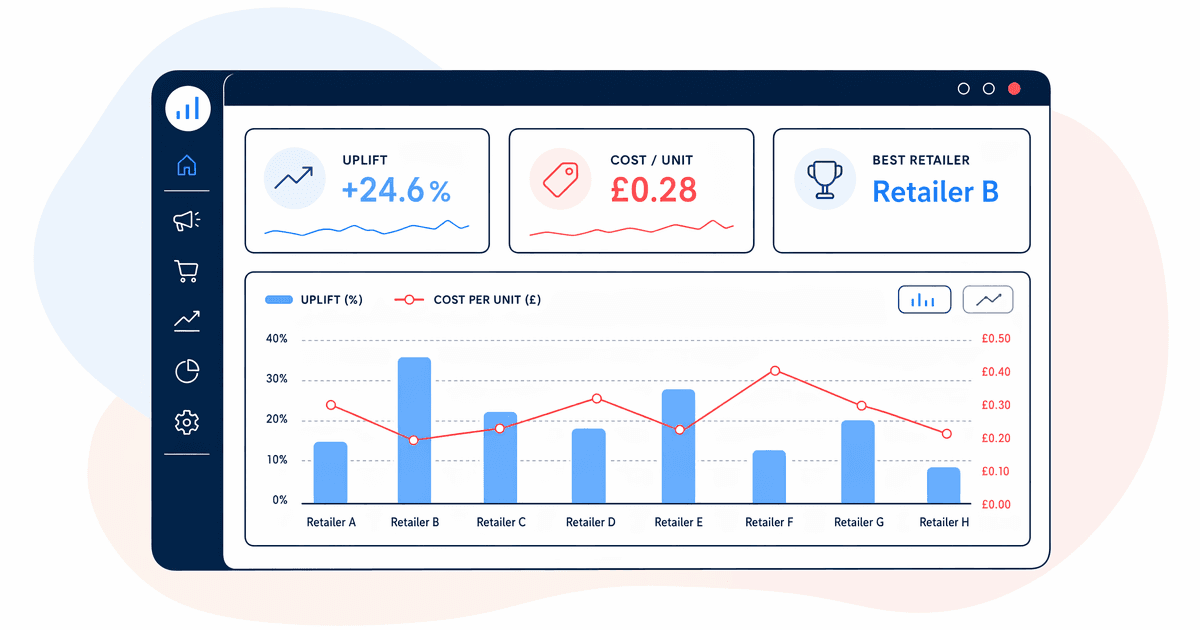
After activation, you need to calculate actual uplift versus baseline, compare cost per incremental unit across different activation types, and determine ROI. AI processes EPOS data and produces structured analysis faster than manual spreadsheet assembly, turning a half-day task into 30 minutes of review.
The data workflow
- Pull EPOS data from retailer portals (Tesco Dunhumby, Sainsbury's Nectar 360, Asda analytics)
- Feed raw data to AI with your pre-activation baseline period clearly identified
- AI calculates: uplift percentage, incremental volume, cost per incremental unit, ROI versus activation cost
- Output: Structured comparison table with narrative summary
What the output looks like
Instead of spending 4 hours in Excel, you get analysis like: "The Tesco gondola end delivered 340% uplift at £3.20 per incremental unit versus the Sainsbury's Nectar offer at 180% uplift at £1.80 per incremental unit. The Nectar offer delivered lower absolute volume but higher efficiency per pound spent."
We've seen teams go from producing quarterly performance reviews to campaign-by-campaign analysis once AI handles the data processing. The insight quality improves because you're comparing activations while they're still fresh, not reconstructing context three months later.
That kind of rapid comparison lets you reallocate budget mid-year. If Nectar offers consistently deliver better cost-per-unit than gondola ends, you shift spend in Q3 rather than discovering the pattern in your annual review.
Citation capsule: BCG's 2026 CPG AI research found that only 11% of consumer goods companies have scaled AI beyond pilot stage in marketing, yet those that have report measurable improvements in campaign speed and performance visibility, particularly in post-activation data analysis and reporting workflows.
How Do You Automate Post-Campaign Reporting?
Retailers want performance reports. Your commercial team wants them too. AI generates first-draft reports from your data in the format each audience needs, cutting a full-day task to roughly 2 hours including review and personalisation.
The reporting workflow
- Gather inputs: EPOS data, activation costs, baseline comparisons, photos of in-store execution
- Feed to AI with a report template: executive summary, key metrics table, performance versus objectives, lessons learned, recommendations
- AI generates the full first draft with data populated throughout
- You add: relationship context ("buyer mentioned interest in Q4 seasonal"), strategic recommendations, and next-steps tailored to your retailer relationship
Why human review still matters
AI doesn't know that your Tesco buyer is sceptical about meal-deal inclusions, or that Sainsbury's have hinted at expanding your fixture space if the next promotion hits 200% uplift. Those relationship insights and strategic nudges are what make your report more than a data dump.
The 2-hour figure includes reading the AI draft, correcting any data misinterpretations, adding your relationship intelligence, and formatting for the specific recipient.
When Do You Still Need an Agency?
AI doesn't eliminate the need for agencies entirely. For certain campaign types, professional media planning and high-end creative direction still justify the fee. The question is whether your specific activation falls into the "AI can handle this" or "hire a professional" category.
Agency-appropriate scenarios
- National TV or radio campaigns requiring media buying expertise and rate negotiation
- Multi-channel campaigns above £100k where coordination complexity exceeds what a small team can manage
- Retailer presentations requiring pitch-level creative for major listing decisions or range reviews
- Zero in-house marketing capacity: AI needs a person to direct it, review output, and maintain brand standards
The hybrid approach
Most brands at this scale end up with a hybrid. They use AI for the 8-10 routine retailer activations per year (Clubcard offers, Nectar promotions, seasonal gondola ends) and bring in an agency for 1-2 major launches or high-stakes pitches.
That hybrid model might look like: £0-£2,000 in AI tooling subscriptions handling routine activations, plus £15,000-£30,000 in agency fees for 1-2 major campaigns. Compare that to £60,000-£200,000 for agency-managed everything.
The real shift we've seen isn't brands dropping agencies entirely. It's brands becoming better clients, because they arrive at agency briefings with AI-generated first drafts and data analysis already done. The agency spends time on strategy and creative elevation rather than production basics.
Frequently Asked Questions
Can AI fully replace a media agency for FMCG retailer activations?
No. AI replaces execution capacity: first-draft creative, asset resizing, data analysis, and reporting. It doesn't replace retailer relationship strategy, media slot negotiation, or creative direction. For campaigns under £100k with an in-house person to direct the tools, AI handles production tasks that agencies typically charge £5,000-£20,000 per campaign to deliver.
How much time does AI save on retailer activation campaigns?
First-draft creative production drops by 60-70%. Retailer-specific asset adaptation goes from 2 days per retailer to roughly 2 hours of review. Post-campaign reporting shrinks from a full day to approximately 2 hours. The cumulative effect across 8-12 annual campaigns frees significant capacity for strategic work.
Which AI tools work best for FMCG retailer activation creative?
For visual assets, Canva AI and Adobe Firefly handle format-specific generation well. For promotional copy, Claude and ChatGPT produce usable first drafts when fed retailer brand guidelines. The key is building a reference library of retailer specifications and approved past examples that AI can draw from.
Making This Work in Practice
The brands getting value from AI in retailer activation share a common setup: one person who understands the retailer requirements, a library of brand assets and retailer guidelines, and 2-3 AI tools they've learned well rather than dabbling in ten.
Start with your next scheduled activation. Run it with AI assistance alongside your normal process. Measure the time difference. In our experience, teams see enough savings on the first campaign to justify the setup investment, and by the third campaign, the workflow feels natural.
If you're earlier in your AI journey, our practical guide to AI for FMCG covers the foundations. For teams already using AI across departments, the retailer portal guide covers the specific data extraction workflows that feed into campaign analysis.