
Every vendor in 2026 is selling "agentic AI" for supply chain. According to NVIDIA(January 2026), 47% of retail and CPG respondents are using or assessing agentic AI. But dig one layer deeper: only 20% actually have agents active. The rest are evaluating, planning, or just ticking a survey box.
If you run supply chain operations at a mid-market food brand, you need to know what an agent actually is, what it can reliably do today, and where the vendor claims outrun the evidence. That's what this post covers. No hype, no "agentic revolution" language. Just the working reality.
Related: broader AI guide for FMCG teams
The Bottom Line: - Only 20% of retail/CPG firms have AI agents active in production (NVIDIA, Jan 2026) - Proven agent use cases today are narrow: PO processing, portal checks, stock monitoring - One UAE distributor cut PO processing from a full day to 10 minutes using browser automation agents (Duvo, March 2026) - Full autonomous supply chain decision-making is projected, not measured - Start with structured, repetitive tasks where failure cost is low
What does "agent" actually mean in supply chain context?
The term is being stretched to meaninglessness. According to BCG(June 2026), agentic capabilities could expand AI value opportunity to 1.7x current levels. But that's a projection about potential, not a report on what's running today.
Here's a working definition that's actually useful. An AI agent is software that can perceive its environment, make decisions, and take actions without step-by-step human instruction. In supply chain terms, that means it can look at a retailer portal, interpret what it sees, decide what action to take, and execute that action.
The key distinction: agents don't follow a script. They interpret context.
A replenishment agent might log into Tesco's supplier portal, read current stock levels, compare them against your agreed service levels, and raise a purchase order if stock is dropping below threshold. It doesn't follow a fixed click-path. It reads the page, understands the data, and acts.
That sounds impressive. In practice, today's supply chain agents are much narrower than that description implies. Most handle one specific task in one specific system. They're not making strategic decisions. They're automating grunt work with enough flexibility to handle minor interface changes.
Related: what AI agents mean for broader FMCG teams
Citation capsule:According to NVIDIA (January 2026), 47% of retail/CPG respondents are using or assessing agentic AI, but only 20% have agents active in production. BCG (June 2026) projects agentic capabilities could expand AI value opportunity to 1.7x current levels, framing this as future potential rather than measured reality.
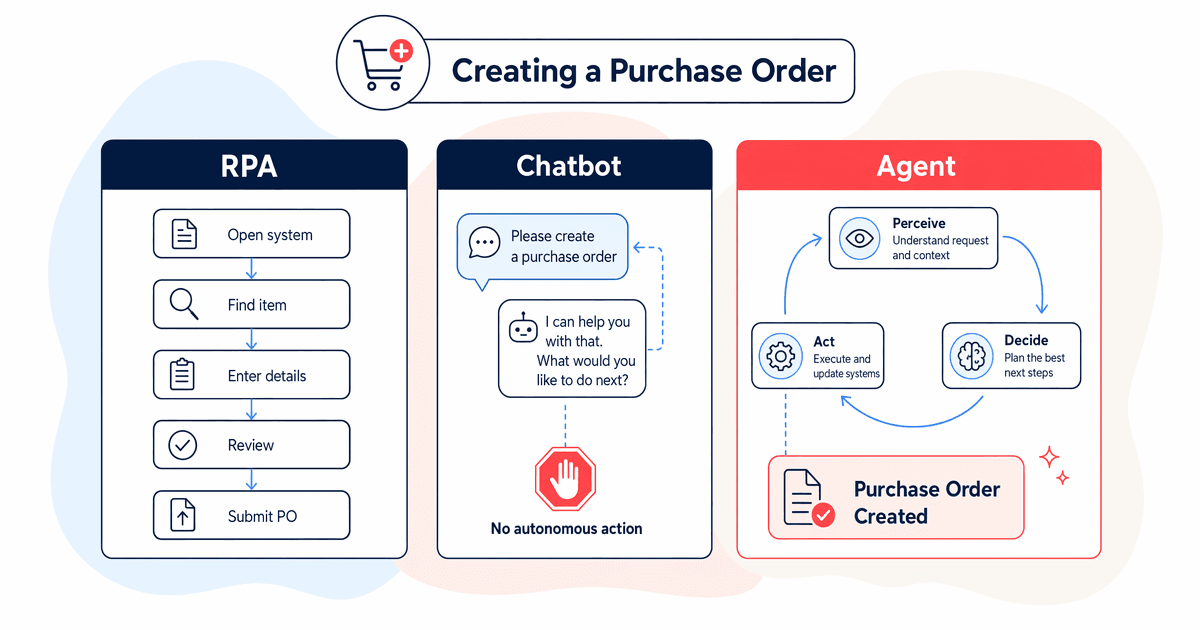
How do agents differ from RPA and chatbots?
The distinctions matter because vendors blur them deliberately. Deloitte(January 2026) found 64% of CPG executives believe they're ahead on agentic AI. As Deloitte notes: surely not everyone can be above average. Much of what's called "agentic" is actually RPA with a language model bolted on.
RPA (Robotic Process Automation)
Follows a pre-scripted sequence of clicks and inputs. If the supplier portal moves a button from the left side to the right, RPA breaks. It has zero adaptability. It's fast and reliable when interfaces don't change, brittle the moment they do.
Chatbots and copilots
Respond to your questions but don't take autonomous action. They might suggest a reorder quantity but won't log into SAP and create the PO. They need you in the loop for every action.
Agents
Perceive, decide, act. They read unstructured inputs (a web page, an email, a PDF invoice), interpret context, choose an action, and execute it. They can handle minor interface changes because they "understand" what they're looking at rather than following pixel coordinates.
The honest middle ground
What's actually deployed in FMCG supply chains today sits between RPA and true agents. Call it "adaptive automation." Browser automation tools that use a language model to navigate portals, but that still operate within tight guardrails. They handle the happy path well. They escalate exceptions to humans.
Related: RPA vs AI comparison
Citation capsule:Deloitte (January 2026) reports 64% of CPG executives believe they are ahead of competitors on agentic AI adoption. The gap between claimed agent deployment and actual capability reflects widespread conflation of RPA, chatbots, and true autonomous agents in vendor marketing.
What supply chain tasks can agents handle today?
Duvo(March 2026) reports AI agents for FMCG supply chain reduce logistics costs 5-20%. One UAE distributor reduced PO processing from over a day to 10 minutes using browser automation agents with SAP. These are real results from narrow, structured tasks.
Here are the specific supply chain workflows where agents work reliably right now.
Purchase order creation
Browser automation agents log into SAP or similar ERP systems, pull demand signals from a dashboard, and create purchase orders. This works because PO creation follows predictable logic: if stock level X is below threshold Y, create order for quantity Z. The decision rules are simple. The value is in removing manual data entry.
Retailer portal stock checks
In our work with food brands, the most practical agent use case today is automated stock-level checks across 3-5 retailer portals. An agent logs into each portal daily, captures current stock positions, and flags anomalies. It replaces 30-45 minutes of manual checking each morning.
Supplier portal navigation
Agents can navigate supplier portals to check delivery schedules, confirm ETAs, and download invoices. They handle the login, navigation, and data extraction steps that a human would otherwise do manually.
Basic exception flagging
UnifyApps(May 2026) reports Supply Chain RCA Agents reduce root-cause analysis manhours by up to 60%. These agents monitor dashboards, detect when a metric falls outside expected range, and flag it for human review. They don't fix the problem. They notice it faster.
What makes these work
Notice the pattern. Every proven use case shares three traits: the task is repetitive, the environment is structured (web portals, ERP screens), and the decision logic is simple. Agents aren't making judgment calls. They're executing well-defined workflows with enough flexibility to handle minor UI changes.
Citation capsule:According to Duvo (March 2026), AI agents reduce FMCG logistics costs 5-20%, with one UAE distributor cutting PO processing from over a day to 10 minutes via browser automation agents integrated with SAP. UnifyApps (May 2026) reports Supply Chain RCA Agents reduce root-cause analysis manhours by up to 60%.
What supply chain tasks are agents still projected to handle?
Veeva(January 2026) finds 72% of CPG companies are using, preparing, or planning to adopt agentic AI for manufacturing. But "planning to adopt" isn't the same as "running in production." Several ambitious agent use cases remain largely theoretical.
Autonomous demand sensing
The vision: an agent that monitors real-time signals (weather forecasts, social media trends, promotional calendars, competitor activity) and adjusts demand forecasts autonomously. UnifyApps(May 2026) claims Demand Forecasting Agents improve planning accuracy by up to 38%.
The reality: this figure comes from vendor documentation, not independent measurement. We haven't seen a mid-market food brand running fully autonomous demand sensing with an agent making unsupervised forecast adjustments.
Multi-supplier negotiation
The vision: an agent that contacts multiple suppliers, compares quotes, negotiates terms, and places orders based on cost/lead-time optimisation.
The reality: no credible deployment evidence exists for FMCG. Negotiation requires relationship context, quality history, and judgment about reliability that agents can't yet access.
End-to-end exception resolution
The vision: when a delivery fails or a quality issue arises, an agent identifies the root cause, contacts the relevant parties, arranges replacement stock, and adjusts downstream plans.
The reality: agents can flag exceptions (proven). They can't resolve complex, multi-party supply chain disruptions. Too many variables, too much unstructured context.
Intelligent Operations Centre management
UnifyApps (May 2026) reports Intelligent Operations Center Agents reduce manual metric reporting by up to 90%. This represents a real efficiency gain, but "reducing reporting" isn't the same as "making autonomous supply chain decisions." It's closer to dashboard automation than strategic decision-making.
Related: evidence gaps in AI for FMCG
Citation capsule:Veeva (January 2026) reports 72% of CPG companies are using, preparing, or planning to adopt agentic AI for manufacturing. However, autonomous demand sensing, multi-supplier negotiation, and end-to-end exception resolution remain projected capabilities without independent deployment evidence in mid-market FMCG.
How wide is the evidence gap?
The gap between what's marketed and what's measured is significant. BCG(June 2026) frames agentic AI as expanding the AI value opportunity to 1.7x current levels. That's a projection about what could happen if the technology matures and adoption scales. It's not a measurement of current returns.
What's measured
- PO processing time reduction: from over a day to 10 minutes (Duvo, March 2026, single case study)
- Logistics cost reduction: 5-20% (Duvo, March 2026, range across early adopters)
- Root-cause analysis time: up to 60% reduction (UnifyApps, May 2026, vendor-reported)
- Manual reporting reduction: up to 90% (UnifyApps, May 2026, vendor-reported)
What's projected
- 1.7x expansion of AI value opportunity (BCG, June 2026)
- 38% improvement in planning accuracy (UnifyApps, May 2026, vendor claim)
- Broad "5-20% supply chain cost reduction" (industry-wide claim, multiple vendor sources)
Why this matters for your business case
Here's what we've observed: the vendors reporting the largest agent ROI figures are also selling agent platforms. That doesn't make the numbers wrong. But when you're building a business case for your board, separate the proven narrow wins (portal automation, PO creation) from the projected broad gains (autonomous planning, multi-party coordination). One is something you can pilot in four weeks. The other might take four years.
If a vendor tells you their agent platform will "reduce supply chain costs by 20%," ask for a named customer reference in food and drink. Ask what specific tasks the agent performs. Ask how they measured the 20%.
Related: how to evaluate AI evidence
Citation capsule:BCG (June 2026) projects agentic AI could expand the total AI value opportunity to 1.7x current levels. However, measured deployment evidence in FMCG supply chain is limited to narrow automation tasks: PO processing and logistics cost reduction of 5-20% (Duvo, March 2026), primarily from single vendor case studies rather than independent research.
What does a supply chain agent deployment actually look like?
Forget the vendor demo. Here's what deploying a supply chain agent looks like in a real mid-market food brand with 200-800 SKUs, 3-5 retail customers, and a small ops team.
Week 1-2: Pick one task
Choose the most repetitive, structured, low-stakes workflow. Stock checks across retailer portals is a good starting point. PO creation in SAP is another. Don't try to automate exception handling first. Start boring.
Week 3-4: Build and test
We've tested browser automation agents on supplier portals. They work reliably for structured, repetitive tasks. They don't handle exceptions well yet. Setup typically takes 2-3 weeks including testing across different portal states (logged out, session expired, data loading slowly).
Configure the agent for your specific portals. Test it against edge cases: what happens when the portal is down? When a field is empty? When the layout changes slightly? Build in human escalation paths for every failure mode.
Week 5-6: Run in parallel
Run the agent alongside your existing manual process. Compare outputs. You'll find discrepancies. Some will be agent errors. Some will be human errors you never noticed. Adjust the agent configuration.
Week 7 onwards: Supervised production
Move to agent-primary, human-supervised. The agent executes daily. A human reviews the output for the first month. Gradually reduce oversight as confidence builds.
What it costs
For a single-task agent (portal monitoring or PO creation), expect:
- Platform/tool costs: 200-500 per month
- Setup and configuration: 2-4 weeks of someone's time
- Ongoing oversight: 15-30 minutes per day initially, reducing to spot checks
That's not the "million-pound AI transformation" vendors sell. It's a practical automation that saves one person 30-60 minutes daily.
Related: pilot planning for demand forecasting
Citation capsule:A practical supply chain agent deployment at a mid-market food brand takes 6-7 weeks from task selection to supervised production. Initial platform costs run 200-500 per month with 2-4 weeks of setup time. The primary value is eliminating 30-60 minutes of daily repetitive portal and ERP tasks per workflow automated.
Should you wait or start now?
NVIDIA(January 2026) shows only 20% of retail/CPG firms have agents running. You're not behind if you haven't started. But waiting for the technology to "mature" means waiting for competitors to build operational muscle you'll then need to catch up on.
Start now if:
- You have repetitive portal-checking or PO-creation tasks consuming 30+ minutes daily
- Your ERP and retailer portals have stable, web-based interfaces
- You have one person willing to own the setup and monitor outputs
- The task you're automating has a low cost of failure (a missed stock check is annoying, not catastrophic)
Wait if:
- You're hoping agents will make strategic supply chain decisions for you (they won't yet)
- Your data foundations aren't in place (agents still need clean inputs to work with)
- You don't have a specific, narrow task in mind (agents aren't a general solution)
The practical first step
Pick one task. One portal. One workflow. Give it six weeks. Measure the time saved versus the cost. That gives you a real data point for your board, not a vendor projection.
Based on the deployments we've supported, the breakeven point for a single-task supply chain agent is typically 8-12 weeks of operation. After that, the time savings compound because you've built the infrastructure to add a second and third task faster.
The gap between the 20% who have agents active and the 47% who are "assessing" will close over the next 12-18 months. The question isn't whether agents will handle supply chain tasks. It's whether you'll have built the operational knowledge to deploy them effectively when the technology catches up to the hype.
Related: getting started with AI for FMCG
FAQ
What's the difference between AI agents and RPA in FMCG supply chain?
RPA follows pre-scripted steps and breaks when a portal changes layout. AI agents perceive their environment, interpret unstructured inputs, and choose actions based on context. In practice, most current "agents" in FMCG are closer to adaptive RPA, using a language model to handle minor interface changes while still operating within tight guardrails on structured, repetitive tasks.
What supply chain tasks can AI agents handle today?
Proven use cases include automated stock-level checks across retailer portals, purchase order creation in systems like SAP, and exception flagging in replenishment workflows. Duvo(March 2026) reports one UAE distributor reduced PO processing from over a day to 10 minutes. These are narrow, repetitive tasks with clear success criteria.
Should mid-market food brands invest in AI agents now?
Start with one narrow workflow where failure is low-cost. NVIDIA(January 2026) found only 20% of retail/CPG firms have agents active, so you're not behind. Pick a structured task like daily stock checks or PO creation. Budget for 4-6 weeks of setup. Keep a human in the loop for all exception cases until you've built confidence in the agent's reliability.
Sources
- NVIDIA, "State of AI in Retail and Consumer Packaged Goods,"January 2026. Third annual industry survey.
- BCG & The Consumer Goods Forum, "AI in CPG and Retail: How Winners Are Pulling Ahead,"June 2026. Survey of 39 senior CPG and retail executives worldwide.
- Deloitte, "2026 Consumer Products Outlook,"January 2026. Survey of 300 senior executives globally.
- Duvo, "FMCG Automation: AI Transforming Operations,"March 2026. Industry analysis with case study data.
- Veeva Systems, "State of AI in Consumer Goods Report,"January 2026. Survey of 150+ IT and functional leaders at global CPG companies.
- UnifyApps (May 2026). "AI Agents for Supply Chain Management." Agent capability documentation with reported efficiency metrics.