
Your BRCGS audit window is approaching. You've got a HACCP plan that hasn't been reviewed in six months, a corrective action log with items you've lost track of, and a document register that may or may not match what Issue 9 actually requires. According to Veeva's industry research, 64% of CPG companies still rely on a mix of digital and manual processes for quality and compliance (Veeva, January 2026). If that sounds like your site, AI tools can compress the document preparation and gap identification work from weeks to days.
This guide covers where AI genuinely helps with BRCGS audit prep and where it doesn't. It's written for the quality manager who's already juggling daily production issues, customer complaints, supplier onboarding, and HACCP records on top of audit preparation.
The Bottom Line - AI compresses document gap analysis from 2-3 days to 2-3 hours - Physical standards, food safety culture, and hazard analysis judgement remain human-only - General AI tools (£0-20/month) handle the gap analysis exercise; specialist QMS costs £200-1,000/month - 15.2% of manufacturing revenue is lost to quality deviations, delays, and rework (Schneider Electric, 2026)
Why is BRCGS audit prep such a time crunch?
BRCGS audits happen annually, either announced (with a fixed date) or unannounced (within a defined window). According to Schneider Electric's 2026 study, 15.2% of manufacturing revenue is lost to delays, downtime, rework, and quality deviations (Schneider Electric, 2026). Audit prep adds to that burden because the quality manager preparing for it is the same person managing those daily quality issues.
Citation capsule: Schneider Electric's April 2026 study found that CPG manufacturers lose 15.2% of revenue to production delays, downtime, rework, and quality deviations, with audit preparation adding further strain to quality managers already managing these daily operational losses (Schneider Electric, 2026).
The pattern we see most often: prep takes 4-8 weeks of focused work layered on top of normal duties. The quality manager is simultaneously handling customer complaints, processing supplier approvals, updating specs, and keeping daily production records compliant. Audit prep becomes evening and weekend work. AI won't do the audit for you. But it can eliminate the most tedious parts of document preparation.
What does that 4-8 weeks actually look like?
A typical audit prep timeline for a mid-market UK food manufacturer includes:
- Reviewing all procedures against current BRCGS standard requirements
- Checking the corrective action log for overdue or unverified items
- Running a mock traceability exercise
- Updating the internal audit schedule and closing open findings
- Verifying staff training records are current
- Walking the site to check physical standards and GMP compliance
The document review and gap identification alone often takes 2-3 weeks. That's where AI makes the biggest difference.
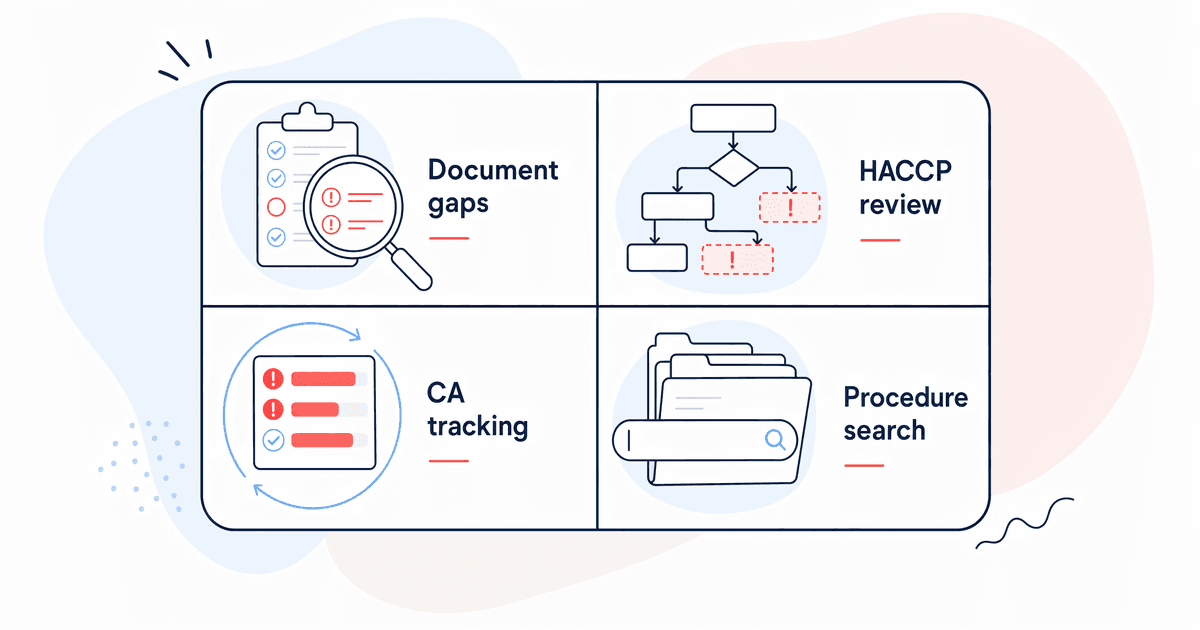
What can AI actually help with in BRCGS audit prep?
AI tools handle four specific areas well in audit preparation. With 64% of CPG companies still mixing digital and manual compliance processes (Veeva, January 2026), even basic AI-assisted document review puts you ahead of most sites. The key is knowing where AI adds genuine value versus where it creates a false sense of security.
Document gap analysis
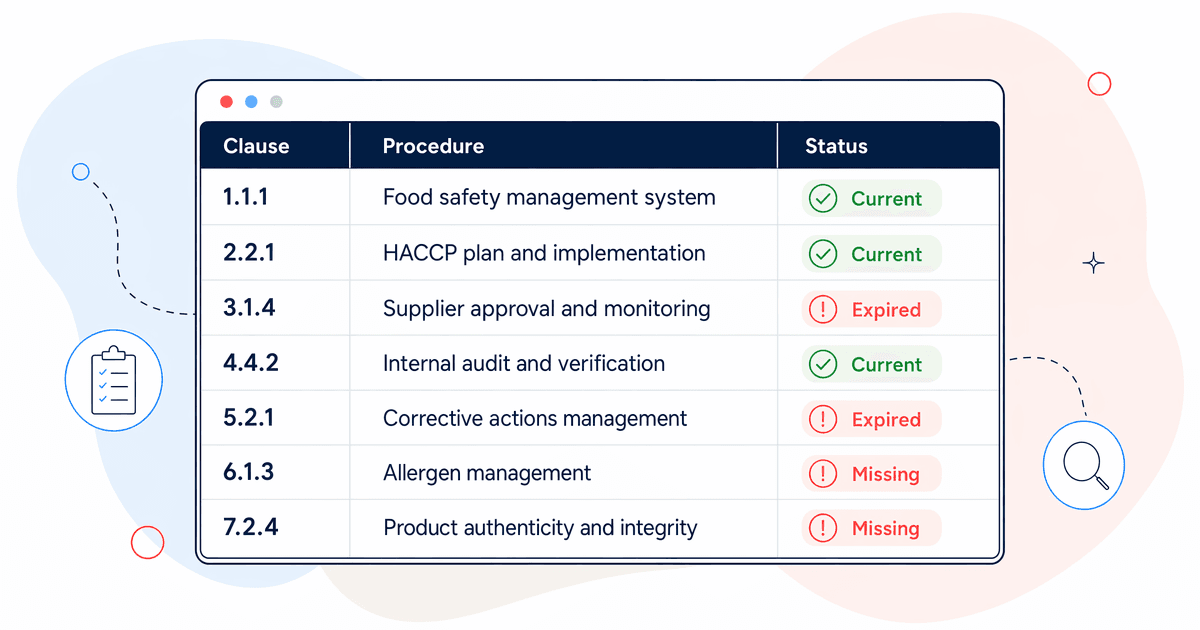
Feed your document register into an AI tool and cross-reference it against BRCGS Issue 9 clauses. The AI can identify which clauses lack a corresponding procedure, which procedures are past their review date, and where your documentation structure has gaps.
Manual approach: 2-3 days of reading through the standard clause by clause, checking each against your procedure list. With AI: 2-3 hours, including the time to upload documents and review the output.
In our experience working with UK food manufacturers, the most common gaps AI identifies are: procedures that exist but haven't been reviewed within 12 months (a frequent minor non-conformance), and clauses where the site relies on "custom and practice" without a documented procedure.
HACCP plan review
AI can check your HACCP plan against Codex Alimentarius principles. It flags structural inconsistencies: CCPs without documented monitoring frequency, hazards identified without corresponding control measures, and decision tree logic that doesn't follow through consistently.
What it won't do: validate your hazard analysis. Whether Salmonella is a realistic hazard at a specific process step requires food safety expertise and knowledge of your specific product and process. AI can spot that you've identified a hazard without a corresponding CCP assessment. It can't tell you whether your hazard identification is correct.
Corrective action tracking
Pull your CA log and ask AI to categorise entries by type, identify overdue items, and flag recurring root causes. Auditors specifically look for systemic issues: the same non-conformance appearing three or more times suggests your corrective action isn't addressing the root cause.
AI is particularly useful here because it can search through 12 months of free-text entries and identify patterns that manual review misses. "Foreign body found in raw material" appearing in different wording across six entries all pointing to the same supplier, for instance.
Procedure search and retrieval
When the auditor asks "show me your procedure for allergen management during product changeovers," you need to find it fast. Two minutes is a reasonable target. AI-powered document search across your QMS beats folder-diving through 500 Word documents in a shared drive.
This isn't about impressing the auditor. It's about not wasting audit time on retrieval, which creates a calm, organised impression that influences how the auditor perceives your food safety culture.
What can't AI help with?
AI handles document analysis well. It handles physical, observational, and judgement-based tasks poorly. A Schneider Electric study finding 15.2% revenue loss to quality deviations confirms that operational execution, not documentation alone, drives real outcomes (Schneider Electric, 2026). Knowing the limits prevents over-reliance.
Physical site standards
Cleaning effectiveness, structural maintenance, pest control, and facility condition are visual and physical assessments. No AI tool can tell you whether the wall-floor junction in your high-care area needs resealing or whether your drain covers are properly secured. Walk the site. Regularly.
Food safety culture
BRCGS Issue 9 places significant emphasis on food safety culture. Auditors assess this through staff interviews, observation of behaviours, and evidence of management commitment. Can your production operatives explain why they follow specific procedures? Do managers visibly participate in food safety activities? AI can't observe or influence this.
GMP on the factory floor
Correct PPE usage, handwashing compliance, no jewellery policies, glass and brittle plastics controls in practice. These are behavioural and observational. Your internal audit programme and management walk-rounds are the tools here, not AI.
Hazard analysis judgement
Deciding whether a specific biological, chemical, or physical hazard is reasonably likely at a given process step requires process knowledge, ingredient knowledge, and food safety expertise. AI can structure your analysis and check for gaps in logic. It cannot make the judgement call.
The risk with AI in audit prep isn't that it gives wrong answers. It's that it gives confident-sounding answers that a non-specialist might accept without challenge. If your HACCP team uses AI output to populate their hazard analysis without critically evaluating each decision, they've delegated food safety judgement to a tool that has no understanding of their specific process. Auditors will spot this immediately when they ask "why" questions.
AI governance for quality teams
Step 1: Get your documents into a searchable format
If your QMS lives in a shared drive with Word documents and PDFs, AI can already search it. According to Veeva, 64% of CPG companies operate with mixed digital and manual systems (Veeva, January 2026). The first step is getting your critical documents into a format AI tools can process.
Priority documents to digitise first
If parts of your QMS are still in paper binders (it happens, no judgement), digitise these six documents first. They're the ones auditors request most frequently and the ones AI can analyse most effectively:
- Food safety policy and supporting objectives
- HACCP plan including flow diagrams and hazard analysis
- Allergen management procedure and risk assessments
- Supplier approval procedure and approved supplier list
- Recall and withdrawal procedure including contact lists
- Traceability procedure and recent exercise records
Scan to PDF as a minimum. OCR-processed PDFs are better because AI can search the text content rather than just reading images.
What "searchable" means in practice
Your documents need to be text-based rather than image-based. A scanned PDF where each page is a photograph won't help. Most modern scanners produce OCR text by default, but check: can you highlight and copy text from the PDF? If yes, it's searchable. If no, run it through an OCR tool first.
Step 2: How do you run a clause-by-clause gap check?
Upload your procedure list (or full procedures if the AI tool supports it) alongside the BRCGS Issue 9 requirements. With 15.2% of manufacturing revenue already lost to quality issues (Schneider Electric, 2026), identifying documentation gaps before the auditor does is basic risk management.
Citation capsule: A clause-by-clause AI gap analysis cross-references existing QMS procedures against BRCGS Food Safety Issue 9 requirements, compressing a manual 2-3 day review to 2-3 hours. With 64% of CPG companies still mixing digital and manual quality processes (Veeva, January 2026), this basic exercise puts sites ahead of the majority.
Focus on the fundamentals first
BRCGS Issue 9 has fundamental requirements in clauses 1-7. These carry critical and major non-conformance risk. A critical non-conformance results in automatic failure. Prioritise your gap check in this order:
- Clause 1: Senior management commitment and continual improvement
- Clause 2: The food safety plan (HACCP/food safety plan based on Codex)
- Clause 3: Food safety and quality management system
- Clause 4: Site standards
- Clause 5: Product control
- Clause 6: Process control
- Clause 7: Personnel
How to prompt the AI tool
Be specific. "Check my documents against BRCGS" is too vague. Try: "Compare this procedure list against BRCGS Food Safety Issue 9 clause 3. For each sub-clause, identify whether I have a corresponding documented procedure, and flag any procedures last reviewed more than 12 months ago."
The more structured your input, the more useful the output. Give it your document register as a table (procedure name, document reference, last review date, responsible person) rather than a narrative description.
Interpreting the results
AI will likely flag more gaps than actually exist. Some clauses are addressed within broader procedures rather than having a dedicated document. Your management review might cover elements of clause 1 without being titled "Senior Management Commitment Procedure." Use the AI output as a starting checklist, not a final verdict.
Step 3: How do you audit your corrective actions?
Pull your corrective action log for the last 12 months and feed it to an AI tool. Most food manufacturers generate 50-200 CAs annually. Manual review of that volume for patterns takes a full day. AI does it in minutes, and it's better at spotting patterns hidden in varied wording across entries.
What to ask AI to identify
Give the AI your CA log and request:
- Categorisation by type: foreign body, allergen, pest, cleaning, documentation, supplier
- Overdue items: any CA past its target closure date
- Recurring root causes: same issue appearing three or more times (systemic)
- Previous audit findings: any CAs from the last BRCGS audit that haven't been verified effective
- Effectiveness verification gaps: closed CAs without evidence that the fix worked
Why auditors care about recurring non-conformances
A single non-conformance is a finding. The same non-conformance appearing repeatedly is evidence that your corrective action process isn't working. Auditors are trained to look for this. If your CA log shows "pest sighting in raw material storage" three times in 12 months with different "root causes" each time, that's a systemic failure in pest management, not three isolated incidents.
We've seen sites genuinely surprised when AI analysis reveals patterns they'd missed. Each individual CA was handled and closed. But nobody stepped back to see that 40% of their CAs originated from the same production line, suggesting an equipment or design issue rather than the procedural fixes being applied each time.
quality and compliance AI use cases
Step 4: How do you prepare your traceability demonstration?
BRCGS requires a traceability exercise, both forward (raw material to finished product) and backward (finished product to raw material), completed within 4 hours. Sites that practice this before the audit pass it cleanly. Sites that don't often scramble and exceed the time limit. AI can help map your traceability links if batch records are digital, but the physical exercise still needs to run.
What AI can do
If your batch records, goods-in records, and dispatch records are in digital format (spreadsheets, ERP exports, or a dedicated traceability system), AI can:
- Map the links between incoming batch numbers and finished product batch codes
- Identify gaps in your traceability chain (a batch with no corresponding goods-in record, for example)
- Cross-reference your mass balance (does input quantity roughly equal output plus waste?)
What still needs human execution
The actual timed exercise must be performed by your team. BRCGS auditors want to see that your people can retrieve the information, not that a tool can. Practice the exercise quarterly. Time it. Record the results. Most sites aim for under 2 hours for both directions combined.
Pick a batch from 3-4 months ago (not last week, when everything is fresh, and not from 11 months ago, when records might have been archived). Run forward and backward traces. Document what you found and how long it took.
Which tools work for BRCGS audit prep with AI?
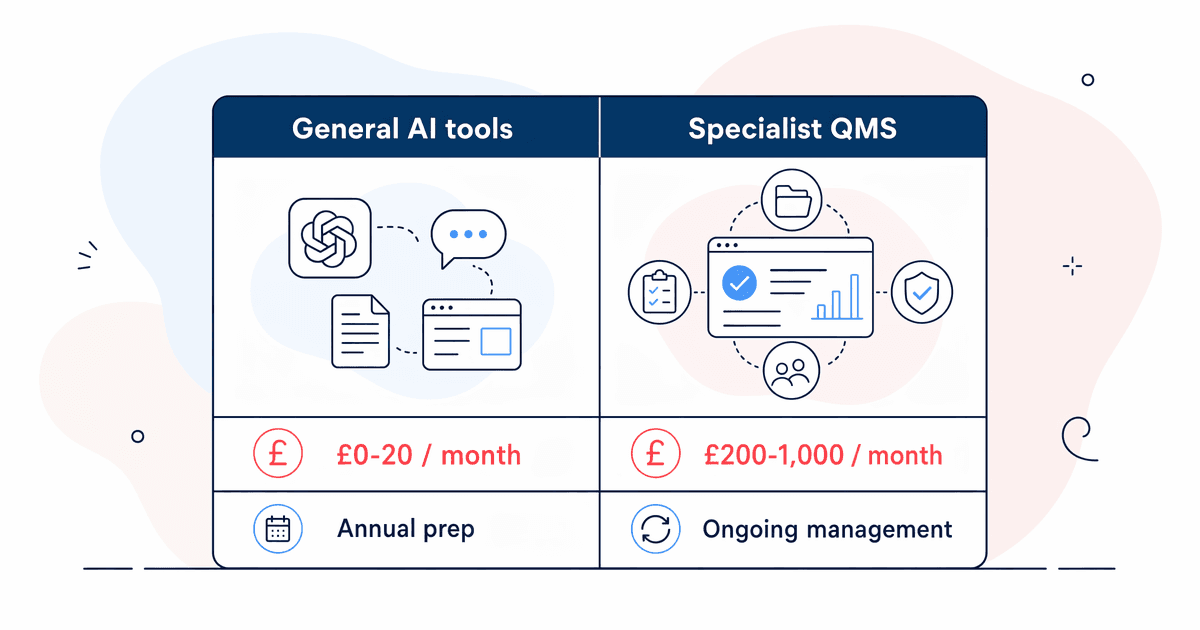
General AI tools handle the gap analysis exercise effectively for a one-off or annual audit prep cycle. Specialist QMS platforms make more sense for ongoing compliance management. With 64% of the industry still operating with mixed processes (Veeva, January 2026), even basic tooling is an improvement.
General AI tools (£0-20/month)
Claude or ChatGPT with document upload capability. Upload your procedure list, your BRCGS requirements summary, and your CA log. Ask specific questions. These work well for:
- One-off gap analysis before an audit
- CA log pattern identification
- Procedure search during prep
- Drafting corrective action responses
Limitations: you're uploading potentially sensitive documents to a third-party platform. Check your company's AI governance position on this. Most quality documents aren't commercially sensitive, but some (customer specifications, proprietary formulations) might be.
Specialist QMS tools with AI features (£200-1,000/month)
Ideagen Q-Pulse, Mango, and Harpc offer QMS management with varying degrees of AI integration. These make sense when:
- You want ongoing compliance management, not just annual audit prep
- Multiple people need access to the system daily
- You need audit-ready reporting at any point in time
- Your customer audit frequency is high (monthly retailer audits, for instance)
The practical recommendation
For annual BRCGS audit prep, general AI tools are sufficient. Do the gap analysis exercise 6-8 weeks before your audit window. If you're dealing with multiple customer audits monthly on top of BRCGS, and your quality team has more than two people, a dedicated QMS platform earns its cost through time savings across the year.
practical guide to AI tools for FMCG
Frequently asked questions
Can AI replace a quality manager for BRCGS audit preparation?
No. AI handles document search, gap identification, and corrective action categorisation well. It cannot assess physical site standards, food safety culture, or validate hazard analysis decisions. Think of it as a research assistant operating at machine speed on document-heavy tasks, freeing the quality manager to focus on site readiness and staff preparation.
How far in advance should I start AI-assisted audit prep?
Six to eight weeks before your audit window. Run the AI gap analysis first (week 1), then spend the remaining time closing gaps, updating procedures, and walking the site. Don't wait until two weeks before. AI compresses the analysis phase, not the fix-it phase. You still need time to write missing procedures, close overdue CAs, and retrain staff.
Is it safe to upload quality documents to AI tools?
Most quality documents (procedures, CA logs, audit schedules) aren't commercially sensitive. Customer-specific specifications and proprietary formulations may be. Check your company's data handling policy. Both Claude and ChatGPT offer enterprise tiers with data processing agreements. If in doubt, anonymise supplier names and product codes before uploading.
What to do this week
You don't need to implement everything at once. If your audit window is approaching, start here:
- Today: get your document register into a single spreadsheet if it isn't already (procedure name, reference number, last review date, owner)
- This week: upload that register plus the BRCGS Issue 9 clause list to Claude or ChatGPT and run a gap analysis
- Next week: pull your CA log for 12 months and ask AI to categorise and identify patterns
- Week 3: run a timed traceability exercise with your team
That sequence covers the document-heavy work. Everything after that is physical: walking the site, observing practices, interviewing staff, and closing the gaps AI identified. The tools compress the discovery phase. The quality manager still owns the action.
We've found that sites completing this four-step sequence identify an average of 8-12 documentation gaps that would have become minor non-conformances. Fixing a gap before the audit costs nothing but time. Finding it during the audit costs a grade reduction. The maths is straightforward.