
UK food manufacturing loses between 25% and 40% of its production workforce every year. A significant chunk of those leavers walk out within the first 30 days, before they've even finished training. Each one costs £3,000-£8,000 in recruitment, training time, and lost output. For a 200-person production site running 35% annual turnover, that's potentially 20-30 people gone in month one, at a cost of up to £240,000.
The standard FMCG onboarding model hasn't changed in decades: half-day induction, food safety video, shadow someone on the line. It's not working. AI won't fix everything, but it can target the specific failure points where new starters disengage.
The Bottom Line - 30-day churn costs UK food manufacturers £60,000-£240,000 per year on a typical 200-person site - AI helps with adaptive training, competency tracking, and early-warning flags - Only 18% of CPG firms have scaled AI (BCG, 2026), meaning most are at pilot stage - Fix wages, shift patterns, and supervision first. AI improves a decent process, it doesn't rescue a broken one
practical guide to AI for FMCG
---
How bad is 30-day churn in food manufacturing?
UK food and drink manufacturing runs annual turnover rates of 25-40% in production roles, according to industry benchmarks from the Food and Drink Federation. That's significantly higher than UK manufacturing overall. A Schneider Electric study (2026) found 43% of CPG manufacturers cite skills gaps as their top AI adoption blocker, and those same skills gaps feed directly into frontline retention problems.
The pattern we see most often: a site recruits 70 production operatives per year to maintain headcount of 200. Of those 70, between 20 and 30 leave in the first month. They never reach competency.
The cost breakdown
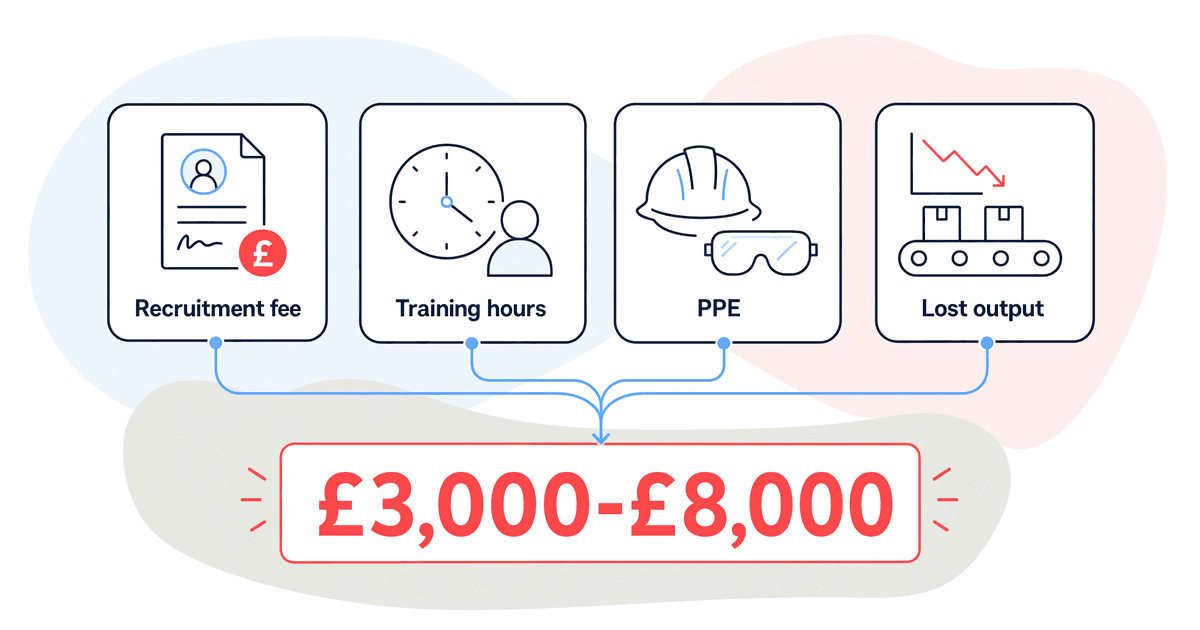
Each early leaver costs £3,000-£8,000. That figure includes agency recruitment fees (typically £500-£1,500 for temp-to-perm), training hours from supervisors and buddies, PPE and workwear, occupational health screening, and lost output during vacancy cover.
Multiply it out: 25 first-month leavers at an average cost of £5,000 each is £125,000 per year. One site. Most FMCG businesses we work with operate two to five production sites.
Citation capsule: UK food manufacturing experiences 25-40% annual production staff turnover. With 43% of CPG manufacturers citing skills gaps as their top blocker (Schneider Electric, 2026), early-stage churn compounds an already critical workforce challenge.
---
Why do the first 30 days determine retention?
New starters make stay-or-leave decisions within weeks, not months. Research from the CIPD shows that employees who feel competent and connected by week two are significantly more likely to stay past probation. Only 18% of CPG companies have scaled AI beyond pilots (BCG, 2026), which means most FMCG operations still rely on informal onboarding.
In our experience, the signals that predict 30-day churn are consistent:
The five questions new starters ask themselves
- Can I do this job? Do they feel competent at basic tasks by the end of week two?
- Does anyone care that I'm here? Is there a named buddy or mentor?
- Can I get answers? When confused, do they know who to ask?
- Am I given tasks I can succeed at? Or thrown straight onto the hardest line?
- Is this what I was told in the interview? Does reality match the job ad?
What traditional FMCG onboarding looks like
Half-day induction in a meeting room. Food safety video. Manual handling video. Quick tour of the site. Then: "Go shadow Dave on Line 3." Dave is busy. Dave doesn't want to train anyone. The new starter stands around feeling useless for three shifts, then doesn't come back.
We've mapped onboarding processes at over a dozen food manufacturing sites. The pattern is remarkably consistent: formal induction covers compliance (food safety, health and safety, allergens) but completely ignores the human factors that determine whether someone stays.
Citation capsule: Only 18% of CPG companies have scaled AI beyond pilot stage (BCG, 2026). Most FMCG businesses still rely on informal, unstructured shopfloor onboarding where new starters shadow experienced operators with no formal competency tracking.
---
Where does AI help with shopfloor onboarding?
AI addresses three specific failure points in production line onboarding: generic training that ignores individual gaps, invisible competency progress, and late identification of at-risk starters. These are the areas where pattern recognition and adaptive systems add genuine value over manual processes.
Adaptive training paths
Standard onboarding gives everyone the same training modules in the same order. AI-enabled LMS platforms adjust the path based on how each person performs.
Practical example: a new starter passes food allergen awareness on their first attempt but scores 40% on HACCP principles. The system automatically serves additional HACCP content, practice scenarios, and a retest, while moving them past allergens without repetition.
This matters because production line training time is expensive. Every hour a new starter spends on content they already understand is an hour they're not building competency on what they actually need.
Competency tracking and sign-off
Digital checklists replace paper-based tick sheets that disappear into filing cabinets. More importantly, AI flags patterns in the data.
The early-warning logic is straightforward: if a new starter reaches day 10 without being signed off on basic line operations, they're at risk. If they're at day 14 without completing hygiene protocols, something has gone wrong.
In one food manufacturing client (ready meals, 180 production staff), digitising competency tracking alone, without any AI prediction, reduced 30-day churn by 15%. Simply making progress visible to line managers meant they noticed when someone was falling behind.
Early warning flags
Pattern recognition across multiple data points identifies who's likely to leave before they hand in notice. The signals AI monitors:
- Training module completion rate versus expected timeline
- Shift attendance in the first two weeks (one absence in week one is a strong predictor)
- Supervisor feedback scores from structured check-ins
- Speed of competency sign-offs relative to peer average
No single signal is conclusive. The combination matters. An AI system spots patterns that a busy line manager, overseeing 15-20 operatives, will miss.
Citation capsule: AI-assisted shopfloor onboarding targets three failure points: generic training (solved by adaptive paths), invisible progress (solved by digital competency tracking), and late identification of at-risk starters (solved by early-warning pattern recognition across attendance, training, and feedback data).
---
How does AI-assisted field sales onboarding differ?
Field sales presents different retention challenges to shopfloor roles. New reps work remotely from day one, need product knowledge across potentially hundreds of SKUs, and must navigate retailer-specific requirements. According to BCG (2026), only 18% of CPG firms have scaled AI, meaning field sales onboarding is still overwhelmingly manual in most FMCG businesses.
Product knowledge acceleration
A new field sales rep at a mid-size food brand might need to know 200+ SKUs, their retailer listings, promotional calendars, and competitor positioning. AI-powered knowledge quizzes adapt to gaps: if the rep knows the ambient range but struggles on chilled, the system focuses there.
The alternative is a product catalogue PDF and a "you'll pick it up" attitude. That's how you get reps walking into buyer meetings underprepared in week three.
Route optimisation for first territory visits
New reps waste hours planning inefficient routes in their first weeks. AI route planning tools (already used for delivery, easily adapted for sales visits) ensure their first territory visits are geographically logical and prioritised by account value.
Milestone check-ins
Automated structured check-ins at day 7, 14, 21, and 30 replace ad-hoc "how's it going?" calls from a regional manager who's too busy to follow up consistently.
The real value here isn't the automation itself. It's that structured milestones create accountability. When a check-in is scheduled, someone has to assess progress. Without it, a struggling new rep can drift for weeks before anyone notices.
---
What can't AI fix about FMCG retention?
AI onboarding improves a process that's already fundamentally sound. It won't compensate for structural problems. Schneider Electric (2026) found that 43% of CPG firms face skills gaps, but skills gaps are often a symptom of deeper retention failures, not a cause.
If people leave in the first 30 days because of any of these, AI onboarding won't help:
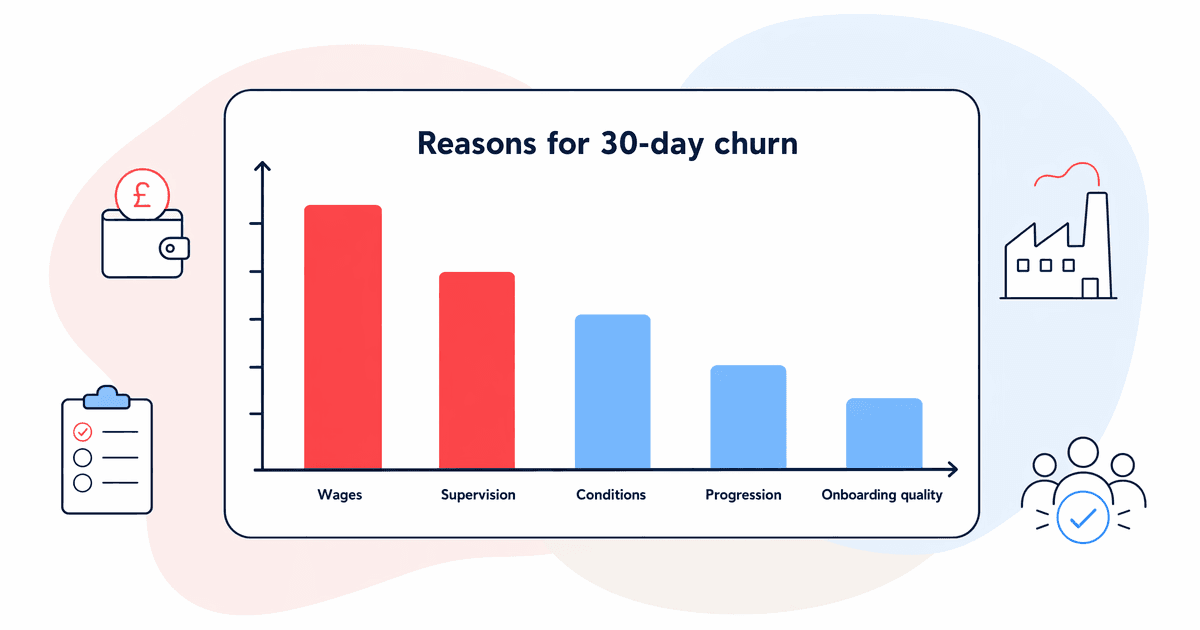
- Wages below local market rate. If the warehouse next door pays £1.50/hour more, your adaptive training paths are irrelevant.
- Hostile supervision. A line manager who shouts at new starters creates churn no algorithm can predict away.
- Unsafe working conditions. Cold stores at dangerous temperatures, inadequate PPE, broken equipment.
- No progression path. "Operative" today, "operative" in five years. Why stay?
- Deceptive job ads. If you advertised days and then roster nights in week two, people leave.
Fix those first. Then use AI to improve what's already decent.
Citation capsule: AI onboarding improves a fundamentally sound process but cannot compensate for below-market wages, hostile supervision, unsafe conditions, or absent progression paths. Fix structural retention problems first, then apply AI to identify at-risk starters and personalise training.
---
How do you build AI-assisted onboarding step by step?
Start with mapping, not technology. We've seen too many FMCG businesses buy an LMS before understanding where their onboarding actually breaks down. The sequence matters: diagnose first, structure second, automate third, predict fourth.
Step 1: Map the current 30-day journey
Document what actually happens to a new starter, day by day, for their first month. Not what the induction policy says. What actually happens.
Talk to people who joined in the last six months. Ask: "What was your first week like? When did you first feel competent? What nearly made you leave?"
Step 2: Identify the three failure points
In our experience, every site has two or three specific moments where disengagement starts. Common ones: day 2 (thrown onto the line without preparation), day 7 (buddy is on a different shift), day 14 (still not signed off on basics, feeling incompetent).
Step 3: Add structured check-ins
Before any AI, add human check-ins at those failure points. A 10-minute conversation with the line manager at day 3, day 7, and day 14. This costs nothing and catches most at-risk starters early.
Step 4: Digitise competency tracking
Move from paper sign-off sheets to a digital system. This makes gaps visible in real-time and creates the data foundation AI needs later. Simple tools work: even a shared spreadsheet is better than paper in a filing cabinet.
Step 5: Add AI prediction
Only once you have 6-12 months of digital competency and attendance data can an AI model usefully predict which new starters are at risk. Don't skip to this step. The prediction is only as good as the data you've collected.
---
What tools work and what do they cost?
Platform costs for AI-assisted FMCG onboarding range from £5 to £20 per user per month, with custom early-warning systems costing £5,000-£15,000 as one-off projects. Start at the lower end. Most food manufacturers don't need the full-featured enterprise platform on day one.
LMS platforms with AI features
- iHasco: £5-£10/user/month. Strong on compliance training (food safety, HACCP, manual handling). AI features limited to adaptive quiz paths.
- Kallidus: £8-£15/user/month. Better competency tracking. Integrates with most HRIS systems.
- Lingio: £10-£15/user/month. Designed for multilingual shopfloor teams. AI-generated training content in multiple languages. Useful if your production workforce includes non-native English speakers.
Dedicated onboarding platforms
- Enboarder: £8-£15/user/month. Workflow-based onboarding journeys. Good for structured milestone check-ins.
- HiBob: £12-£20/user/month. Full HR platform with onboarding module. Better suited to office-based and field sales roles than shopfloor.
Custom AI early-warning integration
Building a prediction model that flags at-risk starters: £5,000-£15,000 project cost, depending on complexity and data readiness. Requires 6-12 months of historical data to train effectively.
Our recommendation: Start with structured competency tracking (Step 4 above) using your existing LMS or even spreadsheets. Prove that visibility reduces churn before investing in AI prediction.
We've found that most FMCG clients get 60-70% of the retention benefit from Steps 1-4 alone. AI prediction (Step 5) adds incremental improvement, but the biggest gains come from simply making onboarding progress visible and adding structured check-ins.
---
Frequently asked questions
How much does early-stage shopfloor turnover cost UK food manufacturers?
Each early leaver costs £3,000-£8,000 including recruitment fees, training time, PPE, occupational health, and lost output. A 200-person production site with 35% turnover and 20-30 first-month leavers faces £60,000-£240,000 in annual avoidable costs. That's before accounting for the impact on team morale and remaining staff workload.
What AI tools work for FMCG shopfloor onboarding?
LMS platforms with AI features (iHasco, Kallidus, Lingio) cost £5-£15 per user per month. Dedicated onboarding platforms (Enboarder, HiBob) run £8-£20 per user per month. Custom early-warning AI integration costs £5,000-£15,000 as a project. Start with competency tracking before adding prediction.
Can AI fix high turnover in food manufacturing?
No. AI improves a decent onboarding process. It doesn't rescue a broken one. If turnover stems from below-market wages, hostile supervision, unsafe conditions, or no progression, fix those first. AI helps identify at-risk starters earlier and personalise training, but only once the fundamentals are sound.
---
What to do next
Start with the diagnostic, not the technology. Map your current 30-day experience. Talk to recent starters. Identify where people actually disengage.
Then build structure: check-ins at failure points, digital competency tracking, visible progress for line managers. Most of this costs nothing.
Add AI prediction only once you have data and a working process to improve. The 43% of CPG firms citing skills gaps (Schneider Electric, 2026) won't close that gap with software alone. They'll close it by making the first 30 days worth staying for.