
You know forecast accuracy is costing you money. Overstock ties up cash. Stockouts lose listings. But when you sit down to brief a vendor, internal data team, or AI consultancy on a demand forecasting project, what exactly should that document contain?
We've reviewed dozens of forecasting project briefs from UK food and drink brands. The ones that lead to successful pilots share the same five sections. The ones that stall almost always skip the same two: defining the baseline metric and documenting what data is missing.
This guide gives you a practical template. It covers what to include, what questions to answer before the first vendor call, and how to spot red flags in the responses you get back. No technical background required. Just an understanding of your own supply chain pain points.
Related: demand forecasting fundamentals
The Bottom Line: - Data plumbing accounts for 40-60% of real project cost, not the model itself (Heizen, 2026) - AI reduces demand forecasting errors by up to 50%when properly deployed (McKinsey, 2024) - More than half of companies don't formally measure AI ROI, making pilot-to-scale decisions almost impossible (BCG, June 2026) - A brief without a defined baseline metric is a brief that cannot prove success
What does a good brief actually contain (and why most are too vague)?
Most AI forecasting briefs fail because they describe the dream outcome without specifying starting conditions. BCG(June 2026) found that more than half of companies don't formally measure AI ROI, which traces directly back to briefs that never defined what "better" means. A good brief isn't a wish list. It's a constraint document.
The five sections below form a complete brief. Each one answers questions that any competent vendor, data team, or consultancy needs answered before they can scope work accurately.
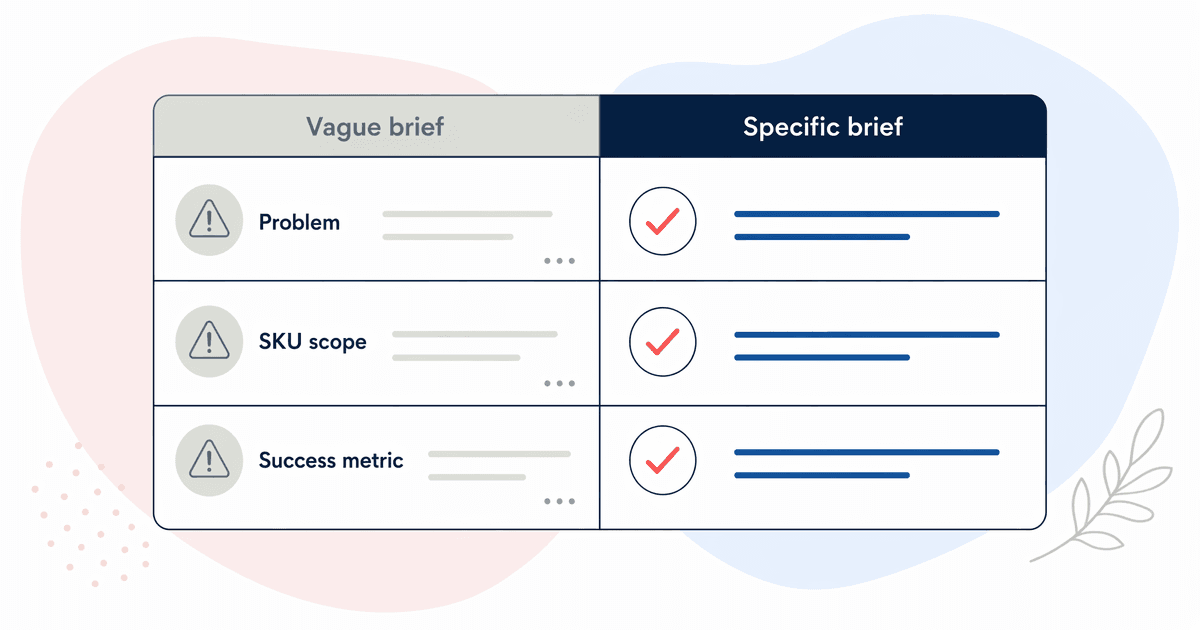
Why do most briefs fail? They focus on what the business wants (better forecasts, less waste, fewer stockouts) without specifying what they're working with. They describe the destination but not the starting point, the vehicle, or the fuel available.
From our review of 30+ FMCG forecasting briefs, the two most common gaps are: (1) no documented baseline accuracy metric, and (2) no honest inventory of data gaps. Without both, vendors can't distinguish between a 4-week project and a 4-month one.
A complete brief covers: business context, available data, success criteria, workflow integration, and budget framing. Skip any one of these and you'll get proposals that don't compare, timelines that slip, and results you can't measure.
Related: choosing the right starting point
Citation capsule:A complete AI forecasting brief requires five sections: business context, available data, success criteria, workflow integration, and budget framing. BCG (June 2026) found more than half of companies don't formally measure AI ROI, a gap that starts with briefs that never define baseline metrics.
Section 1: Business context and constraints
Your brief should open with a 200-word business context section. One CPG manufacturer working with Rockmere(May 2026) started at a 24-point MAPE before AI deployment, achieving an 11-point improvement after. That improvement only made sense because the business context was specific enough to target.
What to include in this section
State the problem in operational terms. Not "we want better forecasts" but "we currently run a weekly S&OP cycle with a 24-point MAPE across 180 active SKUs, and overstock is costing us 3% of revenue in markdowns."
Include these specifics:
- SKU count and complexity.Are you forecasting 50 SKUs or 2,000? Ambient shelf-stable products or short-life chilled?
- Current process.Who owns the forecast today? What tool do they use? How often is it updated?
- Key constraints.Retailer lead times, promotional commitments, seasonal peaks, NPD pipeline.
- What triggered this project.A lost listing? A warehouse full of expired stock? A new retailer onboarding?
Don't bury the pain point. Lead with the specific problem that made someone approve budget for this work.
What to leave out
Don't prescribe the technical approach. If you've written "we want an LSTM neural network trained on 3 years of EPOS data," you've already narrowed the solution space before the people with expertise can advise you. Describe the problem. Let the vendor propose the method.
Section 2: How do you document data you can provide (with honest gaps)?
Data plumbing accounts for 40-60% of real project cost (Heizen, 2026). The model itself is rarely the expensive part. What takes time and budget is extracting, cleaning, and connecting the data your model needs. Your brief must document both what exists and what's missing.
Data inventory checklist
For each data source, document:
- What it is.Weekly EPOS from Tesco, monthly shipment data from your 3PL, promotional calendar in a shared spreadsheet.
- Format.CSV exports, API access, PDF reports that need manual extraction, someone's inbox.
- History depth.6 months? 24 months? 5 years with gaps?
- Update frequency.Real-time, daily, weekly, ad-hoc.
- Known quality issues.Missing weeks, category changes, SKU code migrations, retailer format differences.
Being honest about gaps
The most common gap we see: the brief specifies what data exists but not what's missing. Every FMCG brand has data holes. Maybe you lost 3 months of Sainsbury's data during a system migration. Maybe your promotional uplift data only exists in a buyer's head.
Document the gaps explicitly. A vendor who sees "12 months of Tesco EPOS, 8 months of Sainsbury's (gap: Jan-Mar 2025 due to migration), no Morrisons data" can scope accurately. A vendor who discovers this in week 3 will blow your timeline.
Related: data preparation fundamentals
Citation capsule:Data plumbing, not model development, accounts for 40-60% of real AI project cost (Heizen, 2026). Briefs that document both available data sources and known gaps reduce scoping errors and prevent timeline overruns that kill pilot momentum.
Section 3: How do you define success criteria before the pilot starts?
McKinsey(2024) reports AI reduces demand forecasting errors by up to 50%. But "up to 50%" is a benchmark, not your target. Your brief needs a specific, measurable definition of success tied to your current baseline and your business economics.
Defining your baseline
Before any AI work begins, measure your current forecast accuracy. Use the same metric you'll use to evaluate the AI output:
- MAPE (Mean Absolute Percentage Error)is the most common. If your current MAPE is 24 points, a realistic pilot target might be a 5-10 point improvement.
- Bias direction matters.Are you systematically over-forecasting (creating waste) or under-forecasting (causing stockouts)? The AI might improve MAPE but shift the bias direction in ways that hurt different parts of your P&L.
- Granularity.Forecast accuracy at total brand level is meaningless. Measure at SKU-retailer-week level, because that's where the operational decisions happen.
Setting the success threshold
Rockmere(May 2026) documented an 11-point MAPE improvement for a CPG manufacturer. That's a strong result. But "improvement" only counts if you define the threshold before the pilot starts. Write this in your brief:
- Minimum viable improvement.What's the smallest accuracy gain that justifies continued investment? (e.g., 3-point MAPE reduction)
- Target improvement.What would make this a clear success? (e.g., 8-point MAPE reduction)
- Measurement window.How many weeks of AI-generated forecasts do you need before making the go/no-go decision?
- Comparison method.AI forecast vs. current process running in parallel, not AI forecast vs. perfect hindsight.
Most briefs define success as "better forecasts." That's not a criterion, it's a direction. The brief should specify the minimum improvement threshold that justifies the next phase of investment. Without this number, you'll end up in a grey zone where the pilot "kind of worked" but nobody can justify scaling it.
Citation capsule:McKinsey (2024) reports AI reduces demand forecasting errors by up to 50%, but your brief needs a specific minimum viable improvement tied to your current MAPE baseline, not a generic benchmark. Rockmere (May 2026) documented an 11-point MAPE improvement for one CPG manufacturer.
Section 4: What workflow integration requirements should you specify?
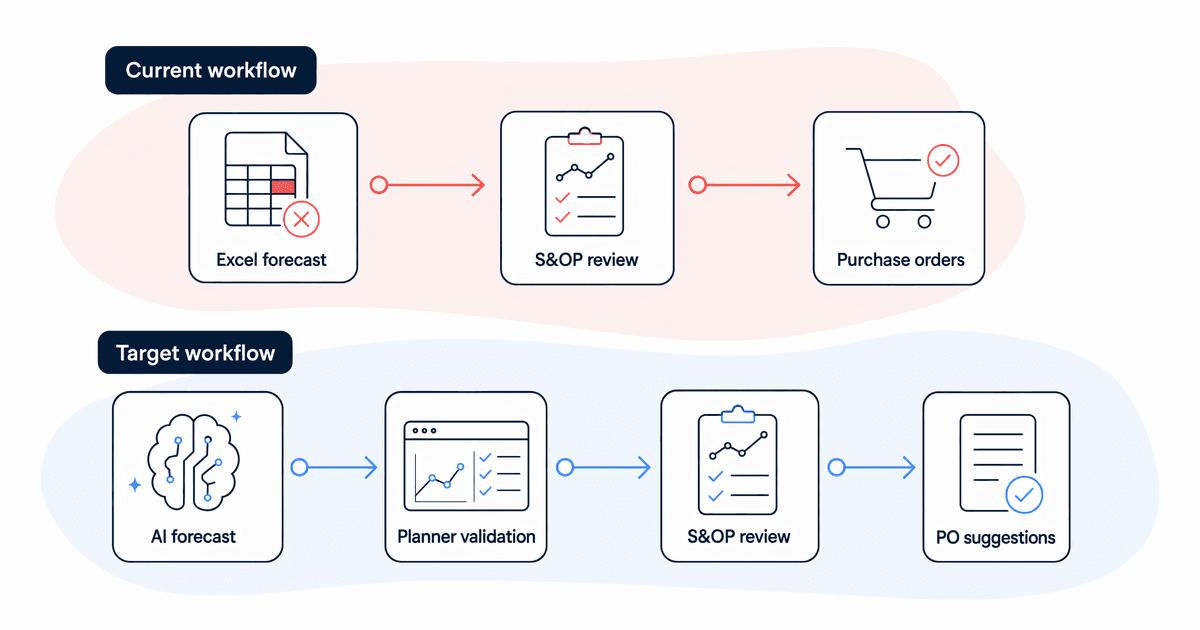
The Rockmerecase study (May 2026) makes a point that often gets overlooked: planner workflow redesign was a separate parallel workstream. The AI model and the process change are two different projects. Your brief must address both, or you'll build a model that nobody uses.
Questions your brief should answer
- Who consumes the forecast today?Demand planner, buyer, supply chain manager, finance team? Each has different needs.
- What decisions does the forecast inform?Production scheduling, purchasing, promotional planning, retailer order quantities?
- What tool do they work in?Excel, a planning platform (Blue Yonder, Anaplan, Slim4), ERP, or a custom spreadsheet?
- How will they interact with the AI output?Dashboard they check weekly? Automated feed into their existing tool? Exception-based alerts?
- What happens when the AI is wrong?Who overrides it? How is the override captured? Does the model learn from corrections?
The parallel workstream problem
Don't assume the AI output slots into your existing workflow unchanged. If your demand planner currently spends 3 days a week building forecasts in Excel, and the AI generates forecasts automatically, that planner's role shifts. They become a forecast validator and exception manager.
Your brief should acknowledge this. It doesn't need to solve it, but it should flag it as a workstream that runs alongside the technical build. Vendors who ignore this are building a model, not a solution.
Related: operational workflow considerations
Section 5: How should you frame budget and timeline expectations?
Heizen(2026) benchmarks show data plumbing accounts for 40-60% of real project cost, and the model needs to start producing value in weeks, not quarters. Your brief should frame budget in a way that separates these phases and avoids the common trap of underestimating data preparation.
Budget structure
Break your budget framing into three buckets:
- Data preparation (40-60% of total).Extraction, cleaning, pipeline setup, gap-filling. This is the work that makes AI possible. It's also the work most likely to overrun.
- Model development and pilot (25-35%).Building, training, testing, and running the forecast model against your baseline.
- Integration and workflow (15-25%).Connecting outputs to existing tools, training users, designing exception processes.
For a UK food and drink brand with 100-500 SKUs, expect the total cost for a 90-day pilot to fall between 5,000 and 25,000 pounds depending on data complexity.
Timeline framing
Be explicit about your constraints. Are you targeting a specific promotional peak (Christmas, summer)? Do you have a board review date that needs results? Is there a parallel system migration that affects data access?
A realistic timeline for a first pilot:
- Weeks 1-3: Data extraction and preparation
- Weeks 4-6: Model development and initial testing
- Weeks 7-10: Parallel running (AI vs. current process)
- Weeks 11-12: Measurement, reporting, go/no-go decision
But here's the reality check. BCG(June 2026) found that pilot economics don't translate to full-scale results. Your brief should acknowledge that the pilot budget and the scale budget are different conversations. Don't let a vendor price a pilot as if it proves the full-scale business case.
Related: broader AI strategy context
Citation capsule:Data preparation accounts for 40-60% of AI project cost (Heizen, 2026), and BCG (June 2026) warns that pilot economics don't translate to full-scale results. Briefs should separate budget into data preparation, model development, and workflow integration phases.
What are the red flags in vendor responses?
More than half of companies don't formally measure AI ROI (BCG, June 2026). Vendors know this. Some exploit it by promising outcomes they know you won't measure rigorously. Here's what to watch for when responses come back.
Immediate red flags
- Accuracy promises before seeing your data.Anyone guaranteeing a specific MAPE improvement without examining your data history is guessing. Or worse, they'll cherry-pick the SKUs where the model performs well and ignore the rest.
- No questions about your current process.If the proposal focuses entirely on model architecture and never asks how the forecast feeds into purchasing decisions, they're building a demo, not a tool.
- "Proprietary AI" with no explanation.You don't need to understand every algorithm, but you should understand what data goes in, what comes out, and how you'll validate it.
- Timeline that skips data preparation.If the proposal goes straight to "model training in week 1," either they're assuming your data is ready (it isn't) or they're planning to discover that problem on your budget.
- ROI projections based on generic benchmarks."AI typically delivers 50% improvement" is a McKinsey statistic about what's possible, not a prediction about your business.
Subtler warning signs
- No mention of how the model handles new SKU launches (cold-start problem).
- No plan for what happens when the AI output conflicts with the planner's judgment.
- Budget that allocates less than 30% to data work.
- No discussion of ongoing model maintenance after the pilot ends.
Is the vendor asking you more questions than you're asking them? That's actually a good sign. The best responses to your brief should come back with 10-20 clarifying questions, not a polished proposal.
Citation capsule:BCG (June 2026) found more than half of companies don't formally measure AI ROI. Key vendor red flags include accuracy guarantees before seeing data, timelines that skip data preparation, and ROI projections based on generic benchmarks rather than your baseline.
A brief template you can copy
Below is the complete structure. Copy it, fill in the specifics for your business, and send it to any vendor, data team, or consultancy you're evaluating. The sections map directly to the guidance above.
The template
1. Business Context
- Company: [name, size, category]
- Problem statement: [specific operational pain, e.g., "24-point MAPE driving 3% revenue loss to markdowns"]
- SKU scope: [number of SKUs, product types, retailer accounts]
- Current forecast process: [who, what tool, what frequency]
- Trigger for this project: [what changed that made this urgent]
- Key constraints: [retailer lead times, seasonal peaks, system migrations]
2. Data Available
| Source | Format | History | Update frequency | Known gaps |
| [e.g., Tesco EPOS] | [CSV export] | [24 months] | [Weekly] | [None] |
| [e.g., Sainsbury's EPOS] | [Portal download] | [18 months] | [Weekly] | [Jan-Mar 2025 missing] |
| [e.g., Promo calendar] | [Excel] | [12 months] | [Ad-hoc] | [No uplift measurement] |
3. Success Criteria
- Current baseline: [MAPE or other metric, measured at SKU-retailer-week level]
- Minimum viable improvement: [e.g., 3-point MAPE reduction]
- Target improvement: [e.g., 8-point MAPE reduction]
- Measurement window: [e.g., 8 weeks of parallel running]
- Comparison method: [AI vs. current process in parallel]
4. Workflow Integration
- Forecast consumers: [roles that use the output]
- Decisions informed: [production, purchasing, promo planning]
- Current tools: [Excel, ERP, planning platform]
- Desired interaction model: [dashboard, automated feed, alerts]
- Override process: [how planners correct the AI]
5. Budget and Timeline
- Total budget range: [e.g., 10,000-20,000 pounds for pilot]
- Hard deadline: [e.g., "need results before Christmas planning cycle"]
- Parallel workstreams: [system migrations, team changes, other projects]
- Scale budget: [separate conversation, but flag expected range]
Related: complete AI readiness assessment
Frequently asked questions
How much data history do you need for an AI demand forecasting pilot?
Most implementations need 18-24 months of SKU-level sales data as a minimum. Twelve months can work for ambient products with stable demand patterns, but seasonal categories need at least two full seasonal cycles. The data doesn't need to be perfect. It needs to be documented, including the gaps.
Can you brief an AI forecasting project without a data team?
Yes. The brief template above doesn't require technical expertise to complete. You need operational knowledge: what data exists, where it lives, who uses the forecast, and what "better" would look like. The vendor or consultancy handles the technical scoping based on your answers. Your job is to describe the problem and constraints accurately.
What's a realistic timeline from brief to first AI forecast output?
For a UK food and drink brand with reasonably accessible data, expect 10-12 weeks from brief submission to first AI-generated forecast output. Data preparation (weeks 1-3) takes longer than most people expect. The model itself can often be trained and producing initial results within 2-3 weeks of clean data being available. Parallel running adds another 4-6 weeks before you have enough evidence to make a go/no-go decision.
Sources
- Rockmere Partners (May 2026). "CPG Demand Planning AI Case Study." rockmerepartners.com
- BCG & Consumer Goods Forum (June 2026). "How CPG and Retail Leaders Maximize AI ROI." bcg.com
- Heizen (2026). AI implementation benchmarks for consumer goods. heizen.ai
- McKinsey (2024). "Fortune or Fiction: The Real Value of a Digital and AI Transformation in CPG." mckinsey.com